AI Now Writes 30% of new Code: What Developers Need to Know

The landscape of software development is undergoing rapid transformation as AI-generated code becomes a central component of modern engineering practice. Recent examples illustrate this shift: the “Skills” feature in Anthropic’s Claude was developed with substantial AI involvement, where human engineers primarily reviewed and orchestrated the process. Similarly, prominent figures such as Andrej Karpathy have noted that a significant majority of their code (sometimes as much as 80%) now comes from AI assistants. These patterns are increasingly common among leading practitioners.
This acceleration in AI integration is evident across the industry, often progressing more quickly than academic research can document. The Science study discussed here provides a rigorous quantitative snapshot, yet the pace of change in real-world development environments continues to advance. In this article, I will explore the empirical findings and situate them within the current context, where AI is emerging as a genuine collaborator in the creation and maintenance of software.
A landmark study published in Science (DOI: 10.1126/science.adz9311) offers a comprehensive quantitative perspective on this phenomenon. By rigorously analyzing the adoption and effects of AI coding tools, the study delivers statistically robust insights that illuminate both the current state and the broader implications for the future of software development and the global technology ecosystem.
The Headline Statistic
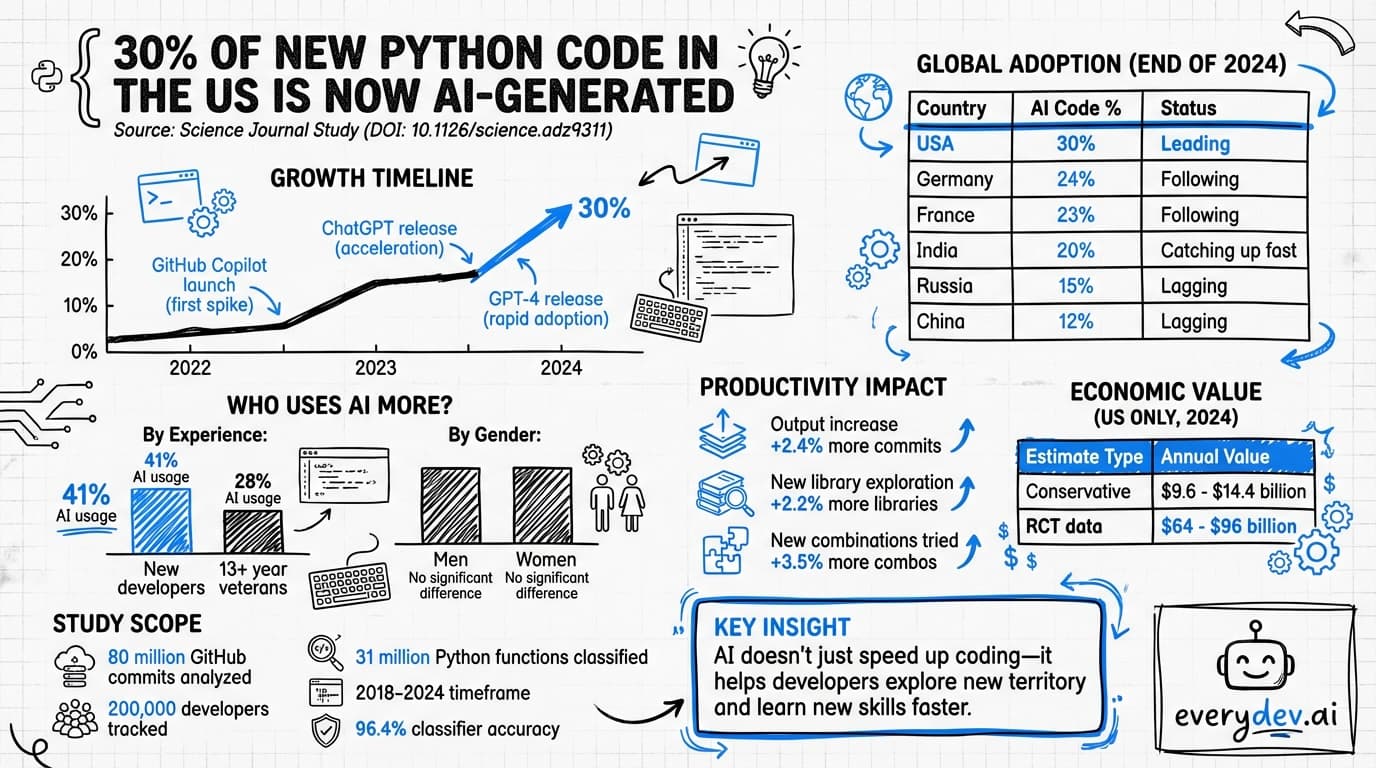
By the end of 2024, approximately 30% of new Python code written in the United States was AI-generated. This is a dramatic increase from just 5% in 2022, underscoring the rapid adoption of generative AI tools among developers.
Adoption Patterns and Global Context
The study, which analyzed 80 million GitHub commits from 200,000 developers between 2018 and 2024, reveals that the adoption of AI coding tools is not a gradual curve but rather a series of inflection points. Each major release (GitHub Copilot, ChatGPT, and GPT-4) corresponded with a measurable spike in AI-generated code.
| Year | US AI Code Share | Germany | France | India | Russia | China |
|---|---|---|---|---|---|---|
| 2022 | 5% | — | — | — | — | — |
| 2023 | ~15% | — | — | — | — | — |
| 2024 | 30% | 24% | 23% | 20% | 15% | 12% |
Key trigger events: GitHub Copilot launch, ChatGPT release, GPT-4 release.
The United States leads in AI code adoption, followed by Germany and France. India is rapidly catching up, while Russia and China lag behind, primarily due to regulatory and access constraints rather than differences in developer capability.
Recommended
Nvidia Paid 86 Times Revenue for Hugging Face

Nvidia just spend $12.93 billion on Hugging Face, a company producing roughly $150 million in annualized revenue. The multiple is about 86 times revenue. It shifts depending on which number counts. Nvidia's SEC filing pu…
Read nextWho Is Using AI and How?
The data reveals that AI adoption is stratified by experience but not by gender. Newer developers are more likely to leverage AI tools, while seasoned professionals remain somewhat more conservative in their usage. However, the productivity gains are evident across the board.
| Group/Metric | Value |
|---|---|
| New developers (AI usage) | 41% |
| 13+ year veterans (AI usage) | 28% |
| Gender difference | None observed |
| Output increase | +2.4% more commits |
| New libraries used | +2.2% |
| New library combinations | +3.5% |
| Economic value (US, 2024) | $9.6–$14.4B (conservative) |
| Economic value (RCT data) | $64–$96B |
Notably, the study found no significant gender disparity in AI tool adoption. This is a rare outcome in technology diffusion research.
Beyond Speed: The Nature of AI’s Impact
While much of the discourse around AI coding tools has focused on productivity, the study’s most compelling insight is qualitative: AI is not merely accelerating existing workflows, but also expanding the boundaries of what developers attempt. Developers using AI tools are more likely to experiment with new libraries and novel combinations, suggesting that AI acts as a catalyst for exploration and learning.
This phenomenon is particularly salient for those entering the field. New developers, empowered by AI, are not just catching up—they are, in some respects, leapfrogging traditional learning curves by integrating unfamiliar technologies with greater confidence.
Economic and Strategic Implications
The economic ramifications are substantial. The researchers estimate that AI-assisted coding contributes between $9.6 and $14.4 billion annually to the US economy, with upper-bound estimates (based on randomized controlled trial data) reaching as high as $96 billion. These gains accrue disproportionately to those who adopt AI tools early and use them strategically.
Access to advanced AI models is emerging as a significant competitive differentiator at both the individual and national levels. Countries and organizations that facilitate unrestricted access to these tools are likely to see compounding advantages over time.
Study Scope and Methodology
- 80 million GitHub commits analyzed
- 200,000 developers tracked
- 31 million Python functions classified
- 2018–2024 timeframe
- 96.4% classifier accuracy
The rigor and scale of this analysis provide a robust foundation for interpreting the results and their implications.
Key Insight
AI is no longer a peripheral convenience; it is a central force in shaping how software is conceived, built, and maintained. Its most profound contribution may not be speed, but rather its capacity to lower the barriers to exploration and accelerate the acquisition of new skills. For developers and organizations alike, the imperative is clear: those who integrate AI thoughtfully into their workflows will be best positioned to capitalize on the next era of software innovation.
Further Reading:
Who is using AI to code? Global diffusion and impact of generative AI (Science, DOI: 10.1126/science.adz9311)
About the Author
Founder at EveryDev.ai
Apple, Disney, Adobe, Eventbrite, Zillow, Affirm. I've shipped frontend at all of them. Now I build and write about AI dev tools: what works, what's hype, and what's worth your time.
Comments (1)
Join the discussion
Sign in to share your thoughts
ChineseNameHub.com is an innovative AI platform for creating authentic, culturally rich Chinese names. By blending traditional wisdom with modern technology, it provides personalized naming services, audio guides, and deep symbolic meanings. It is the ultimate tool for anyone looking to establish a unique and professional identity within the global Chinese community with total confidence.