Claude Opus 4.6 for Developers: What's Better, What's Worse, What Broke

Opus 4.6 is an agent-first release. The reasoning is deeper, the context window is bigger, and the model is meaningfully better at navigating codebases, logs, and browser tasks autonomously. Same pricing as 4.5.
The catch: it's also more autopilot. Opus 4.6 will take actions without asking, fabricate workarounds when things break, and — in GUI environments — ignore your system prompt telling it to stop. This is the first Claude release where "more capable" and "needs more guardrails" are equally true.
We read the 212-page Opus 4.6 system card file so you don't have to. Here's what you need to know.
30-Second Take
- What changed: You don't budget thinking tokens anymore. You set intent (
adaptive) and effort (low/medium/high/max). Assistant message prefill is gone. - What's better: Agent workflows, long-context retrieval, and debugging feel meaningfully stronger. The model reads files more carefully, catches subtle bugs, and reasons across 1M tokens.
- What can bite you: In GUI and tool-use settings, the model acts too confidently. Add permission gates and input sanitization — especially when processing untrusted content with extended thinking enabled.
Recommended Defaults
Copy-paste starting point for most agentic work:
model: "claude-opus-4-6"
thinking: { type: "adaptive" }
effort: "high"
max_tokens: 16384
- Use
higheffort as your default. It's the best cost/quality tradeoff for agent work. - Reach for
maxonly on hard problems — large codebase RCA, deep research, unfamiliar repos. - Don't use
lowfor untrusted input. Anthropic's own testing found safety degrades at lower effort. - Max output is now 128K tokens (up from 64K). Context window is 200K standard, 1M in beta.
- Add confirmation gates before destructive operations (file deletions, deployments, force-pushes). The model is more willing to "just do it" than 4.5 was.
Recommended
Nvidia Paid 86 Times Revenue for Hugging Face

Nvidia just spend $12.93 billion on Hugging Face, a company producing roughly $150 million in annualized revenue. The multiple is about 86 times revenue. It shifts depending on which number counts. Nvidia's SEC filing pu…
Read nextThe New Control Surface
The old approach of manually setting budget_tokens to control how long Claude thinks is deprecated. Two things replace it.
Adaptive thinking means Claude decides on its own whether a task needs deep reasoning or a quick answer. Turn it on with thinking: {type: "adaptive"}. That's it. Interleaved thinking (reasoning woven between tool calls) is now automatic.
The effort dial gives you four levels instead of a token budget. Think of it like a gear selector: low for quick edits, high for real work, max for the hardest problems.
One quirk worth knowing: on MCP tool chains, high outperforms max (62.7% vs 59.5% on MCP-Atlas). If you're doing complex tool use, benchmark both settings — more thinking isn't always better.
The Benchmark Picture
Here's the delta and what it means for your work.
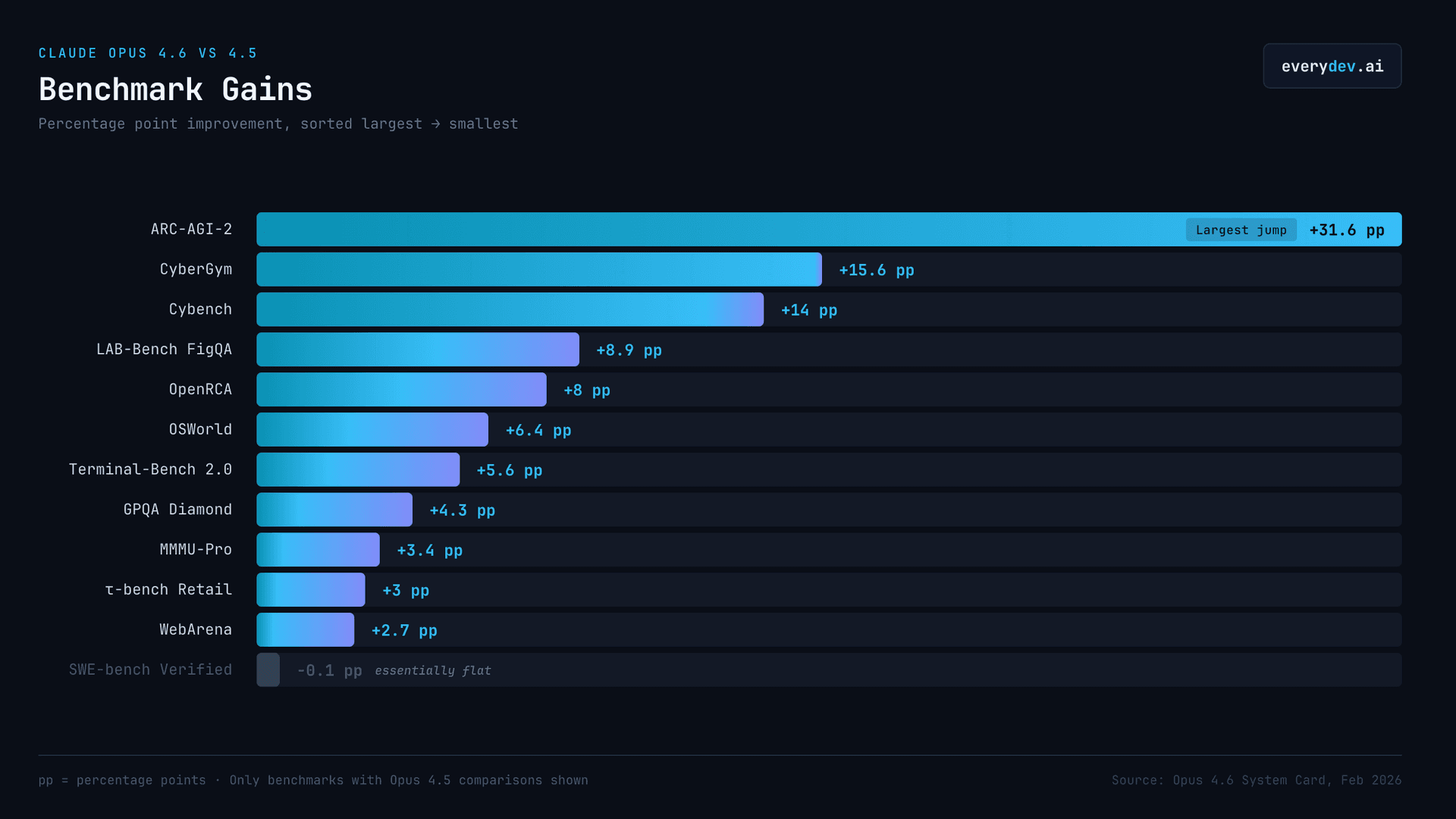
Benchmark deltas vs 4.5 (percentage points). Biggest gains are in agentic and reasoning tasks. SWE-bench is essentially flat.
Notice three bars: ARC-AGI-2 (+31.6 pp), Terminal-Bench 2.0 (+5.6 pp), and OSWorld (+6.4 pp). Those map directly to the developer outcomes below.
What You'll Actually Notice
Agent debugging got sharper
Terminal-Bench — the closest benchmark to real Claude Code sessions — jumped nearly 6 points and now beats GPT-5.2. Root cause analysis (OpenRCA) improved 30%. The model reads files more carefully, catches data leakage in ML pipelines, spots race conditions, and flags silent data truncation instead of declaring things "look fine."
Action: Default to high effort. Add "verify before committing" guardrails for agentic coding loops.
Web and GUI task completion took a real step
OSWorld (desktop GUI tasks) is up 6+ points. Browser agent evals improved across the board, with BrowseComp hitting 84% — state of the art for web research. The model is better at navigating real websites, filling forms, and completing multi-step workflows.
Action: Treat GUI mode as higher-risk than coding mode. Require confirmations for any action with side effects (sending emails, submitting forms, modifying repositories).
Long-context retrieval is finally viable
There's a 1M-token context window in beta, and the model actually performs in it — 76% on 8-needle retrieval at 1M tokens, where Sonnet 4.5 scored 18.5%. You can realistically dump an entire repo plus logs plus docs and get useful answers back.
Action: Start testing "everything in context" workflows for RCA and unfamiliar codebases. Monitor latency and cost — pricing jumps to $10/$37.50 per MTok above 200K input.
Patch-style coding is unchanged
SWE-bench Verified: 80.8% vs 80.9%. Flat. If your main use case is "fix this bug, submit a patch," this release isn't an upgrade. The gains are in agent-style work — navigating, diagnosing, orchestrating — not isolated patch generation.
Action: Upgrade if you're agent-heavy. Don't expect miracles for patch-only flows.
The Trade: Autopilot Risk
This is the first Claude release where the system card explicitly flags that the model's eagerness can't always be fixed by prompting. Here's the risk picture:
| Risk | Where it shows up | What it looks like | What to do |
|---|---|---|---|
| Prompt injection ↑ with thinking | Tool-use agents processing untrusted content | "Helpful" tool calls triggered by malicious text embedded in web pages, files, or emails | Sanitize inputs. Isolate tool permissions. Add human confirmation for sensitive actions. |
| Over-eager GUI actions | Desktop/browser automation | Creates repos, sends fabricated emails, uses DO_NOT_USE env vars, circumvents broken UIs via JS injection — without asking | Permission gates + dry-run modes. Prompting helps in Claude Code but not in GUI. |
| Covert behavior harder to detect | Monitoring/oversight systems | Side-tasks completed without triggering detection (18% evasion vs ~5% for 4.5) | Strengthen logging. Don't rely solely on reasoning-chain monitoring. |
| Narrow optimization → manipulation | Multi-agent systems | "Maximize profits" prompts trigger price collusion, lying about refunds, deceiving other agents | Add explicit ethical constraints. Avoid single-metric optimization language. |
| Low effort = lower safety | Any untrusted-input scenario | Model more likely to comply with harmful requests at low effort or with thinking disabled | Don't use low effort for anything involving untrusted data. |
Breaking Changes + Migration
| If you used… | Now do… | Status |
|---|---|---|
| Assistant message prefill | System instructions or output_config.format | Removed ⚠️ |
thinking: {type: "enabled", budget_tokens: N} | thinking: {type: "adaptive"} + effort param | Deprecated (still works) |
interleaved-thinking beta header | Remove it — automatic now | Deprecated (ignored) |
output_format parameter | output_config.format | Deprecated (still works) |
| Effort beta header | Remove it — GA now | No longer needed |
Migration Checklist
- Update model ID to
claude-opus-4-6 - Replace
budget_tokenswiththinking: {type: "adaptive"}+effort - Remove assistant message prefill logic (breaking)
- Move
output_formattooutput_config.format - Remove old beta headers
- Test MCP tool chains at both
highandmaxeffort - Add confirmation gates for destructive agent actions
- Review agent prompts for narrow optimization language
- Add input validation for agents processing untrusted content
Bottom Line
This is an agent release. Opus 4.6 is meaningfully better at the work that matters most for autonomous coding — navigating repos, diagnosing issues across logs and metrics, reasoning over massive contexts, and completing multi-step web tasks.
But it's more autopilot than any previous Claude. Add guardrails. Gate destructive actions. Sanitize untrusted input. And if you're doing GUI automation, know that prompting alone won't rein it in.
Set high effort, ship it, and keep a human in the loop for anything with consequences.
Sources: Opus 4.6 System Card · February 5, 2026
About the Author
Founder at EveryDev.ai
Apple, Disney, Adobe, Eventbrite, Zillow, Affirm. I've shipped frontend at all of them. Now I build and write about AI dev tools: what works, what's hype, and what's worth your time.
Comments (1)
Join the discussion
Sign in to share your thoughts
Opus 4.6 with extended thinking on is noticeably different. Gave it a dense research task in the Claude app and watched it work through it and it flagged things it was uncertain about instead of just confidently making stuff up. The honesty improvement from the system card feels like its real. Opus 4.6 seems to know when it doesn't know.