From Vibe Coding to VIABLE Coding

Stop Vibe Coding. Start VIABLE Coding.
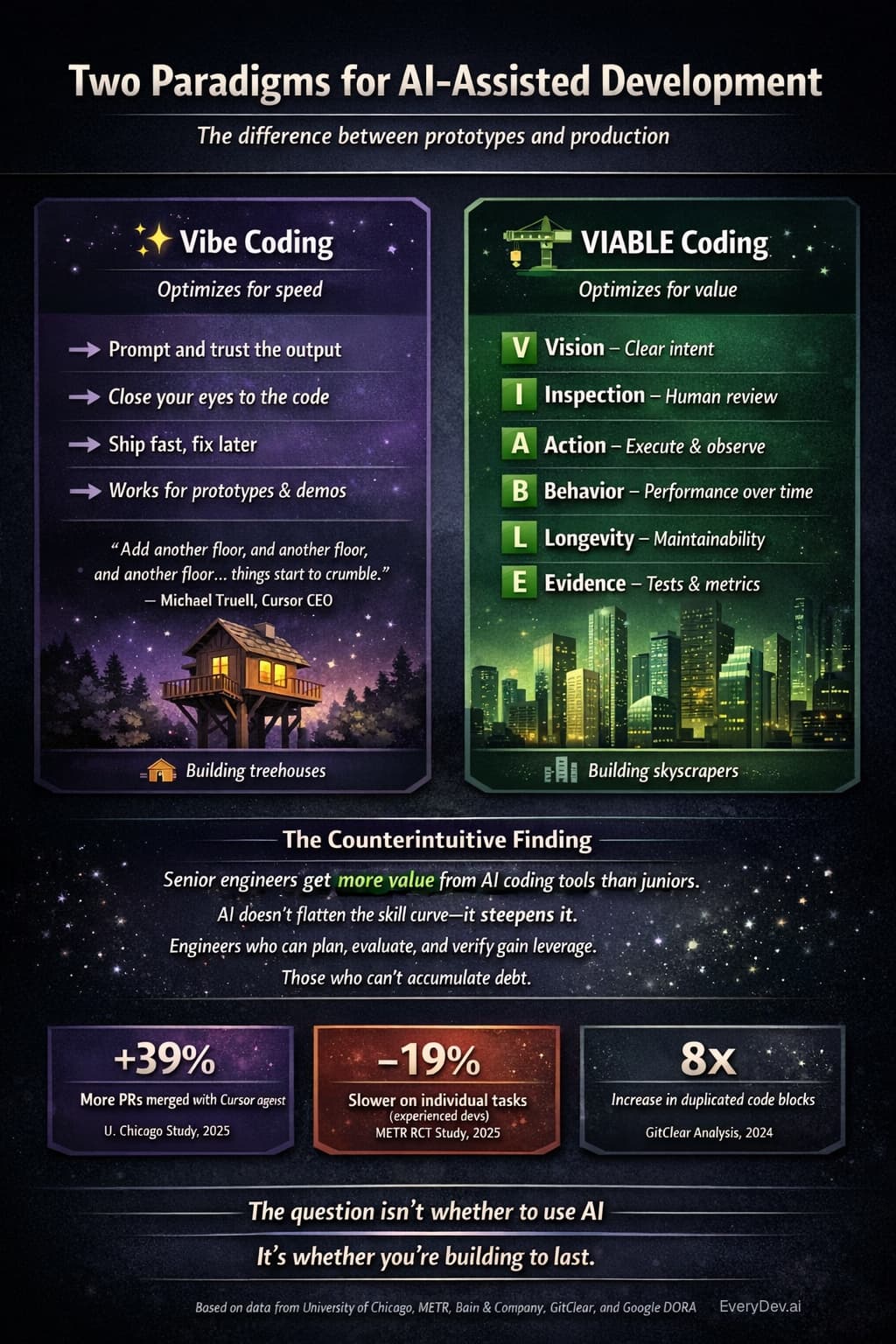
Vibe coding is Andrej Karpathy's term for prompting AI without examining the code. Close your eyes, describe what you want, trust the output. It's fast. It's also fragile. This is the difference between building skyscrapers and building treehouses. Cursor CEO Michael Truell rejects vibe coding for production work: "If you close your eyes and have AIs build things with shaky foundations, as you add another floor, things start to crumble."
VIABLE coding is a framework for AI-assisted development that actually holds up in production. It treats AI as a multiplier of judgment. You still use the tools. You just bring the thinking they can't do for you.
| Step | What it means |
|---|---|
| V — Vision | Know your intent and constraints before prompting |
| I — Inspection | Review structure and assumptions |
| A — Action | Run the code, observe behavior |
| B — Behavior | Test under load, at edge cases |
| L — Longevity | Make it maintainable |
| E — Evidence | Tests, metrics, PRs. Proof, not vibes. |
AI Amplifies Judgment, Not Just Output
Cursor just hit a $10 billion valuation. GitHub Copilot crossed 15 million users. The story everyone told: AI would democratize expertise, letting junior developers punch above their weight by prompting their way to working code.
The data says otherwise. Senior engineers get more value from AI coding tools, not less.
A University of Chicago study of tens of thousands of developers found that AI acceptance rates increased about 6% for every standard deviation of experience. Seniors wrote more "plans" before generating code. They used AI for architecture and strategy, not just autocomplete. Organizations using Cursor merged 39% more pull requests, with no significant increase in revert rates.
Meanwhile, a randomized trial by METR found experienced open-source developers were actually 19% slower using AI tools, even though they believed they were 20% faster.
These findings aren't contradictory. They reveal something important: engineers who can plan, evaluate, and verify gain leverage. Engineers who can't accumulate debt. That's VIABLE coding in action.
Recommended
Nvidia Paid 86 Times Revenue for Hugging Face

Nvidia just spend $12.93 billion on Hugging Face, a company producing roughly $150 million in annualized revenue. The multiple is about 86 times revenue. It shifts depending on which number counts. Nvidia's SEC filing pu…
Read nextSpeed Without Inspection Creates Fragile Systems
Company-reported wins are real but cherry-picked. Cursor claims Salesforce saw 30% productivity uplift with 85% weekly adoption. Salesforce's engineering blog confirms specific wins: 85% reduction in legacy code coverage time, 30% faster test failure triage.
But broader industry data tells a more complicated story.
Bain's September 2025 report called real-world savings "unremarkable." Teams using AI assistants saw 10-15% gains, but saved time rarely went to higher-value work. One reason: developers only spend 20-40% of their time actually writing code. Speed up coding by 30% and you've improved maybe 10% of the job.
GitClear's analysis of 211 million lines found troubling quality trends: code churn nearly doubled since 2021, duplicated blocks increased 8x in 2024, and refactoring dropped from 24% to under 10%. Perhaps most telling: 2024 was the first year copy-pasted lines exceeded moved lines.
Google's DORA report: AI improved code quality by 3.4% but reduced delivery stability by 7.2%.
The pattern is clear. Vibe coding generates output. VIABLE coding generates value.
VIABLE Coding Helps You Build Expertise Faster
Senior engineers bring vision. They know what success looks like before prompting. They can inspect AI output against mental models built over years. They understand behavior at scale because they've debugged production at 3am. They care about longevity because they've inherited unmaintainable code.
Juniors often accept AI output because they can't evaluate it yet. They optimize for working code, not lasting code. They're playing the short game because they don't yet understand the long one.
But here's the good news: the VIABLE framework gives less experienced developers a checklist for the judgment they're still building. It won't replace years of experience, but it will slow you down at the right moments, before you ship something fragile.
AI doesn't replace expertise. It raises the stakes on having it. VIABLE coding is how you build that expertise faster.
Cursor's $29.3 Billion Bet on VIABLE Coding
Cursor's valuation is a bet that the highest ceiling in software belongs to teams that use AI to amplify judgment, not bypass it.
Their roadmap confirms it: more autonomy for well-specified tasks, but with verification built in. Team-level features for code review across human and AI output. Background agents that work while you do other things, then surface results for human inspection.
Their recent acquisition of code review startup Graphite extends this logic. As Truell put it: "The way engineering teams review code is increasingly becoming a bottleneck. Over the past 2.5 years, Cursor has made it much faster to write production code. However, for most engineering teams, reviewing code looks the same as it did three years ago."
Writing code is the Action phase. Cursor is expanding into Inspection, Behavior, and Evidence, the phases where senior judgment compounds.
Asked about an IPO, Truell stayed focused: "We have lots to do to continue building out the technology, the product, and the team."
The Bottom Line
For throwaway projects, vibe coding is fine. For production systems (money, health data, infrastructure), someone needs to look under the floorboards.
The data suggests that someone should be experienced. And that AI makes them more valuable, not less.
Use AI, but bring vision, inspection, and evidence to every prompt. Building skyscrapers takes patience. VIABLE takes time. That's the point.
Sources: University of Chicago/Suproteem Sarkar study via Cursor blog (November 2025); METR RCT study (July 2025); Bain & Company Technology Report 2025; GitClear AI Code Quality Research 2025; Google DORA State of DevOps 2024; Salesforce Engineering Blog; Fortune AI Brainstorm conference (December 2025).
About the Author
Founder at EveryDev.ai
Apple, Disney, Adobe, Eventbrite, Zillow, Affirm. I've shipped frontend at all of them. Now I build and write about AI dev tools: what works, what's hype, and what's worth your time.
Comments
No comments yet
Be the first to share your thoughts