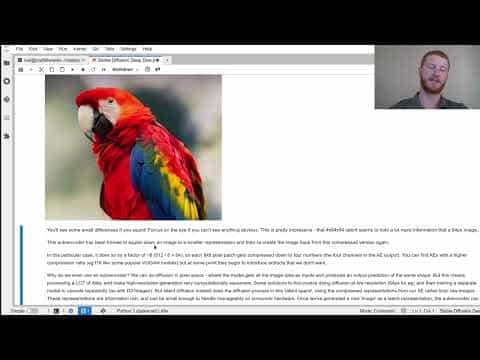
Practical Deep Learning for Coders
A free course teaching deep learning and machine learning for practical problems, covering computer vision, NLP, and model deployment using PyTorch and fastai.
At a Glance
Complete access to all course materials, videos, and resources
Engagement
Available On
Alternatives
Listed Feb 2026
About Practical Deep Learning for Coders
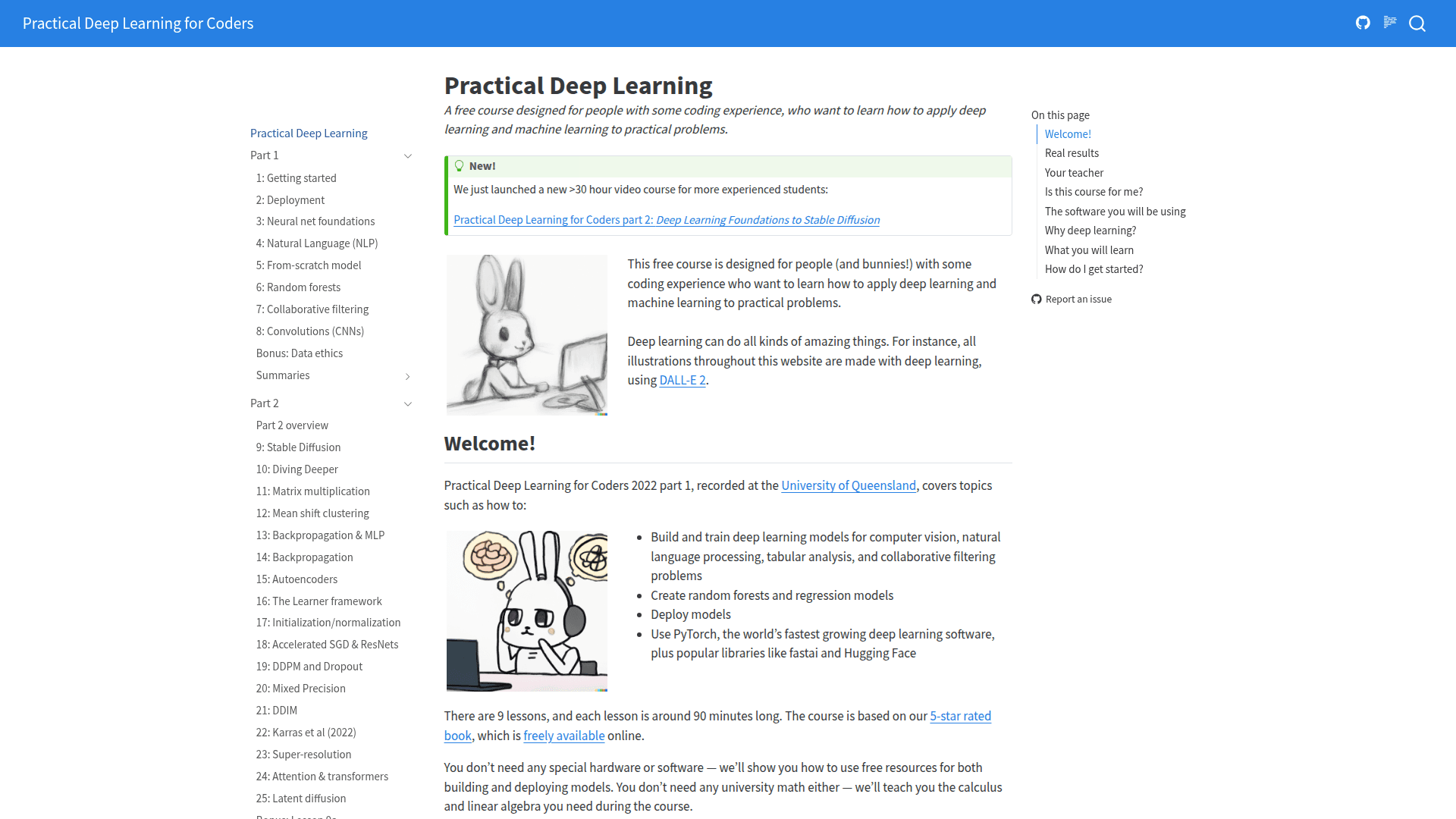
Practical Deep Learning for Coders is a comprehensive free course designed for people with coding experience who want to learn how to apply deep learning and machine learning to real-world problems. Created by Jeremy Howard and fast.ai, the course has been viewed over 6 million times and has helped students land jobs at Google Brain, OpenAI, Adobe, Amazon, and Tesla, as well as publish research at top conferences like NeurIPS.
The course consists of two parts with over 30 hours of video content, teaching everything from building your first model to understanding the foundations of stable diffusion. No special hardware, expensive software, or university-level math is required—the course teaches the necessary calculus and linear algebra along the way.
- Comprehensive Curriculum covers computer vision, natural language processing (NLP), tabular analysis, collaborative filtering, random forests, and regression models across 25+ lessons
- Hands-On Learning enables students to build and deploy their own deep learning models by the end of lesson 2, using real data they collect themselves
- Industry-Standard Tools teaches PyTorch (the world's fastest-growing deep learning library), fastai, Hugging Face Transformers, and Gradio for building and deploying models
- Free Cloud Resources shows how to use Kaggle Notebooks and Paperspace Gradient for training models without needing expensive hardware
- Practical Focus emphasizes examples-first teaching, ensuring concepts are understood in context rather than through abstract theory
- Part 2: Deep Learning Foundations to Stable Diffusion dives deeper into topics like matrix multiplication, backpropagation, autoencoders, attention mechanisms, and latent diffusion
- Supporting Resources include a 5-star rated book available free online, active community forums, and detailed lesson summaries
- Data Ethics Coverage includes a bonus lesson on responsible AI development and ethical considerations
To get started, simply watch lesson 1 and follow along with the interactive Jupyter Notebooks. The course uses Kaggle Notebooks and Paperspace Gradient for hands-on exercises, with a supportive community forum available for questions and help.
Community Discussions
Be the first to start a conversation about Practical Deep Learning for Coders
Share your experience with Practical Deep Learning for Coders, ask questions, or help others learn from your insights.
Pricing
Free
Complete access to all course materials, videos, and resources
- 25+ video lessons
- Interactive Jupyter Notebooks
- Free online book
- Community forum access
- Kaggle Notebooks integration
Capabilities
Key Features
- Computer vision model training
- Natural language processing (NLP)
- Tabular data analysis
- Collaborative filtering
- Random forests and gradient boosting
- Model deployment
- Transfer learning
- Stochastic gradient descent
- Data augmentation
- Image classification
- Entity and word embeddings
- Stable diffusion foundations
- Backpropagation and MLP
- Autoencoders
- Attention and transformers
- Interactive Jupyter Notebooks
- Free cloud computing resources
Integrations
Demo Video