Top 10 AI Trends for Software Development in 2026

From agent swarms to the trust hangover, here's where $2 trillion in AI spending is actually landing and what it means for teams shipping real software in 2026.
84% of developers now use AI coding tools. Only 29% say they trust the output.
If that feels like a relationship headed for couples therapy, yeah. Same.
That tension between mass adoption and growing skepticism pretty much is the software story at the start of 2026. The honeymoon phase is done. Now we find out what holds up in production, under deadlines, with humans on call at 2 a.m.
What follows is distilled from Gartner forecasts, Stack Overflow's 49,000 developer survey, enterprise deployment reporting, and regulatory filings.
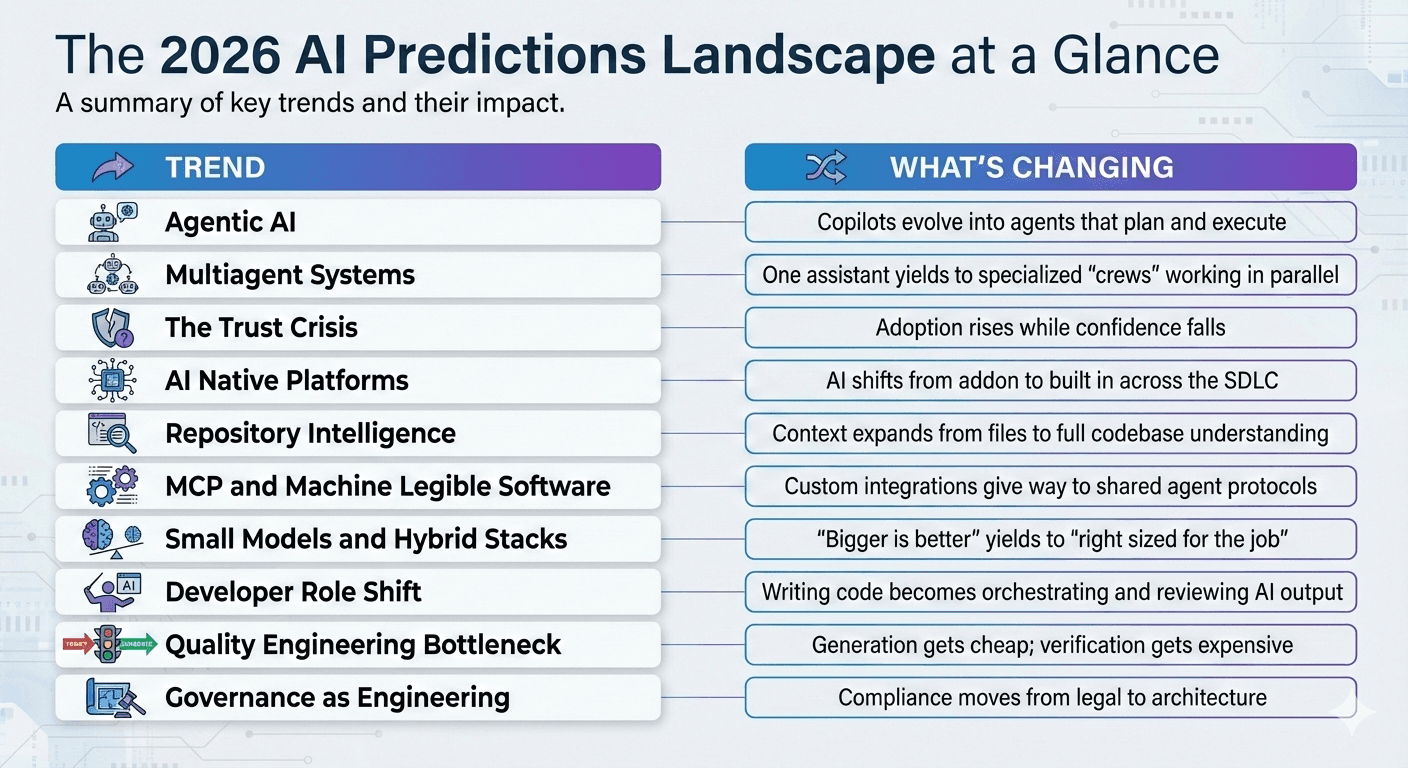
The 2026 AI Predictions Landscape at a Glance
| Trend | What's Changing | Key Stat |
|---|---|---|
| 1. Agentic AI | Copilots evolve into agents that plan and execute | 40% of enterprise apps will include AI agents by EOY (Gartner) |
| 2. Multiagent Systems | One assistant yields to specialized "crews" working in parallel | LangChain, AutoGen, CrewAI moving into mainstream stacks |
| 3. The Trust Crisis | Adoption rises while confidence falls | Trust dropped from 43% to 29% in two years (Stack Overflow) |
| 4. AI Native Platforms | AI shifts from addon to built in across the SDLC | 75% of enterprise software will embed conversational interfaces (AlixPartners) |
| 5. Repository Intelligence | Context expands from files to full codebase understanding | GitHub reports 23% more monthly merged PRs |
| 6. MCP and Machine Legible Software | Custom integrations give way to shared agent protocols | 10,000+ MCP servers; adopted across major toolchains |
| 7. Small Models and Hybrid Stacks | "Bigger is better" yields to "right sized for the job" | Phi 4 (14B) outperforms much larger models on some reasoning tasks |
| 8. Developer Role Shift | Writing code becomes orchestrating and reviewing AI output | Senior devs consistently benefit more than juniors |
| 9. Quality Engineering Bottleneck | Generation gets cheap; verification gets expensive | 66% cite "almost right" code as top frustration |
| 10. Governance as Engineering | Compliance moves from legal to architecture | EU AI Act high risk rules tighten in August 2026 |
1. Agentic AI Becomes the Default
We're moving from "chat" to "do."
Agents don't just answer questions. They plan tasks, execute multistep workflows, edit files, run tests, and open PRs with much less hand holding.
Gartner's projection is the headline: 40% of enterprise apps will include task specific AI agents by the end of 2026, up from under 5% in early 2025. That's not a gentle slope. That's a step change.
In practice, instead of asking "how do I upgrade dependencies?", you assign an agent: "Upgrade them, update lockfiles, run tests, open a PR, and summarize risks."
Your job shifts toward review and judgment, not keystrokes. You're still responsible for the outcome. You're just supervising an intern that never sleeps and doesn't ask for snacks. (It will ask for permissions, though. Constantly.)
Recommended
Nvidia Paid 86 Times Revenue for Hugging Face

Nvidia just spend $12.93 billion on Hugging Face, a company producing roughly $150 million in annualized revenue. The multiple is about 86 times revenue. It shifts depending on which number counts. Nvidia's SEC filing pu…
Read next2. Multiagent "Crews" Replace Solo Copilots
Why use one assistant when you can run a whole pit crew?
A common pattern now: multiple agents with distinct roles working in parallel. An Architect proposes structure and tradeoffs. A Backend agent implements APIs and data flows. A QA agent generates tests and edge cases. A Release agent preps deployment steps and checks.
Frameworks like LangChain, AutoGen, and CrewAI are increasingly shipping with the grown up features: evals, observability, governance hooks.
The pattern that tends to work: bounded authority, human checkpoints at real decision points, and full logging.
The pattern that fails: "here's prod, good luck." That's not innovation. That's roulette.
3. The Trust Crisis Deepens
Here's the paradox that should keep product leaders awake: usage keeps climbing while trust keeps falling.
The story in four bullets:
- 84% of developers use or plan to use AI tools (up from 76%)
- 29% trust AI accuracy (down from 43%)
- 66% cite "almost right, not quite" as the main frustration
- 45% say debugging AI code takes longer than writing it themselves
That last one is the gut punch. If fixing the output takes longer than doing it yourself, you don't have a productivity tool. You have a productivity tax with a nice demo.
What separates winners from losers: teams that measure outcomes (cycle time, defect rates, maintenance burden) versus teams hypnotized by "lines of code generated."
4. AI Native Development Platforms
AI is escaping the IDE and spreading across the entire lifecycle: specs, codegen, CI, deployment, observability, incident response.
It's becoming the water you swim in, not the floatie you grab when you're tired.
AlixPartners forecasts 75% of enterprise software will embed conversational interfaces by end of 2026. Gartner's longer arc points toward smaller core engineering teams augmented by AI over time.
A role that's quietly getting real: the platform engineer for AI native stacks, owning templates, guardrails, and paved road integrations for everyone else.
If you enjoy building the assembly line more than working on it, this is your season.
5. Repository Intelligence Changes Everything
The big unlock: tools are finally escaping single file context.
Modern AI coding systems increasingly incorporate whole repo awareness: history, dependencies, architectural patterns, and cross cutting impact.
What this enables:
- Tracing how a backend change ripples into frontend components across thousands of files
- "Janitorial" automation: docs updates, deprecation cleanup, basic tech debt reduction
- Faster, safer refactors because the system can see relationships instead of guessing
GitHub has reported higher shipping volume, including 23% more monthly merged PRs and 25% more commits pushed. When the tool understands context, you get speed without as much chaos.
It's the difference between a new hire who only reads the ticket and one who actually learned the codebase.
6. MCP Becomes the USB C of AI Connectivity
In 2024, AI integrations felt like proprietary chargers everywhere. Each tool, each API, each glue script. Forever.
MCP (Model Context Protocol) aims to standardize that mess so agents can connect to tools and data sources through a consistent interface.
Why it matters: before MCP, most integrations were bespoke spaghetti. With a shared protocol, you can plug agents into Slack, GitHub, Salesforce, internal services, and databases without rebuilding the plumbing each time.
The tradeoff: universal connectivity also means universal attack surface. Security folks are already flagging prompt injection, over broad permissions, and shaky auth patterns in early implementations. MCP adoption is great, but governance and security have to keep up, or it becomes a speedrun into incident response.
7. Small Models Become the Smart Money
The "bigger is always better" story is cracking, mostly under the weight of GPU costs and latency budgets.
We're seeing serious traction in smaller models and hybrid approaches. Models like Phi 4 (14B) show strong performance on certain reasoning tasks relative to much larger models. Quantized models run locally on constrained devices with minimal quality loss. And there's a broader shift toward industry specific and function specific models for predictable tasks.
The architecture that's emerging: hybrid stacks. Small local models handle routine inference (fast, private, cheap). Cloud LLMs get called when the task truly needs heavyweight reasoning. A routing layer decides which brain to use per request.
There's also a sustainability narrative here. Training and running frontier models is resource intensive, and companies with climate commitments are increasingly interested in "good enough, nearby, efficient" over "largest possible."
8. Developer Roles Shift from Writing to Orchestrating
The cost of generating code has collapsed. The bottleneck moves from "can we write this?" to "should we ship this?"
Several patterns keep showing up. Senior developers get more benefit than juniors because AI amplifies judgment. Productivity gains take time to realize because tooling, workflows, and trust don't change overnight. And "vibe coding" remains mostly a prototype mode, not a production operating system.
Skills that matter more now: architecture, system design, decomposition, verification, and knowing when AI helps versus when it quietly creates debt.
AI is a force multiplier, not a replacement for taste. Giving an AI to someone who can't evaluate output is like giving a calculator to someone who doesn't understand arithmetic. Answers arrive faster, but errors compound in stealth mode.
9. Quality Engineering Becomes the Main Event
When code generation becomes cheap, proving it's correct becomes expensive.
That's where investment is flowing:
- AI generated tests, including fuzzing and property based testing
- Automated code review with stricter, context aware rule sets
- Eval frameworks to prevent agents from "freestyling" in production
- Security scanning tuned for AI generated code and supply chain hardening
Stack Overflow found many developers are most resistant to using AI in the highest stakes zones: deployment, monitoring, and planning. That makes sense. Accountability concentrates there.
The assembly line metaphor fits. Making widgets got cheaper. Quality control did not.
10. Governance Becomes an Engineering Discipline
Compliance is leaving legal and moving into CI/CD. Regulators are making sure it does.
EU AI Act timeline:
- August 2025: requirements begin applying for general purpose AI models
- August 2026: high risk system obligations tighten further
- Penalties can be severe, depending on category and turnover
What teams increasingly need to build in:
- Traceability and data lineage for model outputs
- Human in the loop checkpoints for safety, rights, and financial decisions
- Risk classification for models in production
- Immutable audit trails for AI influenced decisions
Procurement is starting to resemble security procurement: provenance, testing, certifications. Governance isn't a checkbox at the end. It's an architectural constraint you design for upfront.
Teams that do this early move faster later. Teams that don't will spend 2027 retrofitting audit logs while competitors ship.
The Bottom Line
Strip away the hype cycles and the picture gets clearer.
What's real: agentic systems, repo intelligence, MCP plumbing, governance requirements, and the trust deficit.
What's overhyped: vibe coding as a production workflow, fully autonomous development, and "AI replaces senior engineers."
What actually matters: measuring outcomes, building guardrails from day one, and developing the judgment to know where AI helps versus where it quietly taxes you.
Gartner calls 2026 the "trough of disillusionment." That sounds bleak, but it's often the best phase. The tourists leave. The builders stick around.
The $2 trillion question isn't whether AI changes software development. It already did. The question is whether you're capturing the gains or just paying the productivity tax.
Choose wisely. The debugging costs the same either way.
Sources: Gartner forecasts, Stack Overflow 2025 Developer Survey (49,000+ respondents), AlixPartners 2026 Enterprise Software Predictions, Forrester Predictions 2026, Microsoft and GitHub research, EU AI Office documentation, Linux Foundation AAIF announcement.
About the Author
Founder at EveryDev.ai
Apple, Disney, Adobe, Eventbrite, Zillow, Affirm. I've shipped frontend at all of them. Now I build and write about AI dev tools: what works, what's hype, and what's worth your time.
Comments
No comments yet
Be the first to share your thoughts