AI Dev News Digest: January 16th, 2026

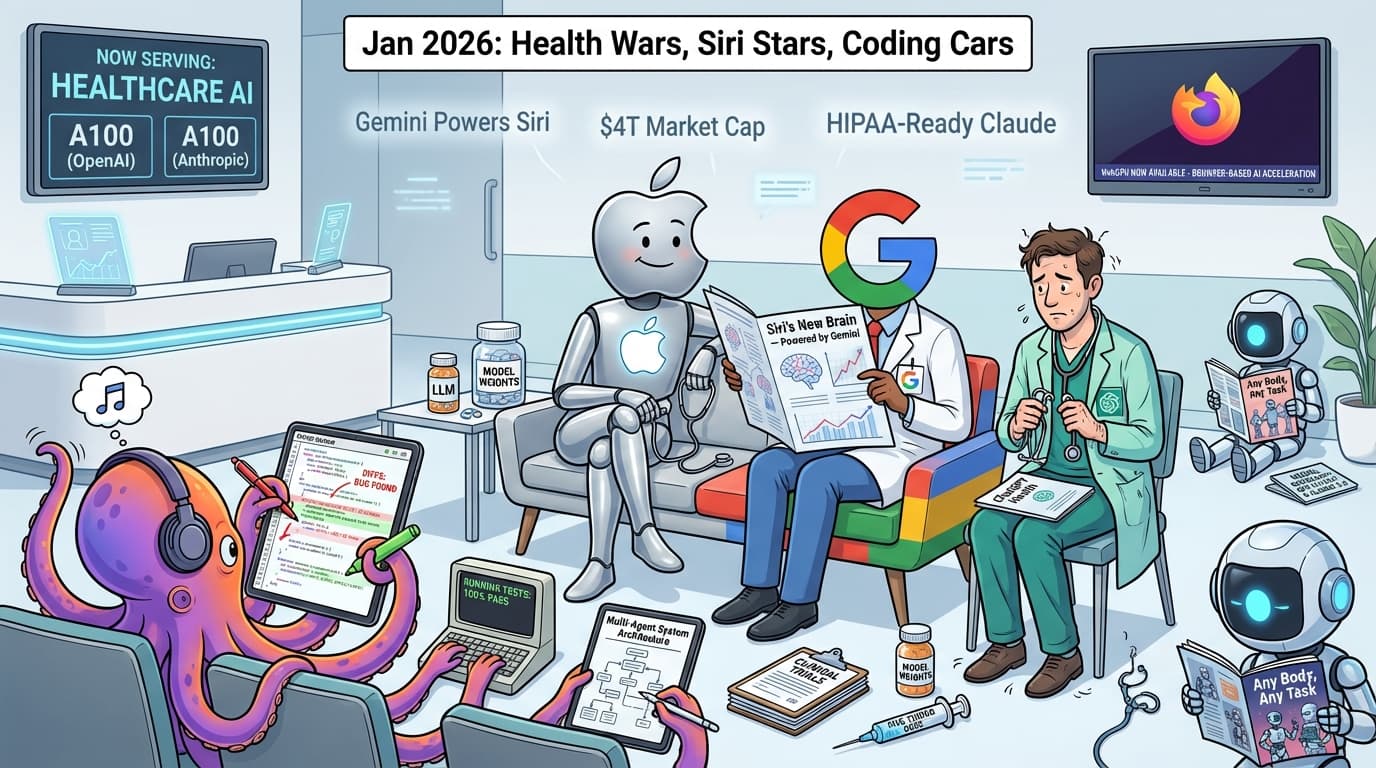
OpenAI and Anthropic are racing each other into healthcare. Both shipped health platforms within days of each other, both promising to connect your medical records, both insisting they won't train on your data. It's the clearest signal yet that the big AI labs see health as a real market, not just a demo.
Meanwhile, Apple made a choice that surprised nobody but still stings for OpenAI: Gemini will power the new Siri. Google gets validation, Apple gets a capable AI partner, and OpenAI's ChatGPT integration suddenly looks like a backup plan. On the developer side, GitHub shipped a bunch of Copilot updates including parallel agents and persistent memory. Skild AI raised $1.4 billion for robots that can inhabit any body. And AI models are quietly solving math problems that have stumped humans for decades. Not a slow week.
Healthcare AI
-
OpenAI and Anthropic both launch healthcare platforms. OpenAI released ChatGPT Health on January 8, letting users connect medical records from Apple Health, MyFitnessPal, and other apps to get personalized health answers. Then on January 12, Anthropic announced Claude for Healthcare with enterprise features including HIPAA-ready infrastructure and connectors to CMS coverage databases, ICD-10 codes, and PubMed. Both companies emphasize they won't train on health data. (OpenAI) (Anthropic)
-
OpenAI acquires Torch Health for medical memory. The acquisition, reported January 13, gives ChatGPT Health the ability to reference long-term medical data during queries. Torch treats medical history as a single persistent timeline rather than isolated files, addressing a common failure mode in health AI: fragmented data across labs, medications, visit notes, and wearables. (Radical Data Science)
-
Google releases MedGemma 1.5 and MedASR. The January 13 update to Google's open medical AI models adds support for 3D imaging (CT, MRI), histopathology, and longitudinal chest X-ray comparisons. MedASR, a new speech-to-text model for medical dictation, achieves 5.2% word error rate on chest X-ray dictations compared to 12.5% for Whisper large-v3. Both models are free for research and commercial use via Hugging Face. Google also launched a $100K MedGemma Impact Challenge on Kaggle. (Google Research)
Industry News
-
AI models are starting to crack high-level math problems. Since Christmas, 15 problems have moved from "open" to "solved" on the Erdős website, with 11 specifically crediting AI models. Terence Tao notes that AI's scalability makes it suited for the "long tail" of obscure problems with straightforward solutions. Neel Somani found that OpenAI's latest model solved a problem after 15 minutes of "thinking," producing a proof that verified correctly. (TechCrunch)
-
AI accelerator market projected to exceed $600B by 2033. Bloomberg Intelligence forecasts 16% compound annual growth from $116B in 2024. Microsoft is on track to spend over $150B in capital expenditures in 2026. GPUs will hold 81% market share; custom ASICs are growing at 27% annually with Broadcom and Marvell leading. (Bloomberg)
-
OpenAI retiring Voice from ChatGPT macOS app. Effective January 15, the feature goes away to focus on "more unified and improved voice experiences" across other platforms. Voice remains available on chatgpt.com, iOS, Android, and Windows. (OpenAI Help)
-
Morningstar launches GenAI 20 Index for private AI valuations. The Morningstar PitchBook GenAI 20 Index tracks 20 generative AI companies including OpenAI, Anthropic, and xAI. It arrives as private AI valuations surge: OpenAI is expected to raise at $750B, Anthropic targeting $350B, and xAI valued above $230B after its $20B raise. (Morningstar)
-
MIT Technology Review names AI coding tools a 2026 breakthrough. The publication included generative AI coding tools in its annual breakthrough technologies list, noting the market hit $5.8B in 2025 with projections to reach $52B by 2035. (MIT Technology Review)
-
IAB releases first AI Transparency Framework with stark consumer-advertiser gap. The Interactive Advertising Bureau published risk-based guidelines requiring disclosure only when AI materially affects authenticity (synthetic humans, digital twins, AI-generated voices/images). Key finding: 82% of advertising executives believe Gen Z and Millennials feel positive about AI-generated ads, but only 45% of those consumers actually do—a gap that widened from 32 to 37 points since 2024. The framework introduces standardized visual labels and machine-readable metadata (C2PA protocols). (IAB)
-
OpenAI to test ads in ChatGPT, expands ChatGPT Go to U.S. Announced January 16, OpenAI will begin testing ads in the free and Go tiers in the U.S. in coming weeks. Ads will appear at the bottom of responses, be clearly labeled, and won't influence ChatGPT's answers. ChatGPT Go ($8/month) is now available in the U.S. with expanded features including image creation, file uploads, and memory. Pro, Business, and Enterprise plans remain ad-free. (OpenAI)
AI Coding Tools
-
Critical vulnerability in Cursor enables sandbox bypass. Pillar Security disclosed CVE-2026-22708, which allows remote code execution through environment variable poisoning. The flaw exploits how Cursor handles shell built-in commands, letting attackers bypass sandbox restrictions even with an empty command allowlist. Patched in version 2.3. (Pillar Security)
-
Kilo Code launches Slack integration with multi-repo support. Released January 16, Kilo for Slack brings AI coding agents into team conversations. Unlike competing Slack bots, it works across multiple repositories and infers which one you're discussing from thread context. The integration uses MiniMax M2.1 as the default model (free for launch week) and supports continuous multi-turn conversations that build on existing PRs. (Kilo Blog)
-
GitLab launches Duo Agent Platform. The January 15 GA release introduces agentic AI across the software lifecycle. Features include Agentic Chat with multi-step reasoning, two foundational agents (Planner and Security Analyst), custom agent support via AI catalog, and integrations for Claude Code and OpenAI Codex CLI. GitLab is introducing usage-based pricing with virtual credits for Premium and Ultimate subscribers. (GitLab)
-
GPT-5.2-Codex is generally available in GitHub Copilot. The model is now accessible across github.com, Mobile, VS Code, Visual Studio, JetBrains, Xcode, and Eclipse. Business and Enterprise admins need to opt-in first. (GitHub)
-
Microsoft Copilot Studio VS Code extension hits GA. Released January 14, the extension lets developers build and manage AI agents directly in VS Code using standard DevOps workflows. Teams can clone agent definitions locally, edit them in YAML with syntax highlighting and IntelliSense, use Git for version control, and deploy through CI/CD pipelines. Over 13,000 downloads so far. (Microsoft 365 Dev Blog)
-
Copilot SDK enters technical preview. GitHub released SDKs for Node.js/TypeScript, Python, Go, and .NET providing programmatic access to Copilot CLI. All SDKs support multi-turn conversations, tool execution, and full lifecycle control. (GitHub)
-
Copilot Memory hits public preview. The feature lets Copilot learn and retain details about your repositories. As you work with coding agent, code review, or CLI, it builds repository-specific understanding that improves over time. Memories are shared across features and automatically expire after 28 days. (GitHub)
-
GitHub Copilot BYOK adds AWS Bedrock and Google AI Studio. Bring your own key now supports Responses API, configurable context windows, and streaming. New provider options join Anthropic, Microsoft Foundry, OpenAI, and xAI as supported choices. (GitHub)
-
GitHub Copilot CLI ships specialized agents and parallel execution. The January 14 update adds four built-in agents: Explore (codebase Q&A), Task (runs tests and builds), Plan (implementation planning), and Code-review. Copilot can now run multiple agents simultaneously. New context management features include auto-compaction at 95% token limit,
/compactfor manual compression, and/contextfor visualizing token usage. Also new: package manager installation via WinGet and Homebrew with automatic updates. (GitHub)
Developer Experience
-
Mozilla releases Firefox 147. The January 13 release brings WebGPU support to all Apple Silicon Macs, zero-copy video playback for AMD GPUs on Linux and Windows, and migration to Safe Browsing V5 protocol. Linux users get XDG Base Directory Specification support (resolving a 20-year-old bug) and improved fractional scaling on GNOME. Picture-in-Picture auto-open is now enabled by default. (Mozilla)
-
Anthropic CEO confirms 90% of Claude code is AI-written. Dario Amodei's March 2025 prediction that AI would write 90% of code in 3-6 months has materialized within Anthropic. Claude Code creator Boris Cherny revealed that every line of code he personally shipped in December 2025 was written by Claude. Amodei clarified this doesn't mean fewer engineers: "They can focus on the 10% that's editing the code or writing the 10% that's the hardest, or supervising a group of AI models. Cowork creator Boris Cherny and PM Felix Rieseberg built the feature in roughly a sprint and a half, with "pretty much" all code generated by Claude. The team noted they had built prototypes beforehand and leveraged Claude Code's existing foundation, so the timeline primarily reflects front-end work. (The Decoder)
-
Anthropic releases Claude Cowork as a research preview. Described as "Claude Code for the rest of your work," Cowork is available to Max subscribers in the Claude Desktop macOS app. It uses a containerized environment that mounts only the files you grant access to. The interface is similar to Claude Code but without requiring terminal knowledge. (Simon Willison)
-
Anthropic cracks down on unauthorized Claude usage. Third-party harnesses like OpenCode that use OAuth to drive automated workflows through consumer Claude accounts are now blocked. The company cites technical instability and the economic reality that heavy automation belongs on the metered API or Claude Code, not flat-rate consumer plans. (VentureBeat)
Foundation Models
-
Mistral releases Ministral 3 technical report. The new family of dense language models (3B, 8B, and 14B) is optimized for low-resource environments. Models include base, instruction-tuned, and reasoning variants with image understanding support. Trained using Cascade Distillation, an iterative distillation and pruning method. (Radical Data Science)
-
Google launches Personal Intelligence in Gemini app. The January 14 feature directly challenges Apple Intelligence by offering personalized AI assistance within the Gemini mobile app. Google is positioning this alongside its Gemini-powered Siri announcement. (CNBC)
-
Google Trends Explore gets Gemini AI integration. The redesigned page uses Gemini to help users find and understand trending searches with AI-generated analysis. (Google Blog)
Enterprise & Partnerships
-
Anthropic commits $1.5M to Python Software Foundation for security. The two-year partnership announced January 13 focuses on protecting the Python Package Index from supply-chain attacks. Funds will go toward automated proactive package review for PyPI and creating a malware dataset for capability analysis. PSF deputy executive director Loren Crary said the methods developed could transfer to other open source package repositories. (Python.org)
-
Apple picks Google Gemini to power Siri. Announced January 12, the multi-year deal has Apple using Gemini as the foundation for Apple Foundation Models and an updated Siri launching later in 2026. The partnership is a setback for OpenAI, whose ChatGPT integration with Siri remains but may be sidelined. Google's stock pushed Alphabet past $4 trillion market cap for the first time. (CNN) (CNBC)
-
OpenAI partners with Cerebras for $10B compute deal. OpenAI will integrate 750 megawatts of ultra-low latency compute through 2028. Cerebras calls this the world's largest deployment of high-speed AI inference. The goal is faster response times for OpenAI's products. (OpenAI)
-
OpenAI seeks US-based suppliers for robotics and consumer devices. A January 15 request for proposals targets companies manufacturing silicon, motors, packaging, and data center cooling equipment. "AI is a catalyst for the reindustrializing of the country," said OpenAI's Chris Lehane. No spending amounts disclosed. (Bloomberg)
-
Mistral AI wins French military defense contract. The Ministry of Armed Forces selected Mistral to provide AI models, software, and engineering teams to French forces, research institutions, and public agencies. Solutions will be deployed on French infrastructure with defense-specific fine-tuning. (Defense Post)
-
Cloudflare acquires Human Native for AI data marketplace. The January 15 acquisition brings a UK startup that connects AI developers with licensed content from publishers and creators. Founded by ex-DeepMind engineers, Human Native transforms unstructured multimedia into AI-ready data. Cloudflare CEO Matthew Prince said the goal is to build a system where AI companies pay creators for training content. Terms not disclosed. (Cloudflare Blog)
-
Cloudflare acquires Astro web framework. Announced January 16, the deal brings The Astro Technology Company team to Cloudflare. Astro is a JavaScript framework used by Unilever, Visa, and NBC News for fast, content-driven websites that prioritize minimal JavaScript loading. The framework will remain open source, and Cloudflare commits to the Astro Ecosystem Fund alongside Webflow, Netlify, Wix, and Sentry. (Cloudflare)
-
Airbnb hires Meta's GenAI leader as CTO. Ahmad Al-Dahle, who led Meta's Generative AI group and the Llama family of models, joins as Chief Technology Officer. CEO Brian Chesky says Airbnb will launch AI search in 2026 to make travel recommendations more interactive and personalized. Al-Dahle previously spent 16 years at Apple working on iPhone display systems, Apple Watch, and autonomous vehicles. (Airbnb)
Funding & Startups
-
Skild AI raises $1.4B, triples valuation to $14B. The robotics startup building an "omni-bodied" brain that can control any robot (quadrupeds, humanoids, tabletop arms, mobile manipulators) raised from SoftBank, Nvidia, Macquarie, Bezos Expeditions, Samsung, LG, and Salesforce Ventures. The company claims it grew from zero to $30M revenue in just a few months. (Crunchbase)
-
Equal1 raises $60M for silicon-based quantum computing. The Ireland Strategic Investment Fund led the round for the company building quantum computers using standard semiconductor manufacturing. The Bell-1 quantum server aims to reduce cost, power consumption, and infrastructure complexity compared to custom quantum systems. (Quantum Insider)
Weekend Watch
-
Spec-Driven Development: How to Control Your Agents — Al Harris from Amazon Kiro explains how to keep AI coding agents from going off the rails. The approach: write specs first, let agents implement against them. If you've watched Copilot or Claude Code generate code that technically works but misses the point, this talk addresses that problem directly. (YouTube)
-
The Minimum Evolvable Product Playbook — Ankit Gupta, Y Combinator General Partner, updates the MVP concept for early-stage startups. Beyond building a minimum viable product, you need one that can adapt to early customer feedback. Gupta outlines counterintuitive strategies for finding your first true believers, learning fast without fearing churn, and letting early users shape your market. Includes a Tesla case study on how adopters define product direction. (YouTube)
Sponsored
ChatGPT Codex
OpenAI's agentic coding tool that runs in ChatGPT, your IDE, and the terminal to handle complex engineering tasks like bug fixes, refactors, and PR reviews.
View toolAbout the Author
Founder at EveryDev.ai
Apple, Disney, Adobe, Eventbrite, Zillow, Affirm. I've shipped frontend at all of them. Now I build and write about AI dev tools: what works, what's hype, and what's worth your time.
Comments
No comments yet
Be the first to share your thoughts