AI Dev News Digest - Nov 28th, 2025

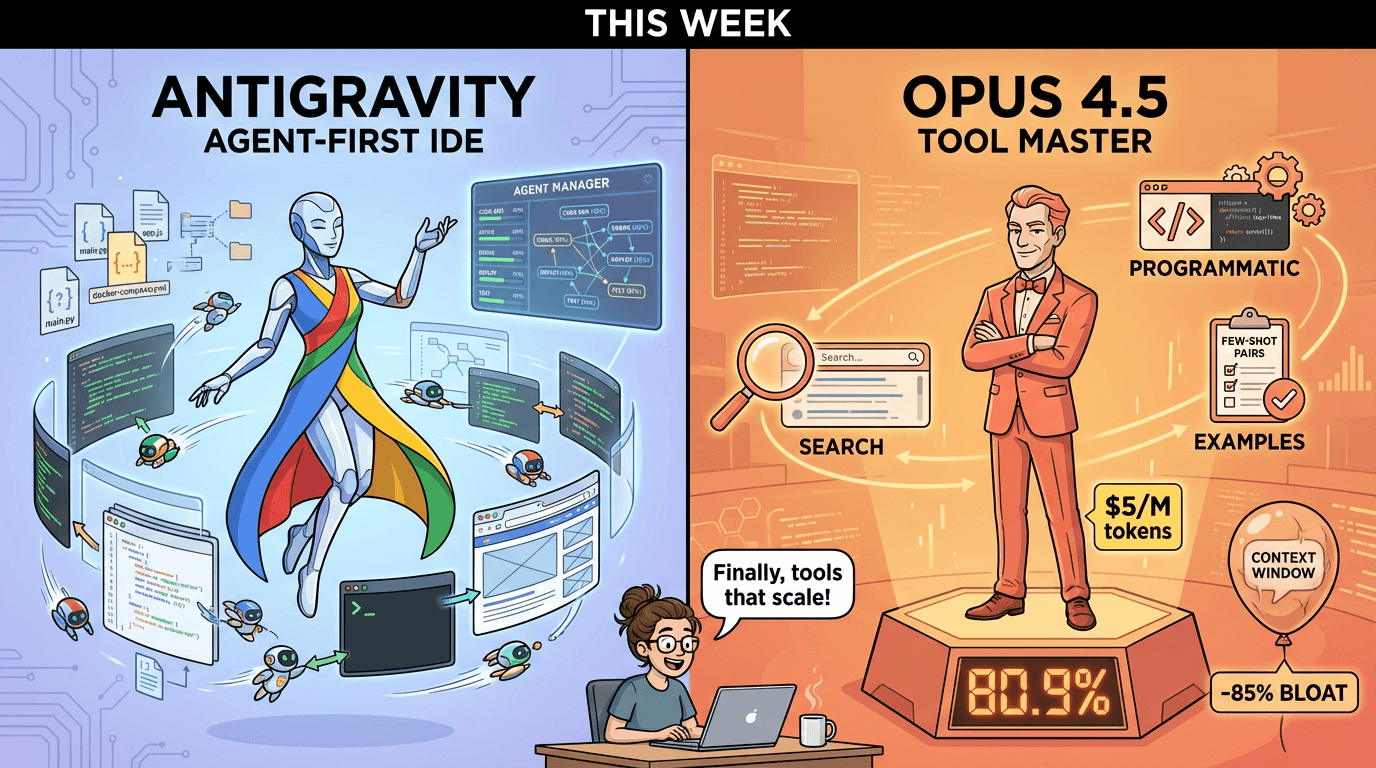
Thanksgiving week turned into a model release party. Anthropic dropped Claude Opus 4.5 on Monday, OpenAI shipped GPT-5.1 the same day, and Black Forest Labs snuck in FLUX.2 for image generation. Each one claiming some version of "best at coding" on the benchmarks. And honestly? They all look good. The pricing wars continue too. Opus went from $15 to $5 per million input tokens, which makes the whole Opus tier actually usable now instead of just aspirational.
On the tooling side, MCP celebrated its first birthday with a spec update that adds async workflows and simpler OAuth. GitHub Copilot got both Opus 4.5 and GPT-5.1, so you can now pick your favorite model for agent mode. OpenAI also rolled out a shopping assistant right before Black Friday. Not exactly dev-focused, but curious how many of you tried asking ChatGPT for gift recommendations this week. The AI labs are clearly betting that consumer features drive growth while coding tools pay the bills.
Foundation Models
-
Anthropic releases Claude Opus 4.5. The new flagship model hits 80.9% on SWE-bench Verified, the first to reach that mark. Pricing dropped to $5/$25 per million tokens, making Opus-level capabilities more accessible. Also includes better prompt injection resistance than any competitor. (Anthropic)
-
OpenAI ships GPT-5.1 for ChatGPT. Two variants: GPT-5.1 Instant for everyday use and GPT-5.1 Thinking for harder problems. New tone presets let you customize how ChatGPT responds. Rolling out to paid users first. (OpenAI)
-
GPT-5.1 hits the API. The developer release adds adaptive reasoning that adjusts thinking time based on task complexity. New apply_patch and shell tools let GPT-5.1 edit multi-file projects and run terminal commands. Extended prompt caching now holds for 24 hours. (OpenAI API)
-
Black Forest Labs drops FLUX.2. The 32B parameter image model generates up to 4 megapixels with better text rendering and multi-reference consistency. NVIDIA helped optimize it to run on consumer RTX GPUs with 40% less VRAM. Open weights available on Hugging Face. (Black Forest Labs)
Developer Tools & IDEs
-
Anthropic ships advanced tool use features. Three new API capabilities: Tool Search (search thousands of tools without loading all definitions), Programmatic Tool Calling (invoke tools from code execution), and Tool Use Examples (examples in schemas). Cut tool context bloat by up to 85% and improved accuracy from 72% to 90%. (Anthropic)
-
Claude Opus 4.5 comes to GitHub Copilot. Available in VS Code, JetBrains, and the coding agent. Cuts token usage in half compared to previous models. Promotional 1x pricing through December 5. (GitHub)
-
GitHub Copilot CLI adds new models. Now supports GPT-5.1, GPT-5.1-Codex, and Gemini 3 Pro. Also bundled ripgrep for faster codebase search and added paste/drag-drop for images. (GitHub)
-
Copilot agent sessions work from Android apps. Share text from any Android app directly into a Copilot agent session using the sharesheet. Turns notes and ideas into agent tasks quickly. (GitHub)
-
Google launched Antigravity IDE. An agent-first development platform that lets async agents operate across editor, terminal, and browser. Includes an Agent Manager for orchestrating tasks and reviewing artifacts. Free public preview with desktop downloads. (EveryDev.ai)
-
Vercel ships "use workflow" for durable functions. The Workflow DevKit makes async JavaScript/TypeScript functions durable, resumable, and observable. Replace ad-hoc queues with declarative workflows that persist state and auto-retry. Open source and runs anywhere. (EveryDev.ai)
-
Unsloth + vLLM ship FP8 GRPO for consumer GPUs. 1.4x faster RL inference and 60% less VRAM. Qwen3-1.7B now fits in 5GB for reinforcement learning. Works on RTX 40/50 series. Collab with TorchAO. (Unsloth)
MCP & Agent Infrastructure
-
MCP turns one year old with a new spec release. The November 2025 spec adds async task workflows, simplified OAuth, and URL mode elicitation for out-of-band authentication. Server discovery through .well-known URLs is coming. (MCP Blog)
-
xAI launches Agent Tools API. Grok 4.1 Fast now available via API with web search, code execution, and MCP integration handled server-side. 2M token context window. Tool usage priced at $5 per 1,000 invocations, free through December 3. (xAI)
-
Microchip releases an MCP server. Gives AI tools direct access to Microchip's product specs, datasheets, inventory, and pricing. Free to use, no authentication required. (Microchip)
AI Shopping & Consumer Features
-
OpenAI launches shopping research in ChatGPT. A specialized GPT-5 mini model trained for shopping. Ask about products and it builds a buyer's guide by crawling trusted sites. Nearly unlimited usage through the holidays. (OpenAI)
-
Perplexity adds shopping with PayPal checkout. Similar to ChatGPT's approach but includes in-app purchasing through PayPal. Remembers your preferences across sessions. (Search Engine Land)
Platform Updates
-
OpenAI expands data residency for business customers. More control over where data is stored and processed. Rolling out worldwide. (OpenAI)
-
Claude for Chrome expands to all Max users. The browser extension that lets Claude take actions across tabs is now generally available for $100/month Max subscribers. (Anthropic)
AI Infrastructure & Investment
-
AWS commits $50B for government AI infrastructure. New data centers for federal agencies with 1.3 gigawatts of compute capacity. Gives government access to SageMaker, Bedrock, Claude, and Trainium chips. Breaking ground in 2026. (TechCrunch)
-
Anthropic's valuation hits $350B. Following the Microsoft and NVIDIA investment announcements from last week. Claude is now the only major model on all three cloud platforms. (CNBC)
-
Tenzai launches with $75M seed for AI security. The Israeli startup builds autonomous AI agents that attack and fix vulnerabilities in enterprise software. Led by Greylock, Battery, and Lux Capital. (Tech Startups)
-
Function Health raises $298M Series B. Consumer health intelligence platform valued near $2.5B. Uses AI to analyze lab tests and provide health insights. (Tech Startups)
-
Suno raises $250M at $2.45B valuation. The AI music generation startup plans to expand into mobile apps and pro audio workstations. Ongoing legal discussions around music rights. (Tech Startups)
Industry & Policy
-
USPTO scraps Biden-era AI inventorship rules. New guidance says single inventors using AI don't need to prove joint inventorship under Pannu factors. Same legal standard applies whether or not AI was used. (IPWatchdog)
-
OpenAI dev lead rejects vibe coding for enterprise. Katia Gil Guzman says fast prompting works for hobby projects but enterprise teams need structured AI that follows project rules and generates proper PRs. (Computing)
-
MIT study: AI can replace 11.7% of US workforce. The Iceberg Index simulation shows $1.2 trillion in wage exposure across finance, healthcare, and professional services. Disruption spreads beyond tech hubs. (CNBC)
-
Tech layoffs hit 180K in 2025 as AI reshapes roles. Microsoft cut 15K, Amazon 14K. Companies are restructuring around AI priorities, not just cost-cutting. Many roles replaced by automation or redirected to AI investment. (TechCrunch)
-
OpenAI and Jony Ive confirm AI device prototype. The screenless, pocket-sized device will launch within two years. Designed for calm, ambient intelligence rather than notification overload. (Fortune)
-
China leads world in AI research output. Now produces as many AI papers as US, UK, and EU combined. Captures 40% of global citations and files 10x more AI patents than US. Open-source models like DeepSeek closing quality gap. (Science)
Weekend Reading
-
US launches Genesis Mission for AI in science. Trump administration plan aims to double scientific productivity in a decade using AI. The Department of Energy leads the effort across national labs. (Science Business)
-
Michael Burry launches newsletter on AI bubble. The "Big Short" investor is back with a Substack focused on AI market risks. Compares current conditions to dot-com and housing bubbles. (CNBC)
-
HP cutting 4,000-6,000 jobs for AI shift. The company is accelerating AI-driven product development and operations through 2028. (TechRepublic)
Sponsored
ChatGPT Codex
OpenAI's agentic coding tool that runs in ChatGPT, your IDE, and the terminal to handle complex engineering tasks like bug fixes, refactors, and PR reviews.
View tool
Comments
Checking profile…