Weekly AI Dev News Digest: March 20th, 2026

NVIDIA owned the week. Jensen Huang used GTC to unveil Vera Rubin, the next GPU architecture, and attached a staggering number to it: more than $1 trillion in "high-confidence demand" through 2027. But the side stories mattered too. Xiaomi turned out to be behind the mystery model OpenRouter users thought was DeepSeek V4. OpenAI bought Astral, which means the company behind Codex now also owns uv and Ruff. Anthropic shipped a way to control your desktop agent from your phone. Microsoft reshuffled Copilot leadership after admitting the app still trails badly on consumer usage.
The security news was rough. GlassWorm is moving through VS Code extensions, GitHub repos, and npm packages, with LLM-generated commits used as cover. Google patched two Chrome zero-days already under active exploitation. Microsoft shipped fixes for 78 vulnerabilities in March Patch Tuesday. And if the GTC mood started to feel detached from reality, The Register had a useful counterweight: two former PwC consultants arguing that a lot of enterprises are still faking their way through AI adoption.
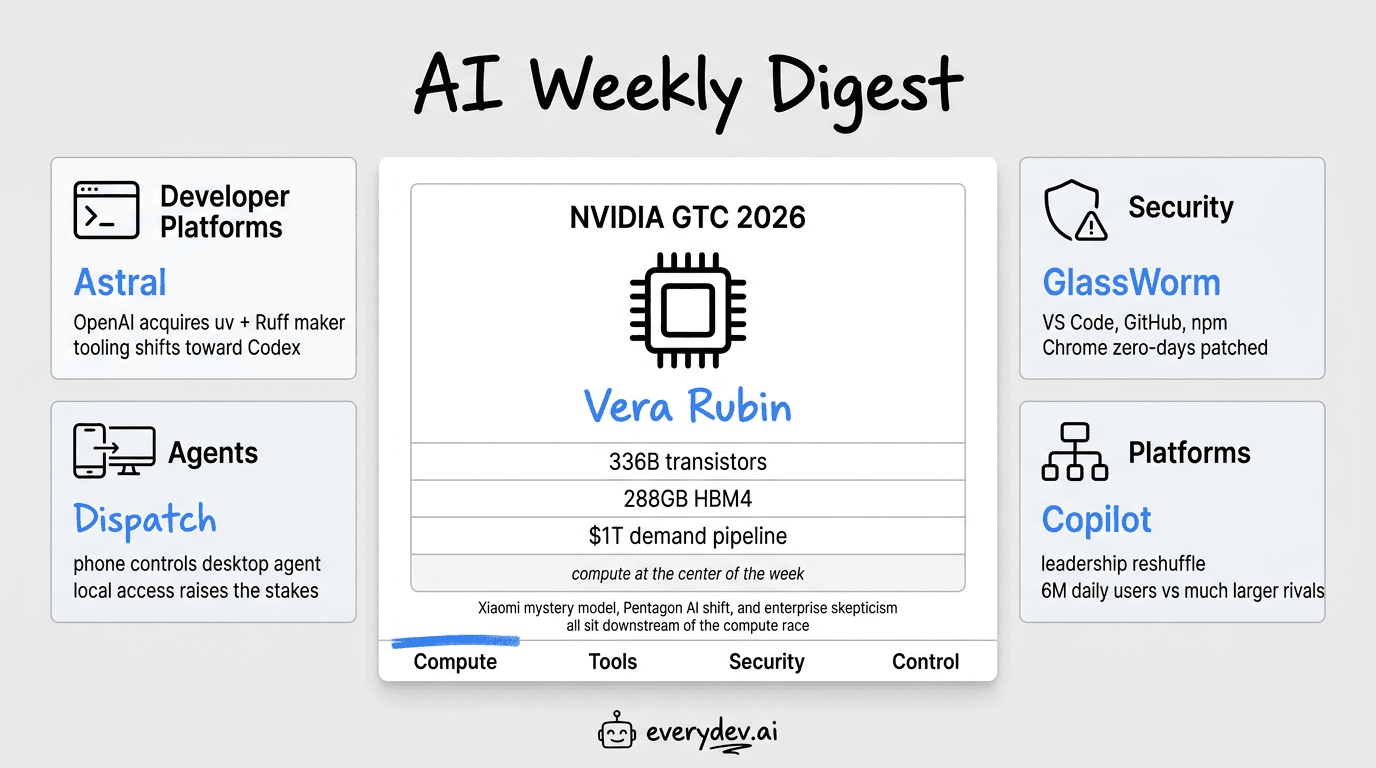
NVIDIA GTC 2026
If you only want the fast version, watch the full keynote in 12 minutes.
-
Vera Rubin GPU architecture revealed. Huang formally unveiled Vera Rubin at the keynote. The headline specs: 336 billion transistors on TSMC 3nm, 288GB HBM4, 50 PFLOPS of inference per chip, and a dual-die design. It replaces Blackwell. Samples are already going to AWS, Google Cloud, Microsoft, Oracle, CoreWeave, and Lambda, with volume production set for H2 2026. NVIDIA also locked in a three-generation roadmap: Vera Rubin in 2026, Rubin Ultra in 2027, and Feynman on TSMC 1.6nm in 2028. The bigger claim was demand. Huang says NVIDIA now sees more than $1 trillion in high-confidence demand through 2027, up from $500 billion through 2026 a year ago. (NVIDIA Blog, Oplexa)
-
Vera CPU and NVL72 rack. The Vera CPU uses 88 custom Olympus Arm cores and is aimed at the CPU bottlenecks that show up in agent workloads, especially tool-call loops and memory coordination. NVIDIA also showed the NVL72 rack with 260 TB/s of aggregate NVLink 6 bandwidth, plus a liquid-cooled NVL144 variant. (Parameter.io)
-
NVFP4 (4-bit floating point). Claimed 5x inference throughput improvement over prior formats. Near FP8 accuracy with differences often under 1%, while reducing memory footprint 1.8x vs FP8 and 3.5x vs FP16. (MarketMinute)
-
NemoClaw: open-source enterprise AI agent platform. This pushes NVIDIA further into the application layer, where it will end up competing with products like LangChain and Microsoft Copilot Studio. It also runs on non-NVIDIA chips. Huang described OpenClaw as "the operating system for personal AI," and compared that role to Mac and Windows. (Oplexa)
-
DGX Station GB300 starts shipping. The deskside system ships with 748GB of coherent memory, 20 PFLOPS of FP4 performance, and support for models up to 1 trillion parameters. NVIDIA sent the first unit to Andrej Karpathy, who said he had been told to expect "a secret gift" that "requires 20 amps." ASUS, Dell, Gigabyte, MSI, and Supermicro will all sell it. (Tom's Hardware)
-
NVIDIA partners with Groq on LPU accelerators. NVIDIA pitched Groq 3 as a complement to Vera Rubin, not a replacement. The split is straightforward: GPUs handle high-throughput batch inference, while Groq's deterministic LPUs target low-latency interactive work. A 256-LPU rack sits next to the Vera Rubin NVL72 in the reference setup. NVIDIA says the combined system can deliver a 35x improvement in tokens per watt at high token rates. (CNBC)
-
Thinking Machines Lab partnership. NVIDIA and Mira Murati's startup announced a multiyear, gigawatt-scale deal. The Financial Times says it is worth "tens of billions." The agreement covers more than 1GW of Vera Rubin capacity starting in 2027. That is a huge commitment for a company with about 120 employees, a valuation above $50 billion, and four co-founders gone since January. (NVIDIA Blog)
-
Nemotron 3 open model family. Nano, Super, and Ultra variants using hybrid Mamba-Transformer MoE for agentic reasoning. Super and Ultra available H1 2026. (NVIDIA News)
-
Physical AI, pharma, and databases. NVIDIA spent a lot of time on robotics, autonomous vehicles, and digital twins. It showed the Isaac GR00T N1.6 humanoid robot model. Lilly announced what it called the most powerful AI factory wholly owned by a pharmaceutical company, built on Vera Rubin. Oracle also rolled out AI Database acceleration built on NVIDIA cuVS. (NVIDIA Blog)
Anthropic
-
Pentagon actively replacing Anthropic's AI tools. Cameron Stanley, the Pentagon's chief digital and AI officer, said the military is installing another LLM to replace Anthropic's tools in operations tied to Iran. He said the transition will take more than a month. The same day, OpenAI announced a deal to sell AI products to US government agencies through AWS infrastructure, including Trainium chips. AWS becomes the exclusive third-party cloud distributor for OpenAI's Frontier products in government. The deal covers roughly 3 million DoD employees plus civilian agencies, but the revenue is still expected to be only a few million dollars over 15 months. Against OpenAI's projected $30 billion annual revenue, that is basically strategic positioning. (Bloomberg, Reuters)
-
CNN analysis: The Pentagon fight may be helping Anthropic. CNN's argument is that the dispute has improved recruiting, brand recognition, and morale. Anthropic reportedly has an 80% retention rate and an 88% offer acceptance rate for tech roles. Enterprise revenue share rose to 40%, while OpenAI's fell from 50% to 27%. Annualized revenue was close to $20 billion by early March. (CNN)
-
Claude Cowork Dispatch: your phone as a remote for your desktop agent. Anthropic released Dispatch inside Cowork. It lets you send tasks from the Claude mobile app to the Claude agent running on your desktop. In practice, your phone becomes a remote control for an agent that can reach local files, browser sessions, and MCP integrations. The work still runs locally rather than in the cloud. Developers get the same pattern through Claude Code Remote Control. OpenClaw got there first, but Anthropic shipping it as a product gives more weight to the idea that your agent should be reachable from anywhere. The risk is obvious: prompt injection is still unsolved, and local access makes mistakes more expensive. (EveryDev.ai)
-
Claude Code channels push events into a live session. Anthropic quietly added channels as a research preview in Claude Code. The feature lets MCP plugins push CI results, chat messages, and monitoring events into a running session so Claude can react while you are away from the terminal. Telegram and Discord are the first supported channels, and Anthropic also ships a localhost fakechat demo. There are some real constraints: channels only work while the session stays open, they require a claude.ai login rather than console or API key auth, and Team or Enterprise admins have to enable them explicitly. The practical takeaway is simple. Claude Code is moving closer to an always-on agent that can sit in the loop while other systems talk to it. (Claude Code docs)
-
Claude Partner Network launched. $100M commitment for 2026 covering training, certification (Claude Certified Architect), dedicated support, and co-marketing. Available across AWS, Google Cloud, and Microsoft. (Anthropic)
-
Anthropic Institute. Anthropic created a new research unit led by co-founder Jack Clark, now Head of Public Benefit. It combines the Frontier Red Team, Societal Impacts, and Economic Research groups. The team has about 30 people so far, including hires from Google DeepMind, OpenAI, and UVA economics. A DC office is set to open this spring. (Anthropic)
-
Claude usage promotion. 2x limits during off-peak hours (outside 8AM-2PM ET weekdays) through March 27. Free, Pro, Max, and Team plans. Bonus usage doesn't count against weekly limits. (EveryDev.ai)
Models & Industry
-
Xiaomi's mystery "Hunter Alpha" model was MiMo-V2-Pro. An anonymous trillion-parameter model showed up on OpenRouter on March 11 with no attribution. It quickly hit the top of the leaderboard and passed 1 trillion tokens in usage. Most people assumed it was DeepSeek V4 because the specs lined up, the knowledge cutoff lined up, and Chinese media had already suggested V4 could land in April. On March 18, Xiaomi's AI division MiMo, led by former DeepSeek researcher Luo Fuli, said it was actually an early test build of MiMo-V2-Pro for agentic workflows. It has a 1 million token context window, is free during launch week, and is partnering with five agent frameworks including OpenClaw. Xiaomi's Hong Kong-listed shares rose 5.8%. (Japan Times)
-
Mistral launches Forge at GTC. Forge is an enterprise platform for training custom AI models from scratch on proprietary data. This is not a fine-tuning product; Mistral is pitching full training. Early adopters include ASML, Ericsson, and the European Space Agency. Mistral also said it is on pace to pass $1 billion in ARR this year. Separately, it released Mistral Small 4, a 119B-parameter open-source MoE model with 6B active parameters per token under Apache 2.0, and joined the NVIDIA Nemotron Coalition. (TechCrunch)
-
Microsoft restructures Copilot leadership. Satya Nadella put consumer and commercial Copilot under Jacob Andreou, formerly a Snap SVP, and moved Mustafa Suleyman back toward frontier models and the broader superintelligence push. The usage numbers explain why. The Copilot app had 6 million daily active users in February, compared with 440 million for ChatGPT and 82 million for Gemini. Microsoft 365 Copilot had 15 million paying users, which is only about 3% of the broader M365 base. (Microsoft Blog, CNBC)
Security
-
GlassWorm supply chain attack escalation. Socket Research found more than 72 malicious Open VSX extensions abusing transitive dependencies. The campaign also touched more than 151 GitHub repos and npm packages. The operators hide payloads with invisible Unicode characters, use the Solana blockchain for command and control, and fall back to Google Calendar when needed. Fake extensions impersonate Claude Code, Google Antigravity, Prettier, and ESLint. Aikido also found LLM-generated cover commits used to hide the injections. (The Hacker News)
-
Two Chrome zero-days patched. Google fixed CVE-2026-3909 (Skia, CVSS 8.8) and CVE-2026-3910 (V8, CVSS 8.8), both actively exploited and added to CISA's Known Exploited Vulnerabilities catalog. (The Hacker News)
-
Microsoft March Patch Tuesday. 78 vulnerabilities including one actively exploited zero-day (CVE-2026-21262) and two critical Office RCE flaws. (Cybersecurity News)
-
WordPress 6.9.2 security release. Patches 10 vulnerabilities: blind SSRF, stored XSS in nav menus, AJAX auth bypass, PclZip path traversal, and XXE in the bundled getID3 library. (WordPress Developer News)
Developer Platforms
-
OpenAI acquires Astral (uv, Ruff, ty). OpenAI said it will acquire Astral, the company behind a set of Python tools that now sit deep in the modern development stack. uv alone had 126 million downloads last month. Ruff displaced combinations of Flake8, isort, and Black while running 10 to 100 times faster. The Astral team is joining OpenAI's Codex group, which now has more than 2 million weekly active users and has tripled since January. Both companies say the open-source tools will stay maintained. That has not stopped the anxiety. The concern is less about sudden breakage and more about direction: people worry these tools will gradually optimize for Codex first and everyone else second. (Astral Blog, OpenAI)
-
WordPress 7.0 RC1 delayed. Was scheduled for March 19, pushed to March 24 over concerns about Real-Time Collaboration performance, client-side media optimization, and release package size. Final release still targeted for April 9. Key features: AI Connectors baked into core (Settings > Connectors page for centralized API key management), real-time collaborative editing, and a visual admin refresh. (WordPress Core)
-
Apple cuts China App Store commission. Effective March 15, commission drops from 30% to 25%. Small Business Program drops from 15% to 12%. Following "discussions with the Chinese regulator." Apple now charges different rates across the EU (17%), Brazil, and China (25%). (TechCrunch)
-
Durable: 360B tokens, 3M customers, 6 engineers. Vercel published a case study on Durable, an AI business builder serving about 1.1 billion tokens per day across multi-tenant, multi-model agents. Durable says it can get new production agents out in a single day and cut infrastructure costs by 3x to 4x versus self-hosting. Their quote gets to the point: "We realized we had to build Vercel, or we had to build on Vercel." (Vercel Blog)
Funding
| Company | Round | Amount | Valuation | What They Do |
|---|---|---|---|---|
| AMI (Yann LeCun) | Seed | $1.03B | $3.5B | "World models" AI, Paris. Largest European seed ever. Company is less than 3 months old. |
| Legora | Series D | $550M | $5.55B | Legal AI. Swedish, expanding in US. Led by Accel. |
| Sunday Robotics | Series B | $165M | $1.15B | Home humanoid robot "Memo." Coatue-led. First deliveries late 2026. |
| Nebius | Strategic | $2B | Undisclosed | AI cloud infrastructure. Amsterdam-based. Investment from NVIDIA. |
Weekend Reading
-
"A folder of prompts, posted with the conviction of a man delivering the sermon on the mount." Y Combinator CEO Garry Tan open-sourced GStack, a set of Claude Code slash commands that assign AI different roles such as CEO, engineering manager, and QA engineer. It took off on Product Hunt and Hacker News. The more interesting follow-up was a viral video that used GStack as a way into a bigger point about AI sycophancy and overconfidence. One study with 3,000 participants found that sycophantic chatbots raise users' self-ratings on intelligence and competence. A separate Aalto University study found that AI users consistently overestimate their own performance, and the most AI-literate users were the worst at judging themselves. The researchers called LLMs "confidence engines." The video's framing is blunt: RLHF-trained models behave like "a drug that adjusts to your tolerance automatically." It is worth watching even if you do not care about GStack. (GStack repo, Sycophancy study, Metacognition study)
-
"AI still doesn't work very well in business, and a reckoning is coming." The Register interviewed the founders of Codestrap, both former PwC consultants, about the gap between enterprise AI rhetoric and actual results. Their view is simple: most organizations still do not know which use cases matter, and a lot of them are pretending they understand the right reference architectures. It is a useful counterweight to the GTC mood. (The Register)
Sponsored
ChatGPT Codex
OpenAI's agentic coding tool that runs in ChatGPT, your IDE, and the terminal—completing engineering tasks end to end across parallel cloud environments.
View toolAbout the Author
Founder at EveryDev.ai
Apple, Disney, Adobe, Eventbrite, Zillow, Affirm. I've shipped frontend at all of them. Now I build and write about AI dev tools: what works, what's hype, and what's worth your time.
Comments
No comments yet
Be the first to share your thoughts