
ADHDev
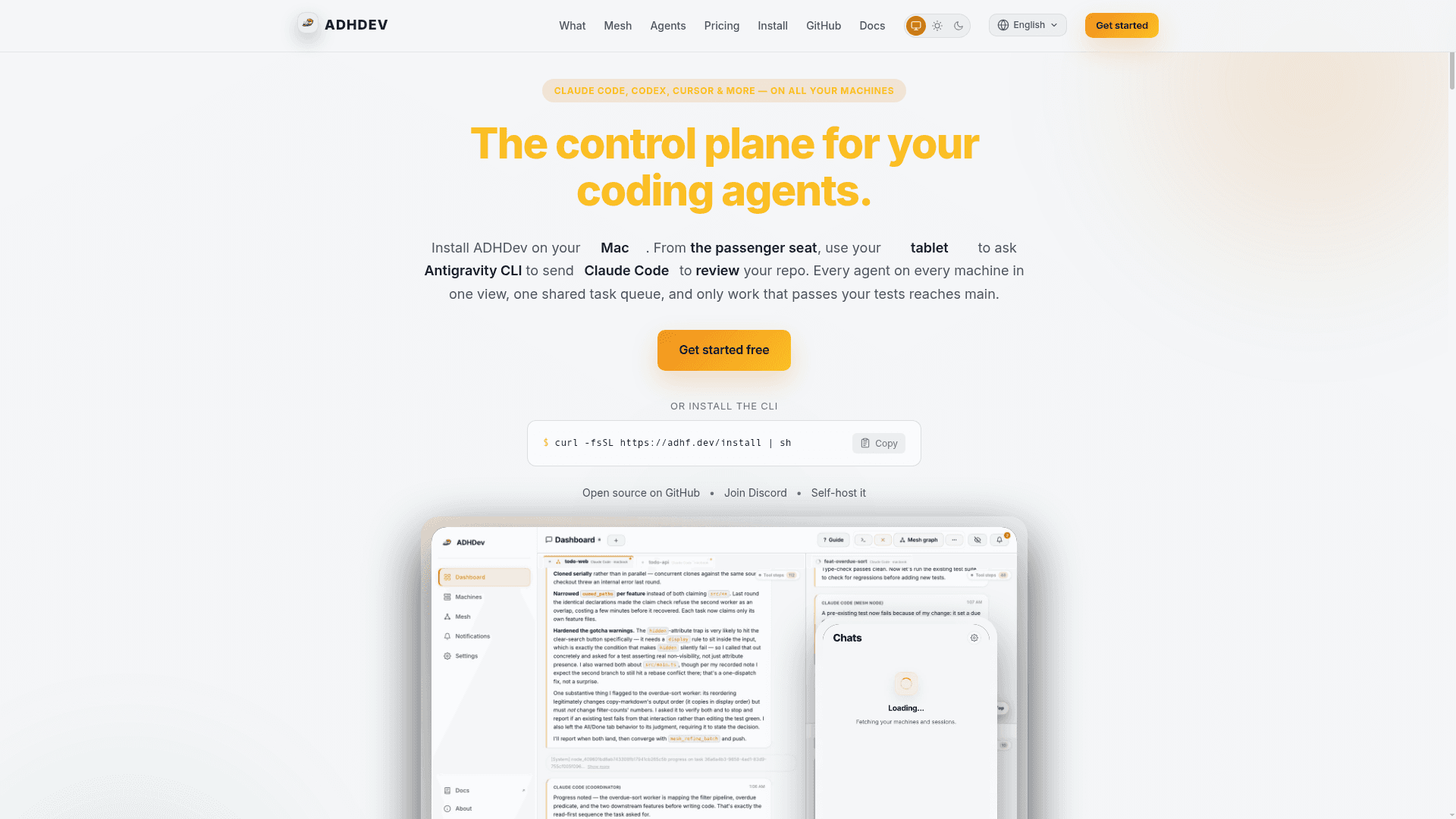
Control plane that launches, monitors and coordinates coding agents across machines from a web or mobile dashboard and merges test-passing work into main.
At a Glance
Start free on one machine; the core is also open source and self-hostable under AGPL-3.0.
Engagement
Available On
Alternatives
Listed Nov 2026
About ADHDev
ADHDev, from RacoLab, is a control plane for AI coding agents such as Claude Code, Codex, Kimi, Cursor CLI, Antigravity CLI, Grok CLI and OpenCode. A local daemon attaches to agents already installed on your machines, and you launch, watch, approve and steer them from a browser or phone dashboard. The engine is open source under AGPL-3.0, with a cloud edition at adhf.dev for reaching machines beyond your own network.
What It Is
ADHDev does not replace or spawn its own agents. A daemon on each machine drives CLI agents through a PTY adapter and attaches to IDEs and IDE extension agents via Chrome DevTools Protocol. Chat, commands and screenshots travel peer-to-peer over WebRTC between the dashboard and the daemon. Each agent keeps its own login, since ADHDev does not manage agent credentials.
Repo Mesh and the Refinery
Repo Mesh binds a mesh to one git repository and runs a pull-based task queue with dependencies, missions, and an append-only ledger. Idle machines claim tasks, each in its own git worktree. A coordinator agent dispatches work and reacts to completion and approval events rather than polling.
The Refinery then runs the repository's own validation gates, checks patch equivalence, and rebases and merges onto main only if main has not moved. It never force-pushes, holds anything ambiguous for human review, and handles git submodules with a reachability gate and atomic pointer bumps.
Routing, Approvals and Review
Tasks can be tagged easy, medium or difficult, and presets choose provider, model and thinking level. The mesh also reads remaining subscription quota and skips plans that are nearly out. Auto-approve presses only the one-time option, and push notifications on the cloud edition let you approve or reject from a phone. For read-only investigations, the coordinator can send the same question to several workers on different providers and compare their answers.
Setup Path
Self-hosted use runs adhdev standalone and opens a local dashboard on port 3847 without an account. The cloud edition installs through a shell or PowerShell script or Homebrew, then pairs machines after sign-in with GitHub or Google. Node.js 22, git, and at least one installed coding agent are required. Custom agents can be added as provider manifests placed in a local providers folder.
Community Discussions
Be the first to start a conversation about ADHDev
Share your experience with ADHDev, ask questions, or help others learn from your insights.
Pricing
Free
Start free on one machine; the core is also open source and self-hostable under AGPL-3.0.
- One machine
- Self-hostable open-source core (AGPL-3.0)
Pro
Cloud plan for two machines.
- Two machines
Ultra
Cloud plan for five machines.
- Five machines
Capabilities
Key Features
- Unified dashboard for CLI and IDE coding agents across machines
- Repo Mesh task queue with dependencies, missions and append-only ledger
- Refinery gated, unattended merging to main with no force-push
- Submodule-aware convergence
- One git worktree per parallel task
- Difficulty-based and quota-aware model routing
- Multi-perspective review across providers
- Push notifications for approvals and completions (cloud edition)
- Image paste, drag and drop upload to terminal agents
- P2P WebRTC transport with TURN fallback
- Narrow auto-approve of one-time permissions
- Custom provider manifests for adding agents
- Playwright MCP browser driving for workers
- Self-hostable standalone daemon and dashboard