
Affordance
Open-source Rust engine that renders TSX apps into the exact token ids a language model reads and runs tool handlers when the model calls them.
At a Glance
Affordance core engine (v0.1 beta) under Apache-2.0, a single Rust binary for Linux and macOS. Third-party chat template files under views/third_party stay under their publishers' terms, some of which are non-commercial or research-only.
Engagement
Available On
Listed Nov 2026
About Affordance
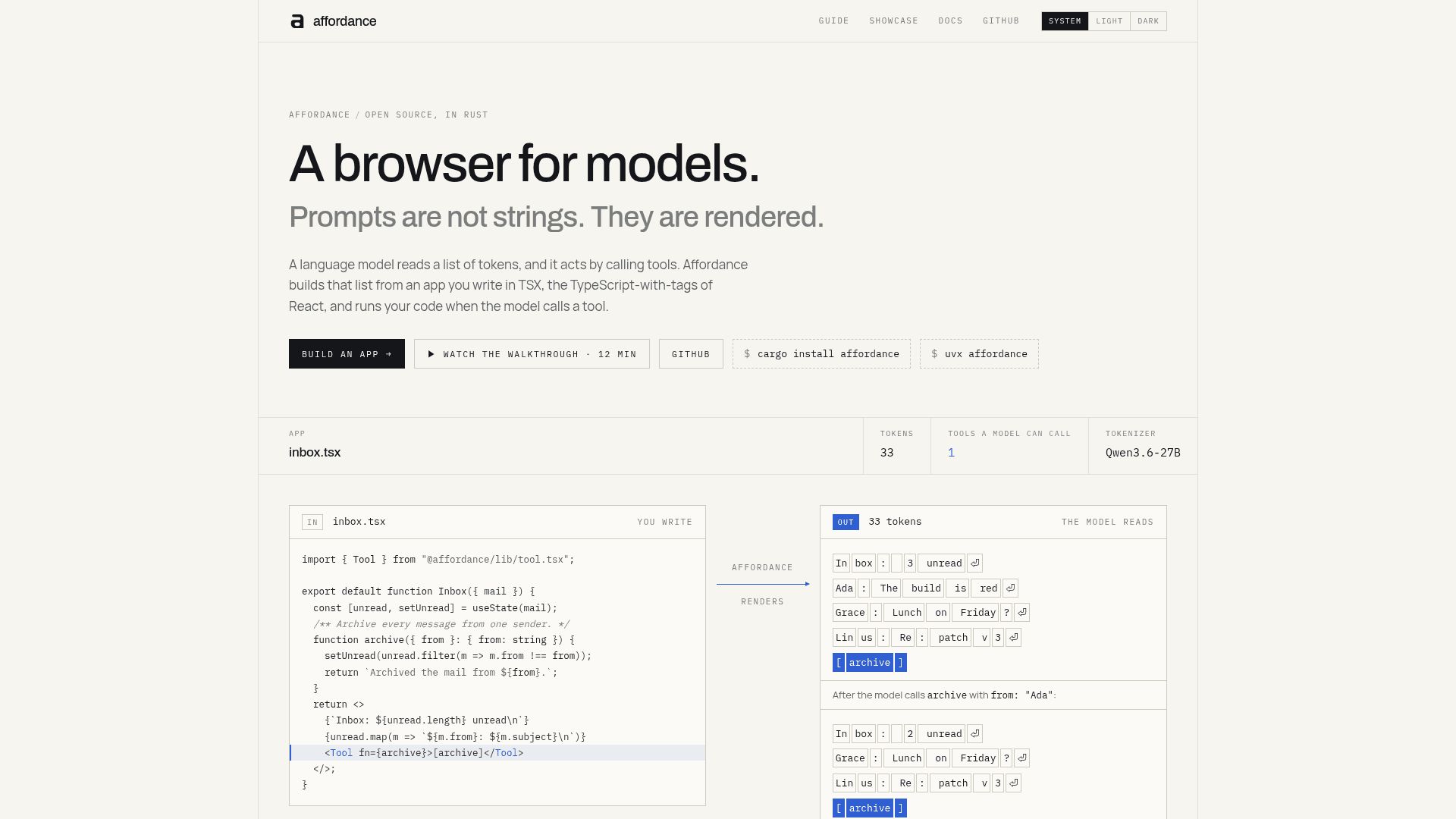
Affordance is an open-source engine from Approximate Labs, written in Rust, that works as a browser for models. An app written in TSX is rendered into the exact token ids a language model reads, and the app's handlers run when the model calls one of its tools. It is currently a v0.1 beta under Apache-2.0 for Linux and macOS.
What It Is
Affordance treats prompts as rendered output rather than strings. A web browser turns HTML into pixels and runs code on clicks; Affordance turns a TSX app into tokens and runs code when the model calls a tool. Apps are functions of state using React-style hooks (useState, useEffect, useRef), written in a documented subset of TypeScript and JSX that is interpreted in Rust, without React, Node or npm.
The project positions it as a replacement for Jinja chat templates and hand-written agent harnesses: the loop, tools, history rules and summarizing become short TSX files plus a token style sheet.
How an App Works
An app's default export takes state as props and returns what the model should read. A <Tool fn={...}> element offers a function to the model, using the function's name, comment and argument type as the tool definition. A tool exists only where it is rendered. After a handler runs and updates state, the app re-renders.
Token style sheets (.tss) set budgets in tokens or context-window percentages, with rules such as max-tokens, overflow clipping and drop-step for dropping old history in steps. ModelContext applies a model's chat format, and useLoop calls the model and runs its chosen tools. The affordance CLI provides run, serve, host, init, render, test, lint and config commands.
Models, Media and Serving
The project says chat formats for 740 models are included and were compared against the official templates and tokenizers; further models can be added with one command. Apps can pass pictures, sound and video to models whose formats support them. Exact tokens require a server that accepts token ids, such as SGLang or vLLM; with chat APIs the server applies its own template. affordance serve can expose an app as an OpenAI-compatible chat completions endpoint. Agent inputs are journaled so runs can be resumed or replayed.
Current Status
The site describes v0.1 as a beta whose app API will change before 1.0. The language is a subset of TypeScript, and only Linux and macOS are supported. The project reports its own benchmarks, including first-token latency in forks of SGLang and vLLM and an RL training run, and notes they come from one machine and one or a few runs each.
Community Discussions
Be the first to start a conversation about Affordance
Share your experience with Affordance, ask questions, or help others learn from your insights.
Pricing
Open Source
Affordance core engine (v0.1 beta) under Apache-2.0, a single Rust binary for Linux and macOS. Third-party chat template files under views/third_party stay under their publishers' terms, some of which are non-commercial or research-only.
- Apache-2.0 licensed core code
- One Rust binary for Linux and macOS
- Install via cargo install affordance or uvx affordance
- Renders TSX apps into exact token IDs
- Deterministic replay via journaled inputs
Capabilities
Key Features
- Renders TSX apps into exact model token ids
- Tools exposed via Tool component with handlers run on model calls
- Token style sheets with token budgets, overflow and drop-step history rules
- Chat formats for 740 models checked against official templates
- Image, audio and video input support
- Deterministic journaling, resume and replay
- Many agents in one process
- Serve any app as an OpenAI-compatible chat completions endpoint
- Runtime loading of TSX modules via loadModule
- Lint, render and test commands
- Cache-reuse diagnostics for prompts