
AGENIUM
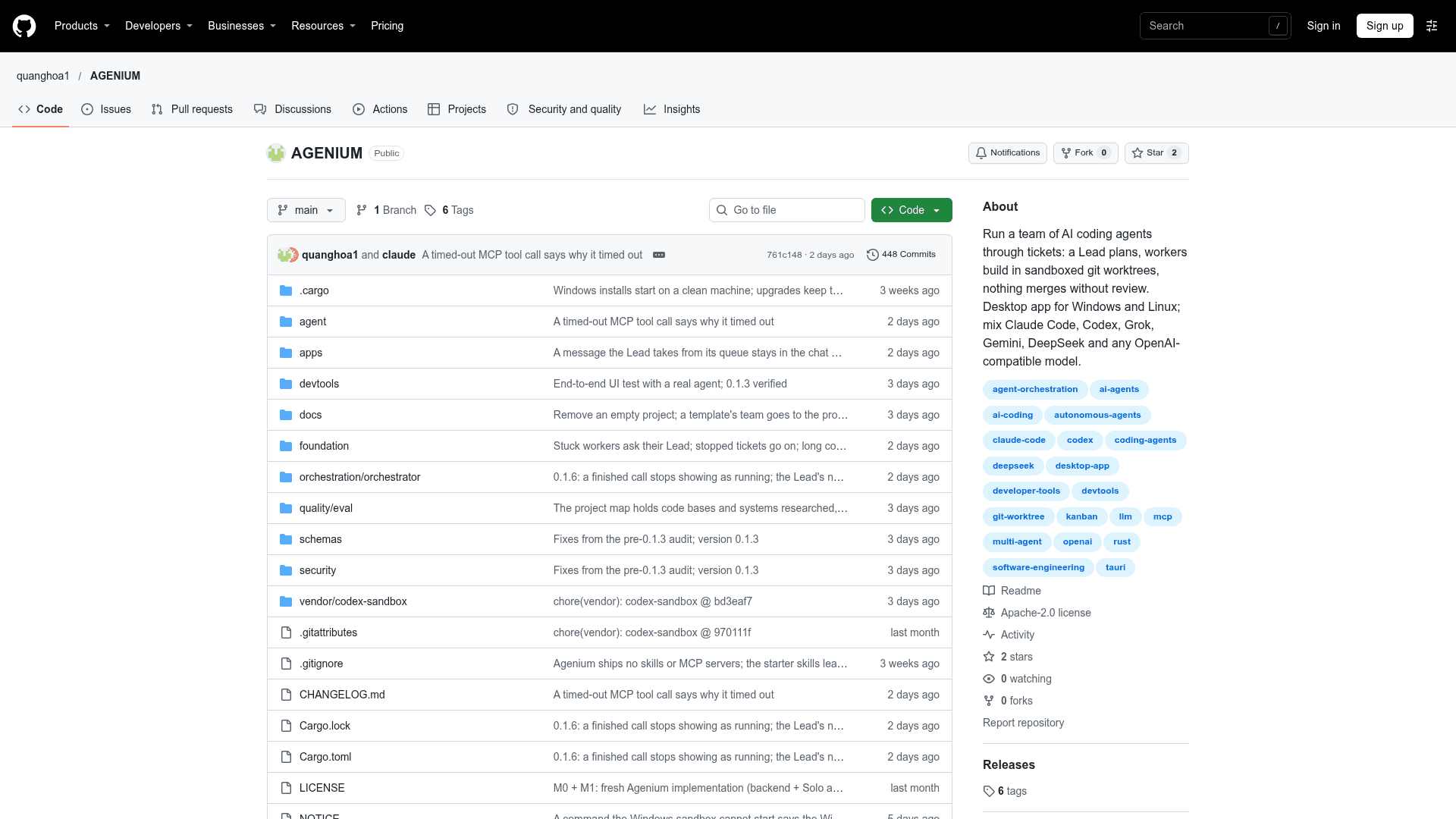
Desktop app and CLI that runs a team of AI coding agents through tickets, with sandboxed git worktrees and review before merge.
At a Glance
Self-hosted desktop app and CLI under the Apache-2.0 license. Users supply their own model/API keys or coding CLIs.
Engagement
Available On
Listed Nov 2026
About AGENIUM
AGENIUM is an open-source, Apache-2.0 licensed ticket-driven multi-agent orchestrator for coding work, published by quanghoa1 on GitHub. A user describes a request to a Lead agent, which writes a spec for approval, plans tickets with acceptance criteria, and assigns each to a suitable agent. The project is at version 0.1.6, described as a release candidate for Windows and Linux.
What It Is
AGENIUM coordinates teams of AI coding agents the way an engineering team uses tickets. Each ticket runs in its own git worktree, and agent commands run in an OS sandbox that can write only to that worktree. Work merges to main only after a review against the ticket's acceptance criteria and passage through a single merge queue. A desktop app and an agenium command line expose the same functionality.
How the workflow runs
The Lead turns a request into a numbered requirements spec, then into tickets with dependencies and required roles. Workers report one result per criterion with evidence, and the Lead reopens tickets that fall short or escalates repeated failures to the user. Agents change state only through typed, validated tool calls, each recorded as an event, so the board and audit trail stay consistent. Actions outside the sandbox, such as network domains or system installs, wait for user approval.
Models, memory and MCP
Teams can mix API models (Anthropic, OpenAI, Google Gemini, DeepSeek, xAI, OpenRouter, Azure OpenAI, Amazon Bedrock, LM Studio/Ollama, any OpenAI-compatible endpoint) with coding CLIs such as Claude Code, Codex, Grok, Gemini (Antigravity), OpenCode and Devin. Each agent keeps facts, lessons and a knowledge graph, and can maintain its own copy of skills written as SKILL.md. MCP servers over stdio, Streamable HTTP and SSE are supported, bound per agent. Secrets are kept in an encrypted vault keyed by the OS keyring.
Current Status and setup
The README lists known limits: Windows process containers are not in current stable Windows 11 releases, so agent commands wait for approval unless sandboxing is disabled; some API vendors are contract-tested but not called with a real key; installers are not code-signed. Git is required. The Windows installer is available from the releases page, and Linux builds from source with Rust 1.89+ and Node.js 20+.
Community Discussions
Be the first to start a conversation about AGENIUM
Share your experience with AGENIUM, ask questions, or help others learn from your insights.
Pricing
Open Source
Self-hosted desktop app and CLI under the Apache-2.0 license. Users supply their own model/API keys or coding CLIs.
- Apache License 2.0 (OSI-approved)
- Desktop app for Windows and Linux
- Mix API models, local models and coding CLIs (Claude Code, Codex, Grok, Gemini, OpenCode, Devin)
- Ticket-driven multi-agent orchestration with sandboxed git worktrees
Capabilities
Key Features
- Lead agent writes approvable requirement specs and ticket plans with acceptance criteria
- Per-ticket git worktrees with OS sandboxing
- Review against acceptance criteria and single merge queue
- Mix API models, local models and vendor coding CLIs in one team
- Desktop app with Kanban board, diffs, live office view and run logs
- Per-agent memory, knowledge graph and SKILL.md skills
- MCP server support over stdio, Streamable HTTP and SSE with OAuth
- Encrypted secrets vault and secret-scanned commits
- Token and cost tracking, pause, cancel, re-run, backups
- Full CLI mirroring the desktop app
- Optional Jev judge to offload small decisions