
agent-manager
A terminal UI to manage multiple AI coding-agent sessions (Claude Code, OpenCode, Codex, Grok Build, Gemini CLI) side by side in tmux with live status, group trees, diff review, and resource gauges.
At a Glance
Fully free and open source under the MIT license. Download and use without restrictions.
Engagement
Available On
Alternatives
Listed Aug 2026
About agent-manager
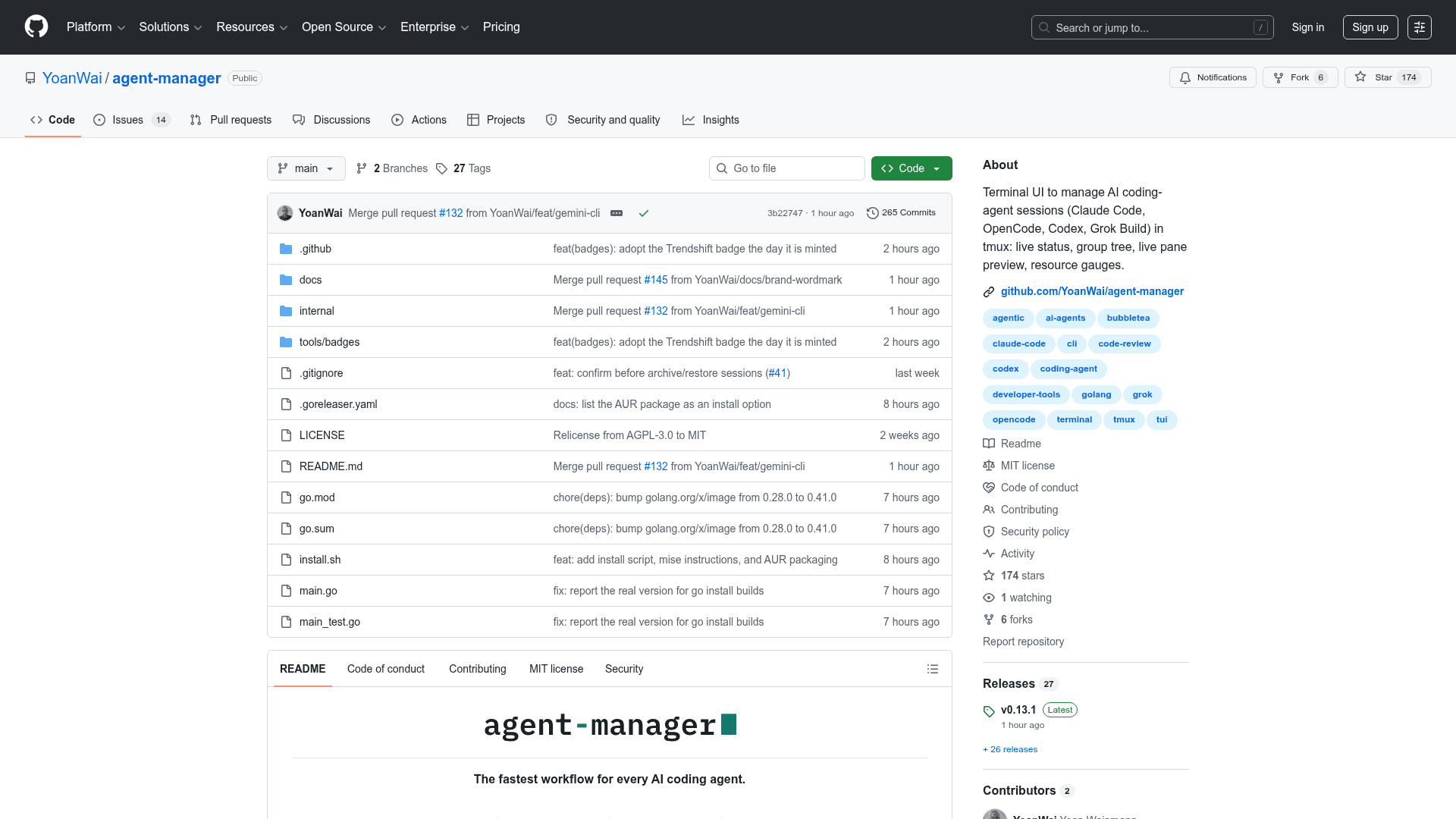
agent-manager is an open-source terminal UI built in Go that lets developers run multiple AI coding agents simultaneously, each in its own tmux session, all visible from a single organized interface. Created by Yoan Wai and released under the MIT license, it reached v0.13.1 as of July 2026 with 174 GitHub stars. The tool is designed to eliminate the friction of juggling terminal tabs when orchestrating several AI agents across a project.
What It Is
agent-manager is a TUI (terminal user interface) session manager for AI coding agents. It wraps tmux to keep agent sessions alive even after the manager itself is closed, and presents every session in a collapsible project tree with live status indicators. Rather than attaching to each agent individually, developers can send prompts, review diffs, and monitor resource usage from one unified view. It supports Claude Code, OpenCode, Codex, Grok Build, and Gemini CLI out of the box, and any other CLI tool can be added via a TOML config block.
How the Workflow Works
The core loop is: spawn agents into named groups, watch their statuses update in real time, answer waiting agents with a quick-prompt bar (space), and review their changes with a full-screen diff viewer (ctrl+r). Key workflow mechanics include:
- Live status polling: Each session's tmux pane is polled every 2 seconds to derive one of six states —
working,waiting,finished,errored,idle, ordead. Claude Code additionally uses hook events for first-hand lifecycle state. - Quick prompt: Press
spaceon a session row to send a message directly into the agent's pane without attaching, or on a group row to spawn a new agent with an embedded prompt. - Diff review:
ctrl+ropens a full-screen whole-file diff with syntax highlighting, line commenting (c), and a singleCkeystroke to send all comments back to the agent as one review prompt. - Session revival:
vrelaunches a dead session and resumes its exact conversation via the tool's resume command (e.g.,claude --resume {id}), preserving name, group, and history. - Self-naming: Agents spawned without a custom name are instructed via their first prompt to run
agent-manager rename "<name>", which the manager picks up on the next poll and updates in the sidebar.
Architecture and Deployment
agent-manager runs entirely on the local machine — there is no cloud component or server. It uses a private tmux server named agentmgr so agent sessions never mix with the user's own tmux. State is persisted in a SQLite database (state.db) next to the config file. The MCP server is embedded in the same binary (agent-manager mcp, stdio), so MCP-capable agents automatically see rename, review_repo, review_base, and review_mode as native tools without per-project setup.
Installation options include Homebrew (macOS/Linux), a curl install script, Arch Linux AUR (agent-manager-bin), mise, go install, and prebuilt binaries for macOS and Linux (amd64/arm64). Windows is supported via WSL2.
Update: v0.13.1
The latest release is v0.13.1, published July 31, 2026. The project has been actively developed since its creation on July 15, 2026, with rapid iteration — the README references earlier versions like v0.11.1 in badge metadata while the GitHub release page shows v0.13.1 as current. The changelog direction includes features like MCP tool registration per agent, agent-declared repo and branch tracking for diff review, nine built-in UI themes with live preview, and system resource gauges (CPU, RAM, swap, disk, network, temperature) in the header. Features noted as not yet implemented include worktree creation, cost tracking, mouse-driven navigation, and inter-agent communication.
Tradeoffs to Know
agent-manager requires tmux 3.1+ and is a Linux/macOS-native tool (Windows requires WSL2). Mouse tracking is intentionally disabled so that click-drag text selection works natively in the terminal. The tool is early-stage (sub-1.0 versioning, 14 open issues as of late July 2026) and several planned features are explicitly listed as not yet available. Custom tools beyond the five built-in agents require manual TOML configuration for status detection rules.
Community Discussions
Be the first to start a conversation about agent-manager
Share your experience with agent-manager, ask questions, or help others learn from your insights.
Pricing
Open Source
Fully free and open source under the MIT license. Download and use without restrictions.
- All features included
- MIT license — free to use, modify, and distribute
- Supports Claude Code, OpenCode, Codex, Grok Build, Gemini CLI
- Live status detection and diff review
- MCP server integration
Capabilities
Key Features
- Manage multiple AI coding agent sessions in a single terminal UI
- Live status detection (working, waiting, finished, errored, idle, dead) per session
- Collapsible project group tree for organizing sessions
- Quick prompt bar to send messages to agents without attaching
- Full-screen diff review with syntax highlighting and line commenting
- Send line comments back to agent as a single review prompt
- Session revival that resumes exact conversation by ID
- Self-naming sessions via agent-manager rename subcommand
- MCP server embedded in binary for MCP-capable agents
- Agent-declared repo and branch tracking for diff review
- Nine built-in UI themes with live preview
- System resource gauges: CPU, RAM, swap, disk, network, temperature
- Per-session and fleet-wide resource usage stats
- Supports Claude Code, OpenCode, Codex, Grok Build, Gemini CLI out of the box
- Custom CLI tool support via TOML config blocks
- Private tmux server namespace to avoid mixing with user's own tmux
- SQLite state persistence
- Automatic update check with badge in header
- Arch Linux AUR package, Homebrew tap, mise, and install script support