
Agent Vault
An open-source HTTP credential proxy and vault that sits between AI agents and the APIs they call, eliminating credential exfiltration risk with brokered access.
At a Glance
Fully open-source under the MIT expat license. Free to use, modify, and distribute.
Engagement
Available On
Listed Apr 2026
About Agent Vault
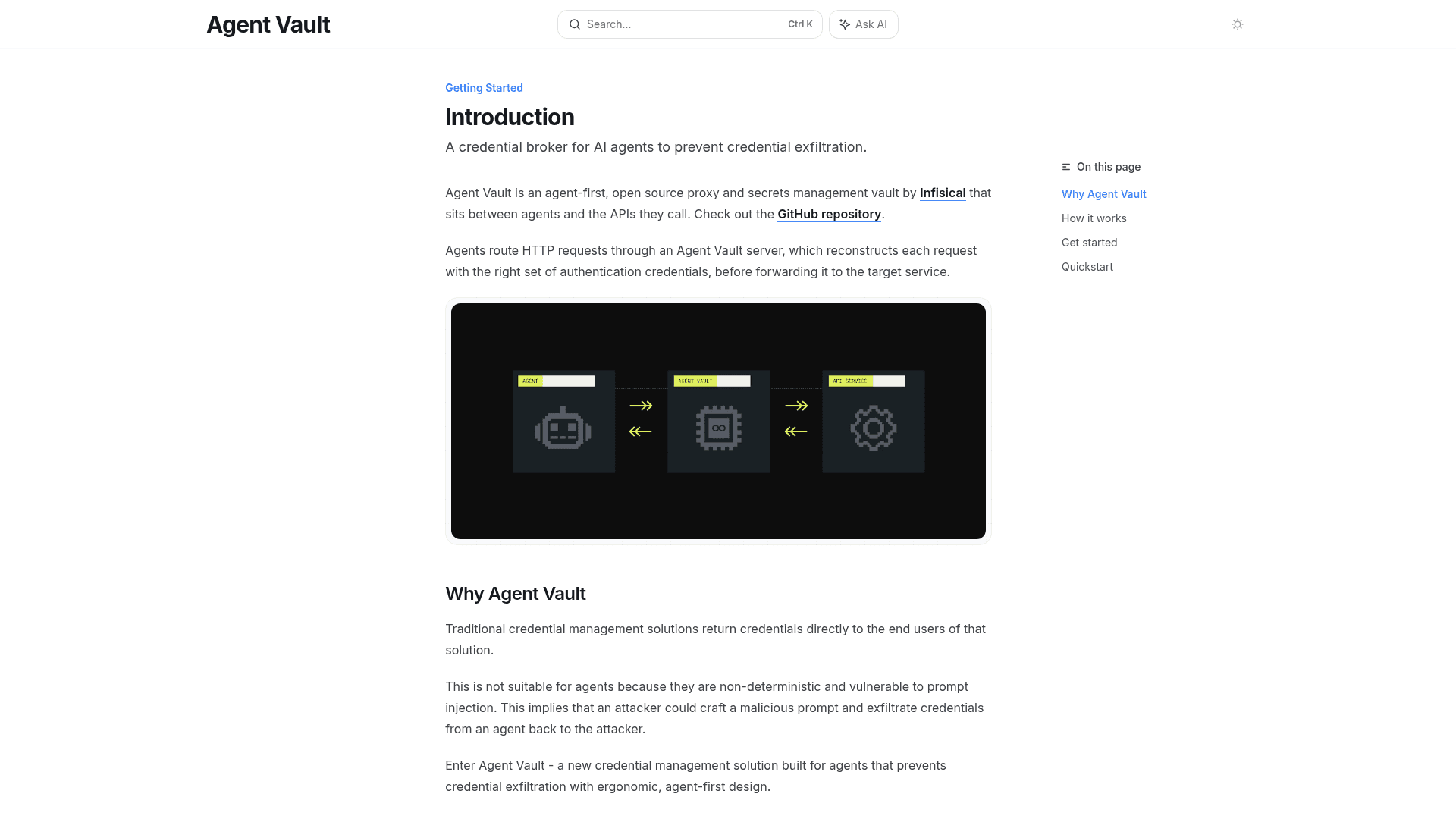
Agent Vault is an open-source credential broker built by Infisical that prevents AI agents from ever possessing or leaking secrets. Instead of returning credentials directly to agents, it routes HTTP requests through a local proxy that injects the right credentials at the network layer — meaning agents call APIs normally without ever seeing the underlying secrets. It supports any HTTP-speaking agent, including Claude Code, Cursor, Codex, and custom Python/TypeScript agents, and can be deployed locally, via Docker, or built from source.
- Brokered access, not retrieval — Agents receive a scoped session and a local
HTTPS_PROXY; credentials are injected at the network layer and never returned to the agent. - Works with any agent — Compatible with custom Python/TypeScript agents, sandboxed processes, and popular coding agents like Claude Code, Cursor, and Codex — anything that speaks HTTP.
- Encrypted at rest — Credentials are encrypted with AES-256-GCM using a random DEK; an optional master password wraps the DEK via Argon2id for secure rotation without re-encryption.
- Container sandbox mode — Launch agents in a Docker container with egress locked down by iptables so the child process physically cannot reach anything except the Agent Vault proxy.
- Request logs — Every proxied request is persisted per vault with method, host, path, status, latency, and credential key names; bodies and headers are never recorded.
- TypeScript SDK — Install
@infisical/agent-vault-sdkto mint sessions and pass proxy config into sandboxed environments like Docker, Daytona, or E2B. - CLI integration — Use
agent-vault run -- claude(or any agent command) to wrap a local agent process with a scoped session and automatic CA-trust env vars. - Web UI — A built-in web interface is available at
http://localhost:14321for managing vaults and viewing request logs. - Self-hostable — Deploy via install script (macOS/Linux), Docker image, or build from source using Go 1.25+ and Node.js 22+.
- Open-source core — Available under the MIT expat license; enterprise features in the
eedirectory require an Infisical license.
Community Discussions
Be the first to start a conversation about Agent Vault
Share your experience with Agent Vault, ask questions, or help others learn from your insights.
Pricing
Open Source
Fully open-source under the MIT expat license. Free to use, modify, and distribute.
- HTTP credential proxy
- Brokered credential access
- AES-256-GCM encryption at rest
- Container sandbox mode
- Request logging per vault
Capabilities
Key Features
- HTTP credential proxy
- Brokered credential access (never reveals secrets to agents)
- AES-256-GCM encryption at rest
- Argon2id master password key wrapping
- Container sandbox mode with iptables egress lockdown
- Per-vault request logging (method, host, path, status, latency)
- Scoped session management
- Transparent HTTPS proxy on port 14322
- Web UI on port 14321
- CLI agent wrapping via `agent-vault run`
- TypeScript SDK for orchestrator integration
- Passwordless mode for PaaS deploys
- Configurable log retention per vault
- Docker support
- macOS and Linux install script