
AgentEnv Framework
Open-source framework from Scale AI for building RL environments and for running and grading agents in them.
At a Glance
AgentEnv Framework is open source under the Apache-2.0 license; install via uv tool.
Engagement
Available On
Listed Oct 2026
About AgentEnv Framework
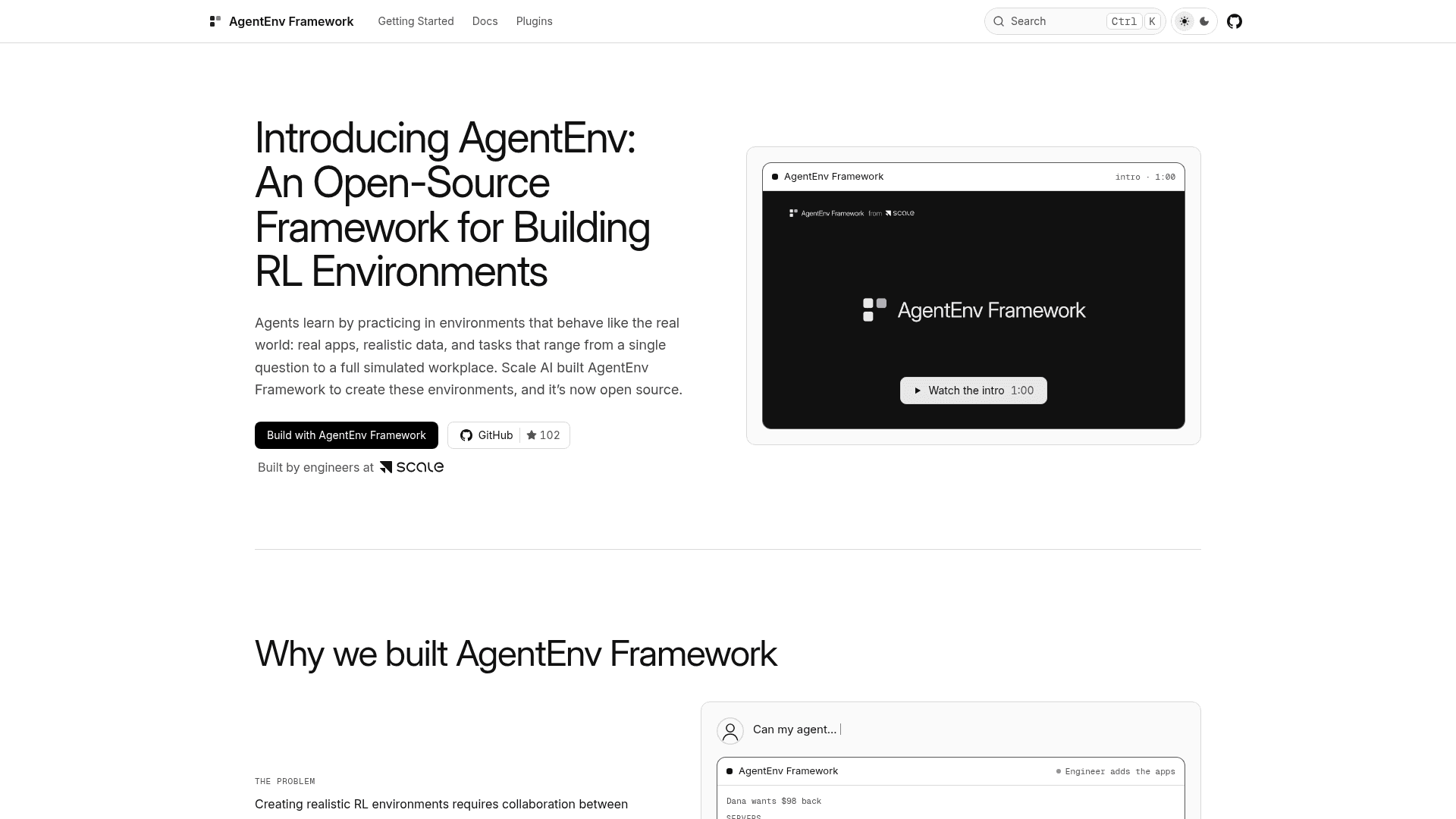
AgentEnv Framework is Scale AI's open-source framework for building reinforcement learning environments, and for running and grading agents inside them. It is released under the Apache-2.0 license, is driven by the agent-env CLI, and runs locally by default without needing a cloud account.
What It Is
AgentEnv Framework builds environments around a simulated world rather than around a single task. One Environment can host many Tasks and many different agents. The framework keeps apps, data, composed environments, tasks, agents and verifiers as separate, versioned primitives. Different contributors such as engineers, operators, researchers and domain experts can work on their own pieces independently, and each task pins its versions so a rerun reproduces the original.
How Environments and Tasks Work
An environment is usually an MCP server plus the state its tools change. Environments expose tools over MCP, REST and a generated CLI, and agents connect through A2A. Individual apps such as Slack or email can be composed into larger environments, from a support desk to a whole workplace.
Tasks are DAGs of steps that deploy environments and agents, prompt the agents and grade their work. The homepage says 49 built-in step types ship with the framework, including deploying an environment and grading a trajectory, so most tasks need no code.
Rules of the World
- Virtual Clock: controls time in the environment and can run up to one virtual day per second.
- Triggers: rules that fire on time, on agent actions, on world state, or on a simulated person, and can reveal or hide data, grant or remove tool access, or have a simulated person respond.
- RBAC: gives each role its own tool set; tools outside a role are not listed and calls to them are refused.
Agents, Sandboxes and Infrastructure
The same environment and task run against any agent that speaks A2A, including wrapped harnesses such as Claude Code. Sandboxes are pluggable, with support for local Docker, Modal containers, and Modal or E2B virtual machines, and custom ones can be registered by name. A registry stores environments, tasks, data and agents, and connects to your infrastructure through a single config file. AWS and Google Cloud are supported from day one.
Plugins and Setup
Plugins add custom environment types, task steps and stores. The homepage points to community plugins such as an OpenCiv3 environment and an iOS mobile environment. Installation requires Python 3.11+ and works with uv, uvx or pip (agent-env run hello runs a first task).
Community Discussions
Be the first to start a conversation about AgentEnv Framework
Share your experience with AgentEnv Framework, ask questions, or help others learn from your insights.
Pricing
Open Source
AgentEnv Framework is open source under the Apache-2.0 license; install via uv tool.
- Apache-2.0 licensed framework
- Install with: uv tool install agentenv-framework
- Pluggable sandboxes: local Docker, Modal containers, Modal or E2B virtual machines
- Image stores: local registry, OCI registry, Amazon ECR, Artifact Registry
Capabilities
Key Features
- Environment-first design: one Environment hosts many Tasks and agents
- Versioned primitives for apps, data, environments, tasks, agents and verifiers
- Composable environments built from shared apps
- Virtual Clock for controlling time in a run
- Triggers for time, action, state and agent-driven events
- Role-based access control for environment tools
- Tasks as DAGs with 49 built-in step types
- Rubric and end-state verifiers for grading agents
- Tools exposed over MCP, REST and a generated CLI
- Pluggable sandboxes: local Docker, Modal, Modal VM, E2B
- Registry for environments, tasks, data and agents
- Plugin system for custom env types, steps and stores