
AgentForge
A low-code, open-source Python framework for rapid development, testing, and iteration of AI-powered autonomous agents and multi-agent cognitive architectures.
At a Glance
About AgentForge
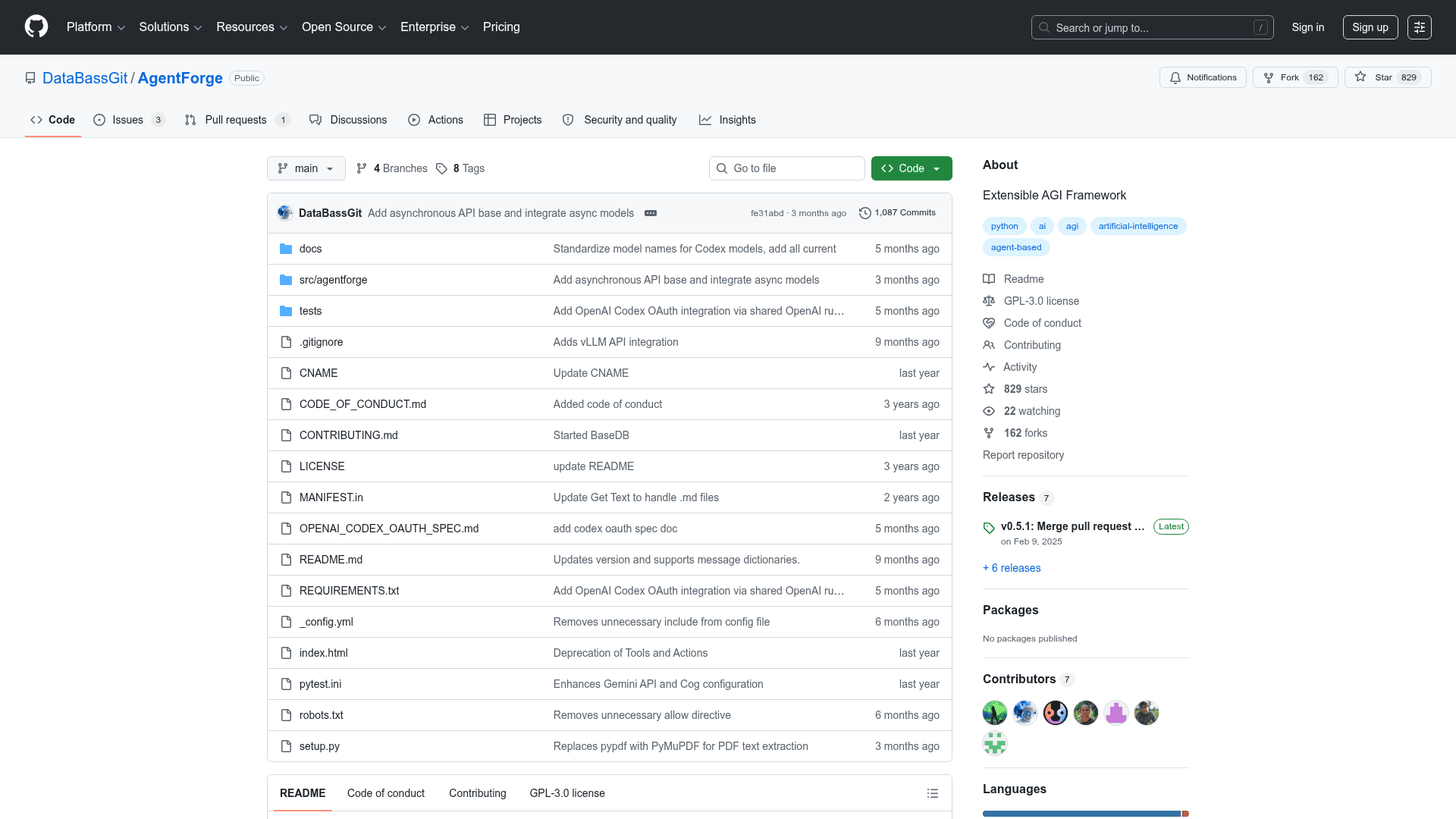
AgentForge is a low-code Python framework for building, testing, and iterating on AI-powered autonomous agents and cognitive architectures. Released under the GNU General Public License v3.0, it is fully open-source and available on GitHub. The project is maintained by DataBassGit and supports a wide range of LLM providers, making it model-agnostic by design.
What It Is
AgentForge sits in the agent framework category, providing the scaffolding developers need to compose individual AI agents into larger, coordinated multi-agent systems. Its three core abstractions—Agents, Cogs, and Memory—cover the full lifecycle from single-task agents to sophisticated branching workflows. The framework is written in Python 3.12 and distributed via PyPI as the agentforge package.
Core Architecture: Agents, Cogs, and Memory
The framework's design centers on three composable primitives:
- Agents: Individual AI units defined through YAML prompt templates and configuration files. Agents can be customized with personas that encapsulate identity, style, and reusable knowledge.
- Cogs: Declarative YAML files that orchestrate multi-agent workflows, branching logic, and memory. The README describes Cogs as "the primary way to compose agents into complex, reusable workflows."
- Memory: Contextual memory nodes declared within Cogs and made automatically available to agents, enabling coherent, context-aware interactions across a session. AgentForge uses ChromaDB as its vector store implementation for memory.
LLM Agnosticism and Model Flexibility
AgentForge connects to a broad set of LLM backends out of the box:
- Cloud APIs: OpenAI, Google Gemini, and Anthropic Claude
- Local models: Ollama and LMStudio for on-device inference
Different agents within the same system can run on different models, giving developers fine-grained control over cost, latency, and capability trade-offs per task.
Developer Experience and Workflow
The framework emphasizes rapid iteration. Prompt templates are dynamic and adapt to context and memory state. Notably, AgentForge supports on-the-fly prompt editing—prompts can be modified in real time without restarting the running system, which shortens the feedback loop during development and experimentation. All agent and cog configuration lives in YAML files, keeping the Python code minimal and the system behavior transparent and version-controllable.
Update: v0.5.1 and MCP Transition
The latest published release is v0.5.1, released on February 9, 2025. The repository remains actively maintained, with the last push recorded in June 2026. A notable architectural direction signal in the current README: the existing Tools & Actions subsystem is explicitly marked as deprecated and will be replaced in a future version by a new system built on the MCP (Model Context Protocol) standard. This positions AgentForge to align with the emerging MCP ecosystem for tool and action integration.
Open-Source Deployment Model
AgentForge is free to use, modify, and distribute under GPL-3.0. It is installed via pip install agentforge and runs locally. The project welcomes community contributions through GitHub issues and pull requests, and maintains a Discord server for community support. The maintainers have also put out an open call for a volunteer UI/UX collaborator to help develop a front-end, signaling that the current project is backend-focused with no bundled GUI.
Community Discussions
Be the first to start a conversation about AgentForge
Share your experience with AgentForge, ask questions, or help others learn from your insights.
Pricing
Open Source
Fully free and open-source under GPL-3.0. Install via pip and self-host locally.
- Full framework source code under GPL-3.0
- Declarative Cogs for multi-agent orchestration
- Customizable Agents with YAML templates
- Integrated ChromaDB memory
- Support for OpenAI, Gemini, Claude, Ollama, LMStudio
Capabilities
Key Features
- Declarative Cogs for multi-agent workflow orchestration via YAML
- Customizable Agents defined with YAML prompt templates
- Integrated contextual memory using ChromaDB vector store
- Persona configuration for agent identity and style
- Dynamic prompt templates adapting to context and memory
- LLM-agnostic: supports OpenAI, Google Gemini, Anthropic Claude, Ollama, LMStudio
- On-the-fly prompt editing without system restart
- Multi-agent branching logic and workflow composition
- Open-source under GPL-3.0