
The Agentic Scientist (AI-Scientist-v3)
Open-source pipeline that orchestrates coding agents to turn a task description into experiments, ablations, and a written paper.
At a Glance
Self-hosted core under the Apache License 2.0. Users supply their own API keys and compute (external costs).
Engagement
Available On
Alternatives
Listed Nov 2026
About The Agentic Scientist (AI-Scientist-v3)
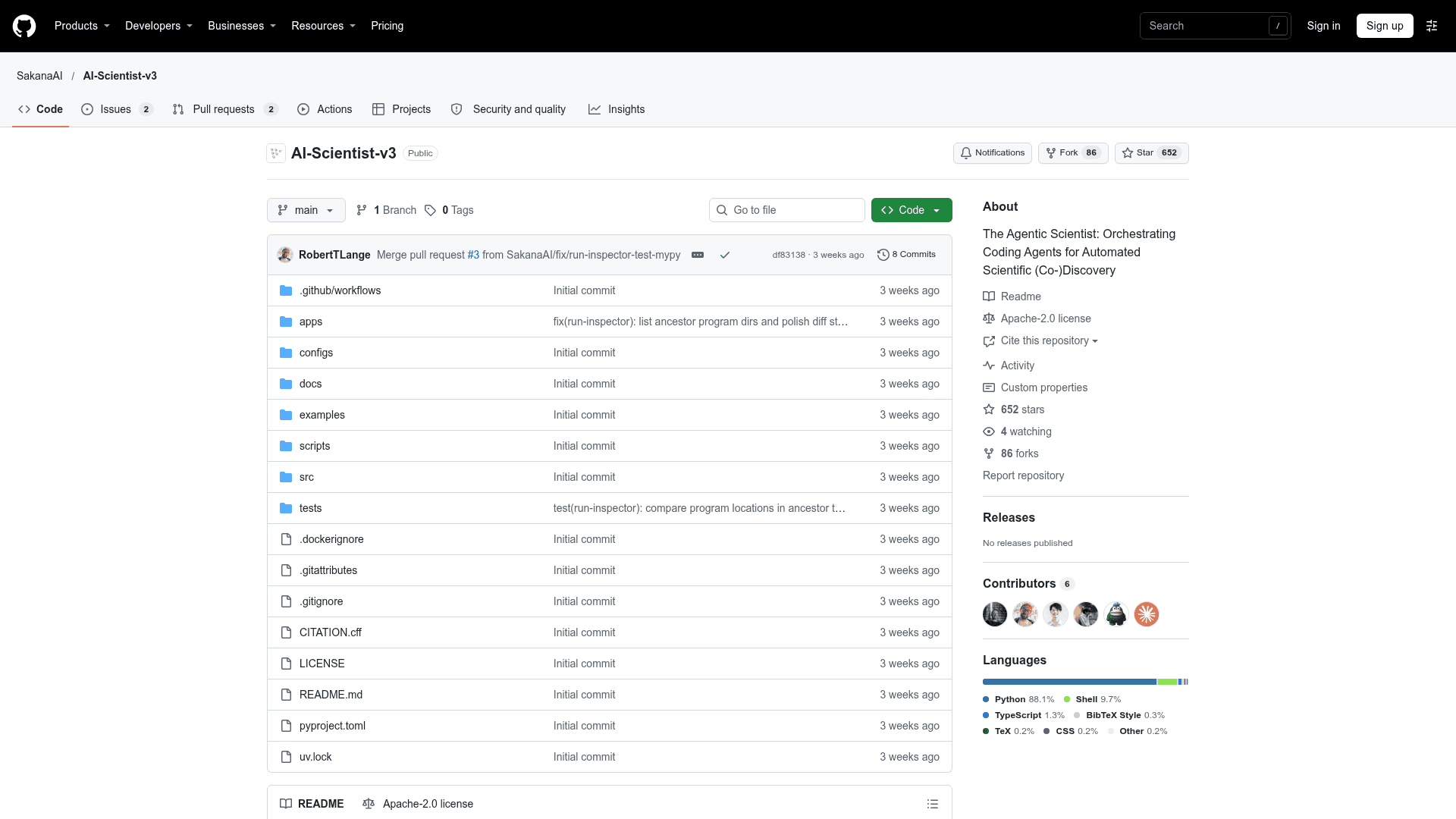
The Agentic Scientist, from Sakana AI, is an open-source pipeline that treats coding agents as AI scientists. Starting from a task.md, agents propose ideas, run experiments, evaluate results against a task rubric, and iterate, then the pipeline runs baselines, ablations, a sealed final evaluation, post-hoc analyses, and writes the paper.
What It Is
Agentic Scientist is a command-line orchestration framework (agsci) for automated scientific discovery. It drives coding agent CLIs such as claude, codex, cursor, opencode, gemini, and pi through Headless CLI, so the same experiment can be repeated across different agents and models. Every agent phase runs inside Docker by default.
How the Pipeline Works
Six phases run in sequence: task drafting, investigation, ablations, final evaluation, post-hoc analysis, and paper writing, with optional review and revision phases afterwards. Investigation is the idea, experiment, evaluate loop. Ablations compare the winning program against baselines and ablated variants, and the final evaluation re-scores it in a sealed environment. Each phase reads only a run-local snapshot of the task, so the shipped examples/ are never modified.
Outputs and Inspection
Each run writes a single directory under results/<task>/<agent>/<run_id>/ containing drafting logs, the task snapshot, investigation records, ablations, final evaluation, post-hoc analyses, and the paper (manuscript, PDF, manifest, and optional AI reviews). Runs can be browsed in a local web UI with agsci inspect start. An OpenAI-backed reviewer can also be run on any PDF with agsci review.
Setup Path and Safety
Setup involves building the Docker agent image, installing the Python environment with uv, and supplying agent API keys in a .env file. agsci doctor checks the host and --dry-run previews commands. The CPU-only circle-packing example is the recommended first run; a GRPO example requires GPUs. The README warns that agents run with full tool permissions and may inherit API keys, so runs should stay inside Docker and only trusted tasks should be used. Drafting a task from a bare research brief is described as experimental.
Community Discussions
Be the first to start a conversation about The Agentic Scientist (AI-Scientist-v3)
Share your experience with The Agentic Scientist (AI-Scientist-v3), ask questions, or help others learn from your insights.
Pricing
Open Source (Apache 2.0)
Self-hosted core under the Apache License 2.0. Users supply their own API keys and compute (external costs).
- Apache License 2.0
- Runs agent phases in Docker via agsci CLI
- Supports claude, codex, cursor, opencode, gemini, and pi agents via Headless CLI
- Requires your own API keys (BYOK) such as ANTHROPIC_API_KEY, OPENAI_API_KEY, GEMINI_API_KEY
- GPUs required only by GPU task presets
Capabilities
Key Features
- Six-phase pipeline: task drafting, investigation, ablations, final evaluation, post-hoc analysis, paper
- Works with claude, codex, cursor, opencode, gemini, and pi agents via Headless CLI
- Docker-contained agent execution
- Sealed final evaluation and reproducible run-local task snapshots
- Baselines and ablation studies
- Automated paper writing and compilation with optional AI review
- Resume runs or run selected phases
- Run Inspector web UI
- Hydra key=value configuration and task presets
- GPU task presets
- Optional Autoillustrate concept figures