
agentproto
Open numbered standards (AIPs) for the markdown files AI agents read, write, and run from, plus a reference TypeScript runtime any agent framework can consume.
At a Glance
About agentproto
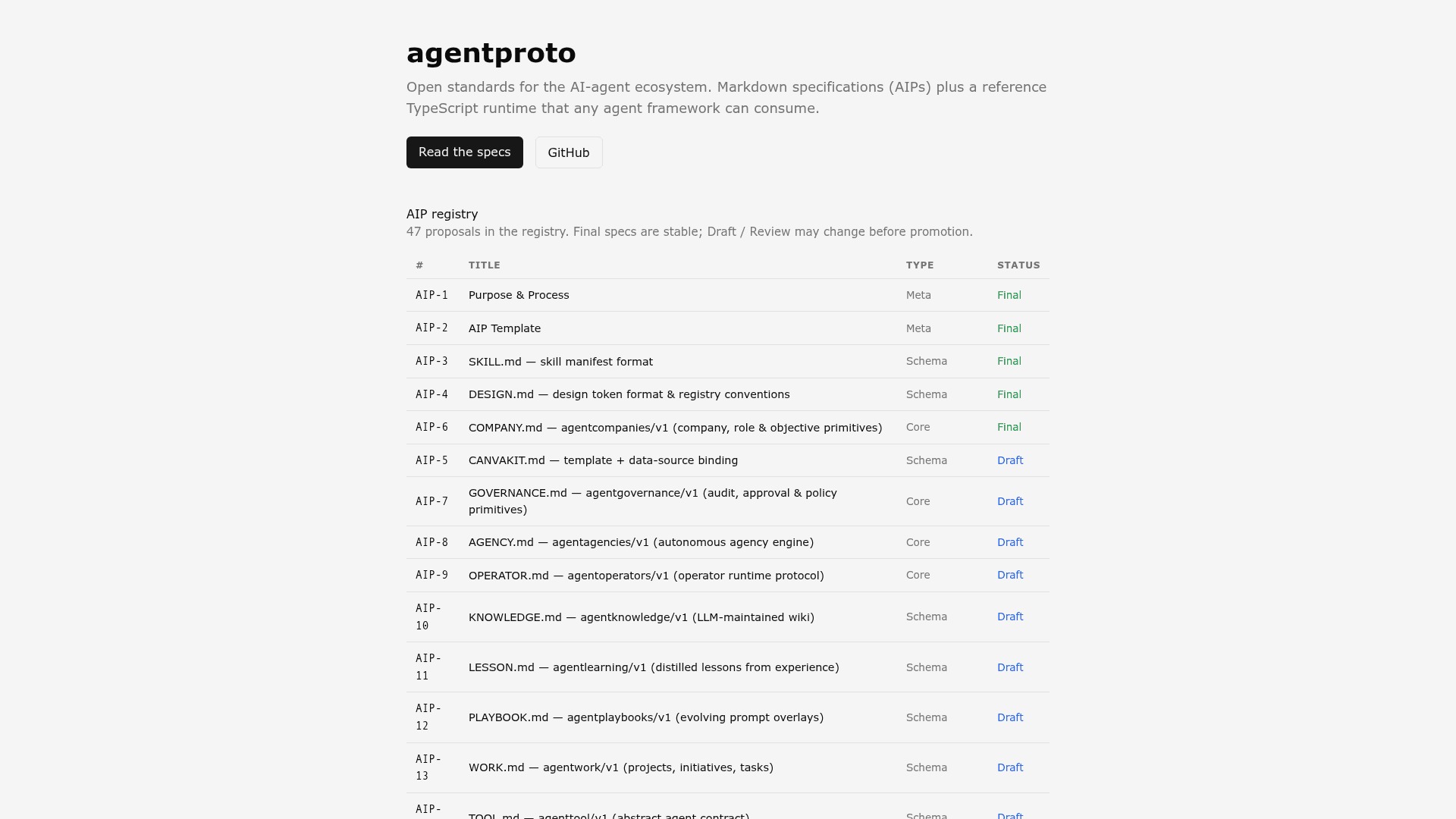
agentproto publishes open, numbered specifications — called AIPs (Agentproto Improvement Proposals) — for the markdown files that AI agents read, write, and operate from. The project is hosted on GitHub under CC-BY-4.0 for specs and MIT for code, and currently sits at version 0.1.0-alpha with 47 proposals in the registry.
What It Is
agentproto is a community standards registry for the AI-agent ecosystem, modeled after ERC (Ethereum), BIP (Bitcoin), and PEP (Python) improvement proposal processes. Each AIP is a numbered markdown specification that defines a single primitive — a skill manifest, a tool contract, a governance policy, an operator profile — so that any agent runtime can consume the same file without rewriting it. The project's README frames the motivation as: every serious agent system is converging on a folder of markdown files the agent reads, writes, and runs from, but without a shared vocabulary there is zero interoperability — "Is it skill.title or skill.name? Does AGENTS.md mean Codex's flavour, Cursor's flavour, or yours?"
The AIP Registry Structure
The 47 proposals in the registry are organized into 8 semantic layers, each answering a distinct question about agents:
- Process — how the standard itself evolves (AIP-1, AIP-2)
- Primitives — shared building blocks like IO, RUNNER, COLLECTION, SECRETS, REF
- Identity — who acts: OPERATOR, IDENTITY, PERSONA
- Memory — what the agent remembers: KNOWLEDGE, LESSON, PLAYBOOK
- Work, Org & Governance — COMPANY, GOVERNANCE, AGENCY, WORK, OFFICE, ASSEMBLY
- Capabilities — SKILL, TOOL, WORKFLOW, INTENT
- Drivers — how capabilities are implemented: DRIVER, CLI, HTTP, MCP, SDK
- Surfaces — what the agent produces or reads: DESIGN, CANVAKIT, CODE
Final-status specs are considered stable; Draft and Review specs may change before promotion.
Why Markdown, Not YAML or JSON
The README explains the design choice directly: agents read the file every turn, so prose in a SKILL.md can carry behavioral semantics — "if the document isn't an invoice, return { error: 'not_an_invoice' } — don't hallucinate fields" — and the model acts on that instruction each run. YAML frontmatter holds the typed fields machines need; the prose body holds the behavioral contract the model reads. The same intent in JSON is described as "dead data"; in a compiled function it is "locked into a release."
Relationship to MCP and A2A
The project's FAQ explicitly positions AIPs as complementary to, not competing with, existing protocols. MCP solves tool transport; AIPs specify the layer above transport and below frameworks — where context lives, roles are defined, and memory is structured. A TOOL.md contract (AIP-14) can be served over MCP, HTTP, CLI, or in-process via the DRIVER layer (AIP-30 through AIP-33). A2A solves agent-to-agent communication; AIPs address how a single agent's components are structured on disk.
Self-Modifying Agents and the Runtime
The reference TypeScript runtime lives in the separate agentproto/ts repository and exposes packages including @agentproto/tool, @agentproto/driver, @agentproto/agencies, @agentproto/governance, and @agentproto/ref, with framework adapters for Mastra and ai-sdk. Because every component — memory, runtime, governance, work backlog — is a file with a declared contract, the README argues that self-modification "stops being a research problem and becomes a write_file call": an agent can add a new tool by writing a TOOL.md and DRIVER.md to disk, swap an OpenAI call for a Replicate one by adding a second DRIVER and updating policy, or deploy itself by running its own CLI driver against its own files.
Current Status: 0.1.0-alpha
The GitHub repository was created in April 2026 and last pushed in May 2026. The project self-describes as "0.1.0-alpha" with specs stabilizing and minor breaking changes expected between alpha releases. The registry currently holds 47 AIPs, with AIP-1 through AIP-6 at Final status and AIP-7 onward at Draft or Review.
Community Discussions
Be the first to start a conversation about agentproto
Share your experience with agentproto, ask questions, or help others learn from your insights.
Pricing
Open Source
All AIP specifications and reference TypeScript runtime are freely available under CC-BY-4.0 (specs) and MIT (code) licenses.
- 47 AIP markdown specifications
- Reference TypeScript runtime packages
- Framework adapters for Mastra and ai-sdk
- Full contribution access via GitHub PRs
- LLM-friendly /llms.txt and /llms-full.txt endpoints
Capabilities
Key Features
- 47 numbered AIP specifications organized into 8 semantic layers
- Markdown-based specs with YAML frontmatter for typed fields and prose for behavioral semantics
- Final, Draft, and Review status tiers for spec stability
- Reference TypeScript runtime with packages for tool, driver, agencies, governance, and ref
- Framework adapters for Mastra and ai-sdk
- MCP driver specialization (AIP-32) alongside HTTP, CLI, and SDK drivers
- Governance primitives: audit, approval, and policy as files (AIP-7)
- Memory primitives: KNOWLEDGE, LESSON, PLAYBOOK (AIP-10, 11, 12)
- Multi-agent collective workspace with council, voting, peer, and hierarchy modes (AIP-24)
- LLM-friendly /llms.txt and /llms-full.txt endpoints
- CC-BY-4.0 specs license with MIT code license
- Contribution workflow via GitHub PRs using AIP-2 template