
AgentRun
Open-source platform adding self-improvement, durable execution, and a control plane on top of agent harnesses like Claude Code, Codex, OpenCode, and Pi.
At a Glance
About AgentRun
AgentRun is an open-source platform from Parcha Labs, the team behind Grep AI, that wraps an agent harness with run management, recovery, and learning. It works with Claude Code, Codex, OpenCode, and Pi, and is released under Apache-2.0. It can be self-hosted with your own model keys or used through the hosted AgentRun Cloud.
What It Is
AgentRun is an agent platform that sits around the harness you choose. The harness handles reasoning and tool use, while AgentRun stores every agent, revision, run, and step, enforces approvals and spend caps, gives agents a computer to work on, and provides a console and API for managing runs. It starts locally with npx @parcha/agentrun, which launches a server, a runner, and a browser console.
How Learning Works
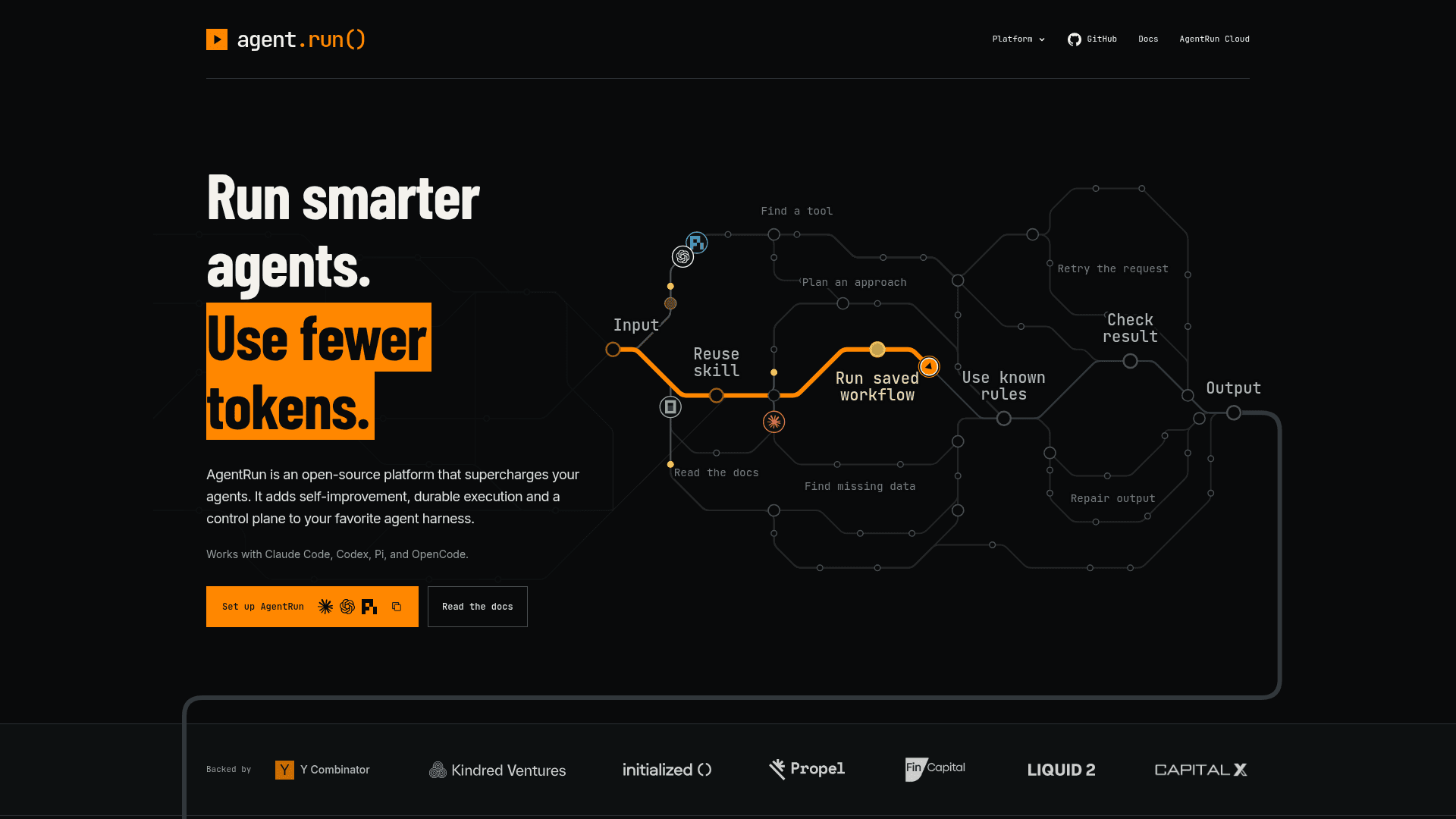
When learning is enabled for an agent, the agent proposes notes, skills, or workflows at the end of a run. AgentRun runs structural checks and an AI grader on each proposal and commits accepted ones to the agent's own git folder, so later runs start from them. Risky changes wait for owner approval. The vendor says this reduces repeated planning and tool discovery, and notes that savings depend on how much work repeats. Learning updates saved knowledge and procedures, not model weights.
Durable Execution and Compute
Runs are recorded in one store (SQLite by default, or Postgres), so a stopped server can resume an unfinished run. Finished steps are not rerun, and a write interrupted mid-call is marked interrupted rather than retried. Agents can be given a computer: a sandbox (Docker, Daytona, Modal, E2B), a Linux desktop, an Android phone, or a browser (Browserbase, Kernel). Per-run spend caps pause a run instead of failing it.
Workflows, Triggers, and Console
Repeatable work can be written as typed JSON workflows combining tool calls, model steps, typed decisions, branching, parallel maps, and agent fallback. Schedules, signed webhooks, and GitHub pull request events can start runs. Five templates are included: code-review, kyb, market-monitor, inbound-lead, and release-notes. The console's Mission Control shows what needs attention, what failed, what is running, and cost, with a per-run timeline and files.
Setup Path
The README requires macOS or Linux with a recent Node.js version. After starting the server, you set a password, add a model key under Settings, and start a run from a template or a new agent. TypeScript (@parcha/agentrun-client) and Python (parcha-agentrun) clients and a CLI are available, and Docker Compose and Render deployments are documented.
Community Discussions
Be the first to start a conversation about AgentRun
Share your experience with AgentRun, ask questions, or help others learn from your insights.
Pricing
Self-hosted
Open-source AgentRun platform under Apache-2.0, self-hosted with your own model API keys. Model and infrastructure costs are yours.
- Free under Apache-2.0
- Learning, recovery, and the console included
- Bring your own model API keys
- Self-host locally or on your own server
Contact sales
Hosted AgentRun deployment from the Grep team; pricing not published.
- Hosted AgentRun deployment
- No server to maintain
- Start in the Cloud console
Capabilities
Key Features
- Self-learning agents that propose notes, skills, and workflows
- Graded and validated learned changes with owner approval for risky ones
- Durable execution with run recovery from a persistent store
- Choice of harness: Claude Code, Codex, OpenCode, Pi
- Computers for agents: sandbox, desktop, phone, browser
- Typed workflow language with agent fallback
- Per-tool approvals and per-run spend caps
- Triggers: schedules, signed webhooks, GitHub pull request events
- Ready-made agent templates with eval cases
- Web console with Mission Control, run timelines, and files
- MCP server connections
- TypeScript and Python clients and a CLI
- Self-hosting via npx, Docker Compose, or Render