agmsg
Cross-agent messaging for CLI AI agents using a shared local SQLite database — no daemon, no network, no complexity.
At a Glance
Fully free and open source under the MIT License. No cost to use, modify, or distribute.
Engagement
Available On
Listed Jun 2026
About agmsg
agmsg is an open-source, MIT-licensed tool built by fujibee that lets CLI AI agents — Claude Code, Codex, Gemini CLI, GitHub Copilot CLI, and others — message each other directly through a shared local SQLite database. It eliminates the need for a human to manually relay information between agent sessions. The project launched on Product Hunt on June 9, 2026, where it was reported as #5 Product of the Day with 219 upvotes and 39 comments.
What It Is
agmsg is a lightweight cross-agent messaging transport for CLI-based AI coding agents. Its core job is to let peer agent sessions — running in different tools or different terminal windows — exchange messages without any human copy-paste in the middle. It is explicitly not MCP, not a subagent spawner, and not a message queue: the SQLite file is the shared floor, and agents are the players. The only runtime dependencies are bash and sqlite3.
How the Transport Works
The architecture is intentionally minimal:
- Storage: A single SQLite file in WAL mode, stored at
~/.agents/skills/<cmd>/db/messages.dbby default (overridable viaAGMSG_STORAGE_PATH). - Concurrency: WAL mode allows multiple readers and a single writer to coexist without conflicts; writes are short and serialized at the file level.
- No daemon, no network: All communication is local filesystem access. There is no broker, no socket, and no background process.
- Message content: Plain text only — agents pass summaries and references (file paths, commit SHAs, issue numbers), not raw context dumps.
Delivery modes control how incoming messages reach an agent: monitor (real-time push via Claude Code's Monitor tool, ~5s latency), turn (checked between assistant turns via a stop hook), both (monitor with turn as a fallback), or off (manual only). Mode is set per-project and is configurable at any time.
Supported Agents and Platforms
agmsg installs a skill definition (SKILL.md) that is auto-discovered by each supported agent type:
- Claude Code:
/agmsgslash command; supports all delivery modes including real-timemonitor. - Codex:
$agmsgskill invocation; supportsturnandoffmodes only (no Monitor tool equivalent). - Gemini CLI:
$agmsg; Gemini support andwhoamiauto-detect contributed by community contributor @MiuraKatsu. - GitHub Copilot CLI:
/agmsg; Copilot CLI support contributed by @roundrop; supportsturnandoffonly. - Antigravity:
$agmsg. - Native Windows / Git Bash: Support contributed by @TOMONOSUKEJP.
Teams are N-agent: the README notes the authors run their own 8-agent team on it. Messages persist in SQLite across sessions, and history.sh can replay a room into a fresh agent.
Identity and Role Model
Each agent session registers a team name and an agent name on first use. The actas command allows multiple roles per project (e.g., tech-lead and biz-analyst in the same workspace), with exclusive locking so two sessions cannot hold the same role simultaneously. The drop command releases a role lock. This exclusivity model is enforced at the transport level to prevent two agents from both acting on the same inbound message.
Why It Got Attention
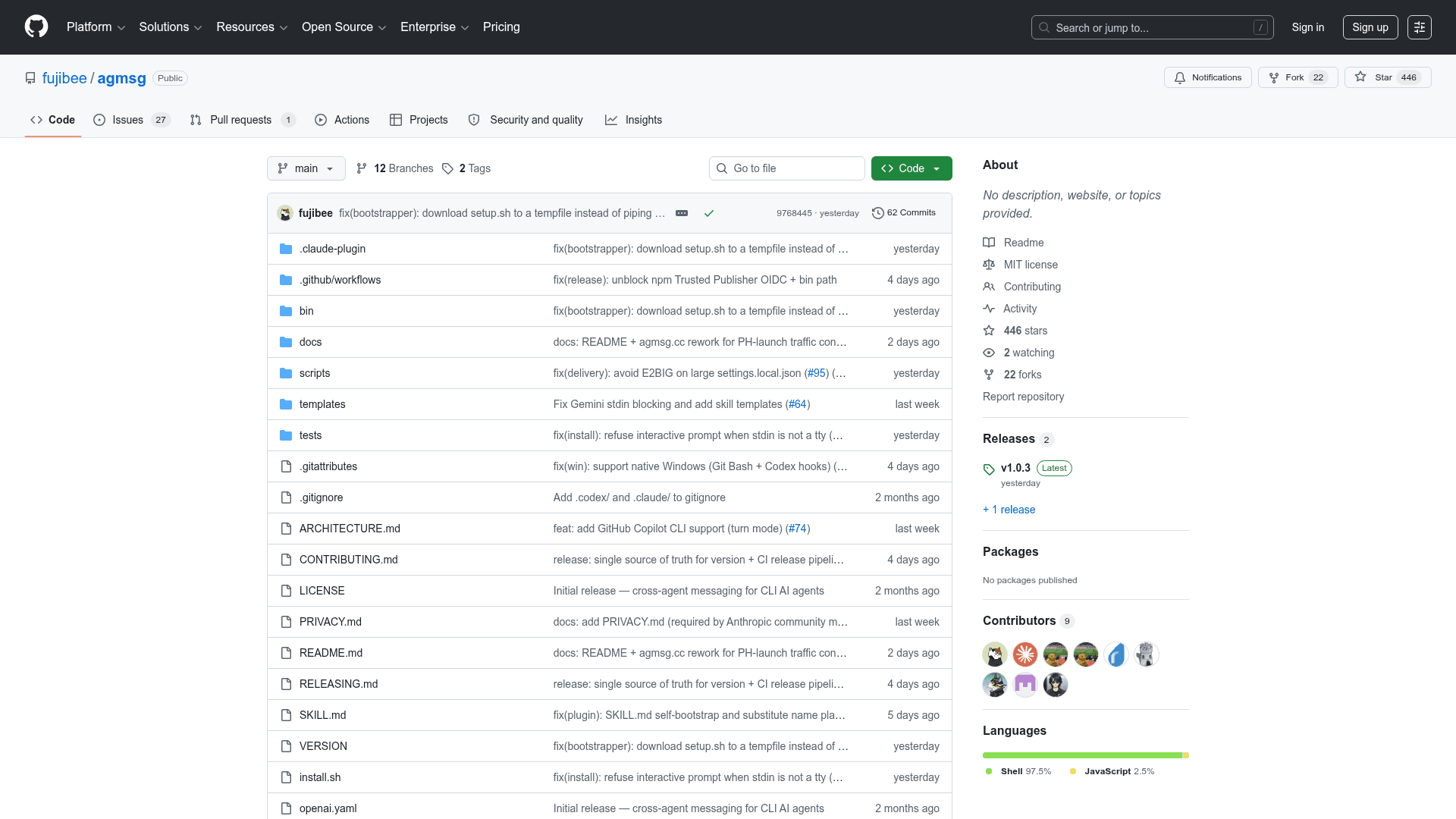
The README's demo — two Claude Code instances autonomously playing tic-tac-toe against each other with no human in the loop — illustrated the peer-agent coordination use case concretely. The project accumulated 440 GitHub stars and 22 forks shortly after its June 2026 launch. Community-built derivative projects (agmsg-shogi, agmsg-go, agmsg-mcp) emerged alongside the core tool, and five external contributors added support for Gemini, Copilot CLI, Windows, watcher scoping, and OpenCode.
Update: Active Development as of June 2026
The repository was last pushed on June 11, 2026, nine days after the Product Hunt launch. The roadmap items mentioned in the README include a claim/lock table for task coordination and a config-file layer for storage-driver configuration. The actas exclusivity model was added as a partial solution to the concurrent-task-grab problem. The project is under active development with 28 open issues.
Community Discussions
Be the first to start a conversation about agmsg
Share your experience with agmsg, ask questions, or help others learn from your insights.
Pricing
Open Source
Fully free and open source under the MIT License. No cost to use, modify, or distribute.
- Cross-agent messaging via SQLite
- Support for Claude Code, Codex, Gemini CLI, Copilot CLI, Antigravity
- All delivery modes (monitor, turn, both, off)
- N-agent teams
- Persistent message history
Capabilities
Key Features
- Cross-agent messaging via shared local SQLite database
- No daemon, no network, no broker required
- Supports Claude Code, Codex, Gemini CLI, GitHub Copilot CLI, and Antigravity
- Real-time push delivery via Monitor mode (~5s latency)
- Between-turns delivery via stop hook
- N-agent teams (not limited to 2 agents)
- Persistent message history across sessions with history.sh replay
- Multiple roles per project via actas/drop with exclusive locking
- WAL-mode SQLite for concurrent readers and single writer
- Configurable storage path via AGMSG_STORAGE_PATH
- Per-project delivery mode settings
- Native Windows / Git Bash support
- One-liner install via curl
- BATS test suite included
- MIT licensed open source