
AIlice
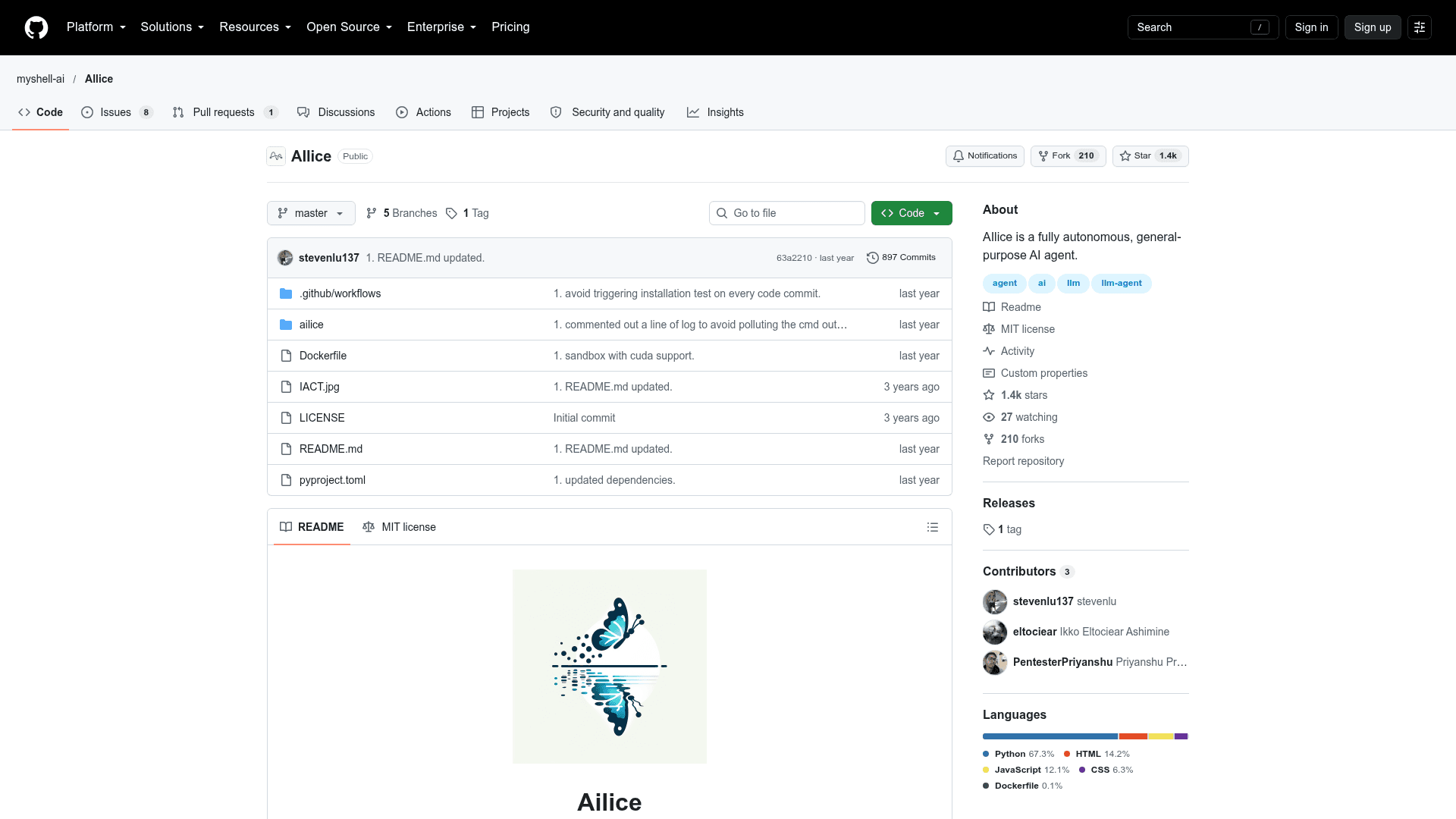
AIlice is an open-source, fully autonomous general-purpose AI agent that decomposes tasks into a dynamic call tree of cooperating agents.
At a Glance
AIlice core agent released under the MIT License; free to use, copy, modify and distribute. LLM API/inference costs are external (BYOK or local models).
Engagement
Available On
Listed Oct 2026
About AIlice
AIlice is an open-source autonomous AI agent from the myshell-ai organization, built to act as a standalone JARVIS-like assistant on top of open-source or commercial LLMs. It runs locally or in Docker and is operated through a browser-based dialogue interface. The README lists thematic research, coding, system management and literature reviews among its demonstrated tasks.
What It Is
AIlice is a general-purpose agent framework and application. Users give instructions in a chat interface, and AIlice breaks the work into subtasks handled by dynamically created agents. Its IACT (Interactive Agents Call Tree) architecture lets sub-agents ask their callers for help, which the project describes as providing high fault tolerance. Outputs from the LLM are parsed by an interpreter that maps text patterns to function calls, variable definitions and other actions.
Models and Configuration
AIlice works with open-source models run locally (for example via LM Studio, or Ollama through litellm), Hugging Face models, and commercial providers such as OpenAI, Anthropic, Mistral, Groq and OpenRouter. Different agent types can be assigned different models through the agentModelConfig setting in config.json. The README says that running LLMs locally needs substantial GPU resources, while using hosted models needs virtually no hardware.
Extension Modules and MCP
External capabilities such as search, browser, code execution and vector database run as independent module processes defined in config.json. MCP servers can be wrapped with the ailice_mcp_wrapper command, in stdio or SSE mode, to act as standard modules. Ailice can also load modules at runtime and, per the README, can write new ext-modules on request.
Setup Path
Installation is via cloning the repository and running pip install -e ., then launching the ailice command and opening the provided web page. Docker options are documented, including CUDA and Linux GUI variants. Optional extras cover PDF reading, speech, Hugging Face models and fine-tuning. The README says it was developed on Ubuntu, macOS usability is similar, and Windows users are advised to use Docker or WSL. A hosted platform built on Ailice, kragent.ai, is mentioned for trying it without local setup.
Community Discussions
Be the first to start a conversation about AIlice
Share your experience with AIlice, ask questions, or help others learn from your insights.
Pricing
Open Source (self-hosted)
AIlice core agent released under the MIT License; free to use, copy, modify and distribute. LLM API/inference costs are external (BYOK or local models).
- MIT License
- Self-hosted via git clone or Docker
- Use your own API key for commercial LLMs or run open-source LLMs locally
- Supports MCP tools and voice interaction
Capabilities
Key Features
- Interactive Agents Call Tree (IACT) architecture for task decomposition
- In-depth research and literature analysis
- Programming, script execution and system management
- Voice interaction support
- Native multimodal support across agents
- Rich media web UI with LaTeX, code highlighting and file upload/download
- Per-agent LLM configuration
- MCP server tool support via wrapper
- Self-constructing and dynamically loaded extension modules
- Interrupt button to guide running agents
- Docker sandbox with optional CUDA and GUI support