
AIPOCH Open-Science
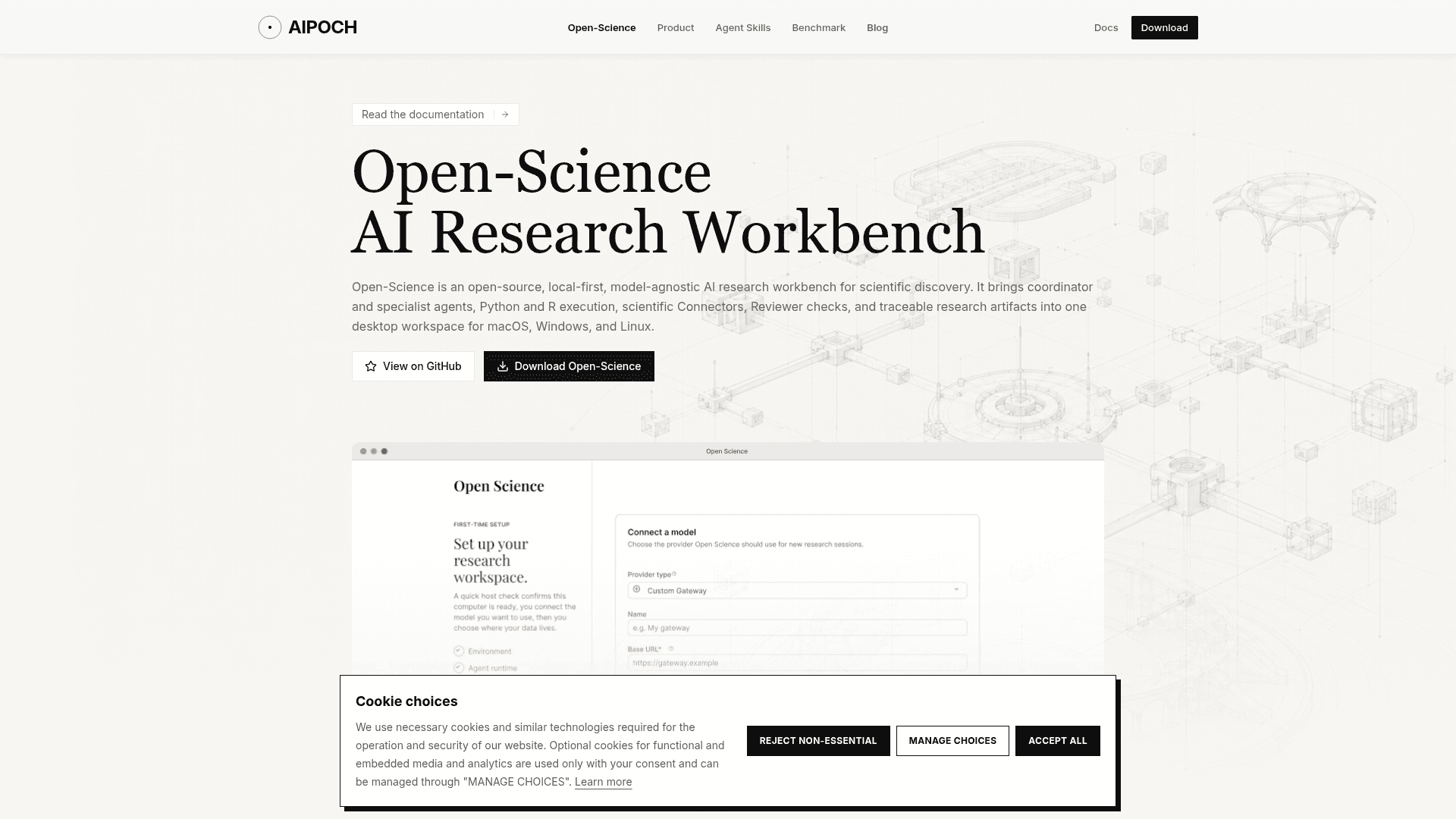
Open-source, local-first, model-agnostic AI research workbench for macOS, Windows, and Linux with scientific agents, Python/R notebooks, data connectors, and reproducible provenance.
At a Glance
Fully free and open-source under Apache License 2.0. No seat license required. External AI model providers, scientific services, or compute hosts may charge separately.
Engagement
Available On
Alternatives
Listed Sep 2026
About AIPOCH Open-Science
AIPOCH Open-Science is an open-source desktop application built by AIPOCH for scientists and researchers who need a reproducible, inspectable AI-assisted research environment. Released under the Apache License 2.0, it runs locally on macOS, Windows, and Linux and connects to any supported model provider without vendor lock-in. The project reached v0.28.0 in September 2026 and has accumulated over 4,000 GitHub stars since its July 2026 launch.
What It Is
Open-Science is a local-first AI research workbench that combines coordinator and specialist agents, persistent Python and R notebook kernels, 24 built-in scientific data connectors, and a traceable artifact system in one desktop workspace. Researchers describe a task in plain language, and the agent reads files, searches the web, queries scientific databases, runs code, and produces reports, tables, and figures — all within a single inspectable session. The workbench is model-agnostic: it supports built-in cloud providers (OpenAI, Anthropic, xAI/Grok, DeepSeek, and others), compatible custom gateways, and existing Claude or Codex subscription logins.
Research Workflow: Define, Plan, Execute, Inspect
The workbench structures work into four stages:
- Define — Describe the research question and attach relevant files or context.
- Plan — An AI coordinator agent plans the work and delegates scoped tasks to Specialists or subagents.
- Execute — The agent searches approved sources, inspects datasets, and runs Python, R, or shell commands.
- Inspect — Generated reports, tables, figures, and notebooks are reviewed alongside execution records, provenance evidence, and optional Reviewer findings.
Persistent Python and R kernels maintain variable state across related steps. Shell execution history is recorded, and supported SSH workflows can submit jobs to remote HPC clusters via Slurm.
Traceability and Provenance Architecture
Traceability is described by AIPOCH as a core design principle. Every generated artifact is stored as an immutable, checksummed version connected to its producer code, execution history, referenced inputs, environment inventory, and the conversation branch that produced it. The v0.28.0 release added Replayable Verification, which re-executes a captured artifact version in an isolated environment and compares the reproduced files with the originals using byte-exact and scientific comparison rules. Evidence that cannot be verified is explicitly marked unavailable rather than inferred. An optional Reviewer agent audits transcripts, execution logs, and artifacts and reports pass/warn/fail findings.
Scientific Connectors, Specialists, and Skills
Open-Science ships with 24 built-in Scientific Connectors covering scientific literature, biomedical databases, genomics, chemistry, and clinical research resources. Specialists are purpose-scoped AI agent profiles configured with selected instructions, skills, connectors, and permissions — the main agent can delegate to a Specialist, but Specialists cannot bypass the researcher's permission settings. The workbench also integrates with AIPOCH's library of 550+ reusable medical research skills spanning evidence synthesis, protocol design, data analysis, and academic writing.
Update: v0.28.0 (September 2026)
The latest release, published September 11, 2026, introduces several notable capabilities:
- Replayable Verification — Re-execute sealed artifact recipes and compare reproduced files with originals.
- Workspace-Wide Search — Categorized search across projects, sessions, messages, files, and the literature library.
- Private Remote Media — Remote media in model output requires explicit activation; remote model endpoints must use HTTPS.
- WSL2 Bash Preview — Windows x64 users can opt into a readiness-checked WSL2 Bash environment.
- Managed Codex Upgrades — Settings provides tested in-place upgrades with separate CLI and adapter version visibility.
The GitHub repository lists the project as actively developed, with 4,082 stars and 265 forks as of the latest update.
Local-First Data and Permission Model
Project state, sessions, uploads, notebook history, and generated artifacts are stored on the user's computer by default. API keys use the operating system's secure credential storage. External data flow occurs only when the researcher invokes a configured model provider, scientific connector, web search, or remote compute host — each governed by the active approval and permission settings. Three permission profiles are available: Ask for approval, Auto-approve edits, and Full access, allowing researchers to match the permission scope to the sensitivity of the task.
Community Discussions
Be the first to start a conversation about AIPOCH Open-Science
Share your experience with AIPOCH Open-Science, ask questions, or help others learn from your insights.
Pricing
Open Source
Fully free and open-source under Apache License 2.0. No seat license required. External AI model providers, scientific services, or compute hosts may charge separately.
- Full desktop app for macOS, Windows, and Linux
- All core research agent capabilities
- 24 built-in Scientific Connectors
- Python and R notebook kernels
- Artifact provenance and versioning
Capabilities
Key Features
- Open-source under Apache License 2.0
- Local-first desktop app for macOS, Windows, and Linux
- Model-agnostic: supports OpenAI, Anthropic, xAI/Grok, DeepSeek, and 15+ providers
- Persistent Python and R notebook kernels
- 24 built-in Scientific Connectors (literature, biomedical, genomics, chemistry, clinical)
- Coordinator and Specialist AI agents with scoped permissions
- Replayable artifact verification with byte-exact and scientific comparison
- Immutable versioned artifacts with full provenance records
- Reviewer agent for auditing transcripts, execution logs, and artifacts
- Workspace-wide categorized search
- Remote HPC compute via SSH and Slurm
- 550+ reusable medical research skills
- Headless CLI and Node.js SDK
- WSL2 Bash preview on Windows x64
- Human-in-the-loop approval controls (Ask, Auto-approve, Full access)
- Literature import by DOI, PubMed ID, arXiv ID, or file
- MCP connector support with tool-level permissions
- Branch-based conversation history with message revision