
aislop
A deterministic CLI that scores AI-generated code 0–100, catching slop patterns like narrative comments, swallowed exceptions, and unsafe casts across 7 languages.
At a Glance
About aislop
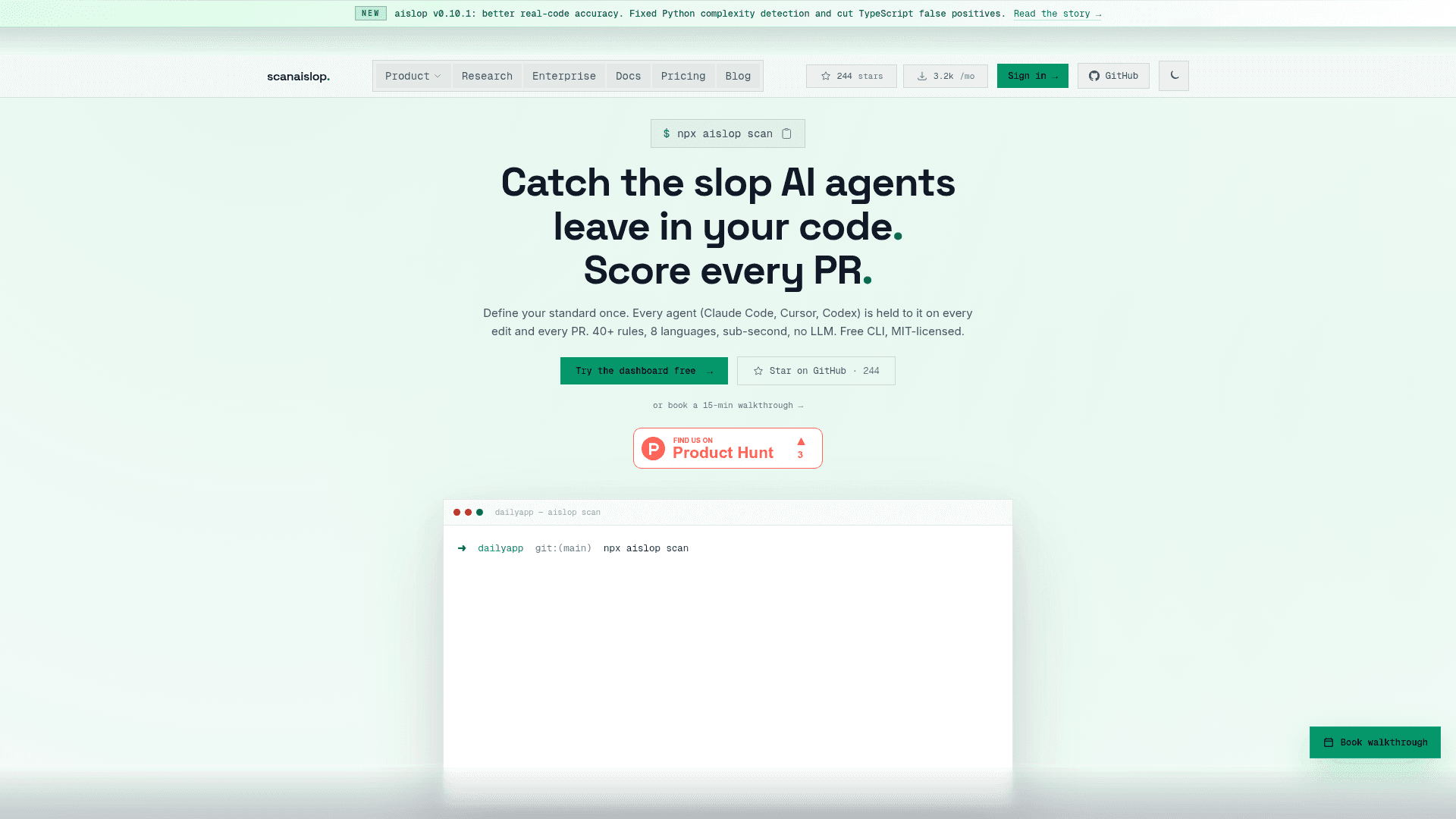
aislop is an MIT-licensed CLI and hosted platform built by Skivelane Limited that detects the low-quality patterns AI coding agents leave behind in codebases. It runs sub-second, deterministic scans using regex, AST analysis, and best-in-class static tooling — no LLM at runtime — and produces a 0–100 score for every file or pull request. The tool is available as a free CLI via npx aislop scan and as a hosted dashboard at scanaislop.com for team-level enforcement.
What It Is
aislop is a code quality gate specifically designed for the era of AI-assisted development. Where traditional linters catch style and syntax issues, aislop targets the structural and semantic patterns that AI agents like Claude Code, Cursor, Codex, and OpenCode routinely produce: narrative JSDoc preambles above self-explanatory code, swallowed exceptions with empty catch blocks, as any type casts, TODO stubs, generic variable names like data2, hallucinated imports, and oversized functions. It scores every change on a 0–100 scale and can block PRs that fall below a configurable threshold.
How the Six-Engine Architecture Works
aislop runs six deterministic engines in parallel, each delegating to specialized tooling where it exists:
- Formatting — Biome, ruff, gofmt, cargo fmt, rubocop, php-cs-fixer
- Linting — oxlint, ruff, golangci-lint, clippy, expo-doctor
- Code Quality — function/file size limits, deep nesting, unused files and dependencies via knip
- AI Slop — aislop's own detectors for narrative comments, trivial comments, dead patterns,
as any,console.logleftovers, and TODO stubs - Security — eval, innerHTML, SQL/shell injection patterns, dependency audits via npm/pip/cargo/govulncheck
- Architecture — opt-in custom import bans, layering rules, and required patterns
The score is weighted so AI-slop patterns and security issues hit harder than style noise. The same code always produces the same score — no API calls, no model variance.
Agent Integration and Workflow
aislop is built around the agentic coding loop. After scanning, npx aislop fix applies mechanical fixes (formatters, unused imports, dead code). For issues requiring judgment, npx aislop fix --claude (or --cursor, --codex, --gemini, and 11 other agents) hands off remaining diagnostics with full context so the agent can resolve them. A hook system (npx aislop hook install) runs after every agent edit to provide immediate feedback. An MCP server (aislop-mcp) exposes aislop_scan, aislop_fix, aislop_why, and aislop_baseline tools for Claude Desktop, Cursor, and Codex. CI integration supports GitHub Actions, GitLab, CircleCI, and pre-commit, with SARIF 2.1.0 output for GitHub code scanning.
Language and Platform Coverage
The tool covers 8 languages: TypeScript, JavaScript, Python, Go, Rust, Ruby, PHP, and Java. It ships 40+ AI-slop detection rules and supports 9 coding agents for hook and handoff integration. The npx aislop scan command requires no installation and no account, and source code never leaves the local machine during CLI scans.
Update: v0.10.1
The latest release, v0.10.1 (published May 30, 2026), focused on real-code accuracy: it fixed Python complexity detection and reduced TypeScript false positives. The project reached 244 GitHub stars and approximately 3,200 npm downloads per month according to the homepage. The GitHub repository was created in March 2026, placing the project in early active development. The hosted scanaislop platform is currently in beta with all features available at no cost during the beta period, according to the pricing page.
Open-Source Deployment Model
The CLI is MIT-licensed and the core source code is publicly available at github.com/scanaislop/aislop. The hosted scanaislop platform adds PR gates, team standards hierarchy (org → team → project), dashboards, and GitHub integration on top of the same engines. The CLI can be run entirely offline; the platform requires an account and connects to GitHub for PR enforcement.
Community Discussions
Be the first to start a conversation about aislop
Share your experience with aislop, ask questions, or help others learn from your insights.
Pricing
Developer
Free forever plan for individual developers with basic repository and scan limits.
- 3 repositories
- 100 scans / month
- 3 team members
- PR check runs
- Basic standards manager
Pro
Full-featured plan free during beta. Locks in at early-adopter pricing when beta ends. Early users get 40% off forever.
- 20 repositories
- 2,000 scans / month
- 15 team members
- Full standards manager
- Standards hierarchy (org → team → project)
Enterprise
Custom plan for large teams with unlimited repositories, scans, and members plus enterprise features.
- Unlimited repositories
- Unlimited scans
- Unlimited members
- Strict CLI policy bootstrap
- Agent hook + MCP rollout guidance
- Enterprise roadmap alignment: SSO, audit export, custom rule packs
- Priority support
- Private pilot planning for regulated teams
Capabilities
Key Features
- 40+ AI slop detection rules
- 0–100 deterministic code score
- Sub-second scan time (no LLM at runtime)
- 8 language support: TypeScript, JavaScript, Python, Go, Rust, Ruby, PHP, Java
- 6 parallel scan engines: Formatting, Linting, Code Quality, AI Slop, Security, Architecture
- Auto-fix for mechanical issues (unused imports, dead code, formatters)
- Agent handoff to Claude Code, Cursor, Codex, Gemini, and 11+ others
- Per-edit agent hooks for immediate feedback
- MCP server with aislop_scan, aislop_fix, aislop_why, aislop_baseline tools
- CI integration: GitHub Actions, GitLab, CircleCI, pre-commit
- SARIF 2.1.0 output for GitHub code scanning
- Configurable quality gate with failBelow threshold
- Public README score badge via badges.scanaislop.com
- Standards hierarchy: org → team → project
- Score history and trend tracking
- Zero-config start with npx aislop scan
- Extends config for monorepo support
- JSON Schema for .aislop/config.yml editor validation