
Antirion
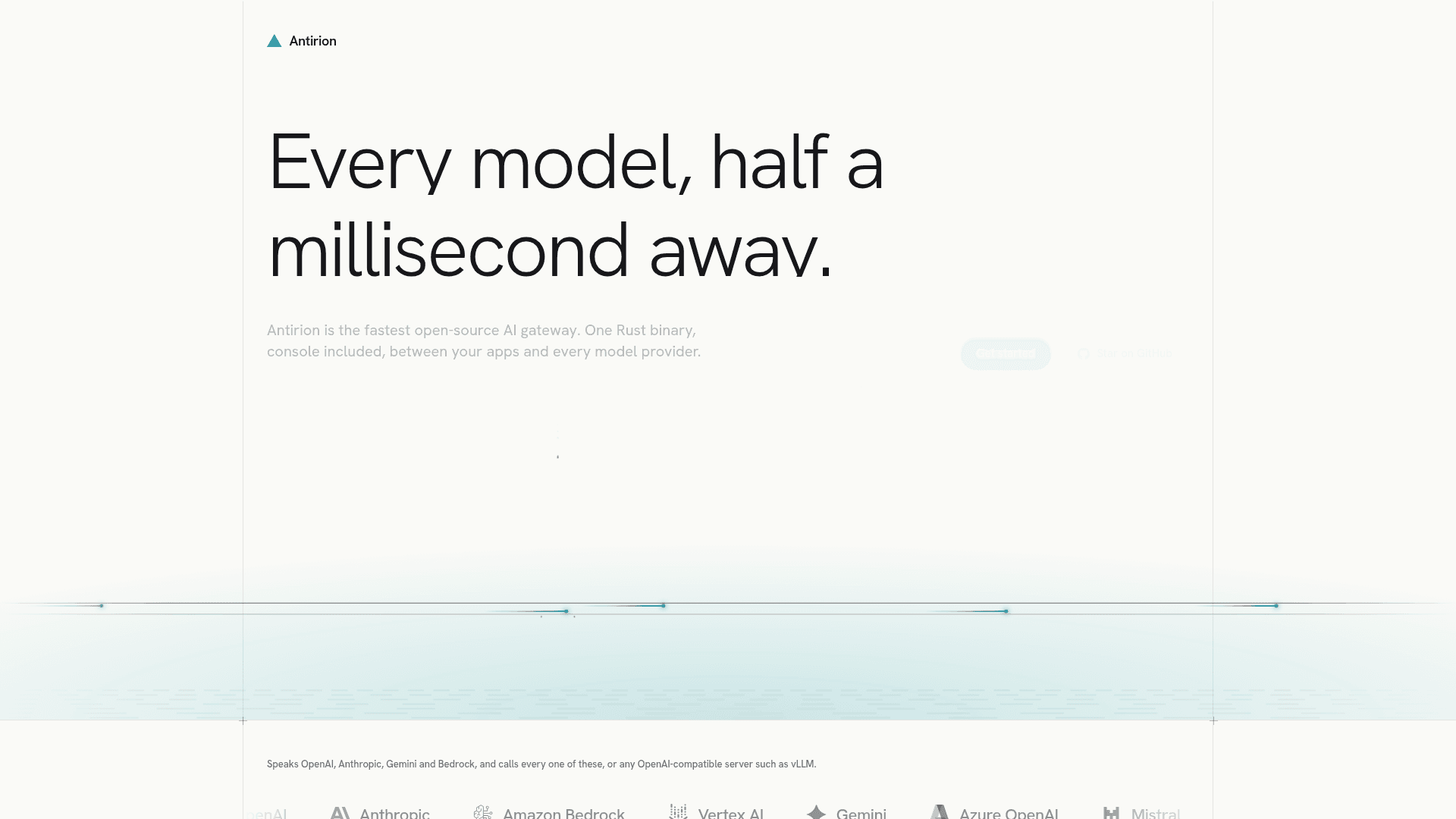
Open-source AI gateway delivered as a single Rust binary with a built-in console that routes, secures, budgets and observes LLM calls across model providers.
At a Glance
Self-hosted Apache 2.0 licensed AI gateway with every feature included and no paid tier.
Engagement
Available On
Alternatives
Listed Nov 2026
About Antirion
Antirion is an open-source AI gateway written in Rust and published by Elias Biondo under the Apache 2.0 license. It sits between applications and model providers, exposing one API that routes, retries, budgets, guards and records LLM calls. The gateway, Admin API and web console ship together as one binary or distroless container image.
What It Is
Antirion is a self-hosted LLM gateway. Clients speak the OpenAI, Anthropic, Gemini or Bedrock APIs, so official SDKs, LangChain and the Vercel AI SDK work by changing the base URL. Antirion translates between these dialects, so any client can call any supported provider, including OpenAI-compatible servers such as vLLM. Requests go from your network directly to your providers.
How a Request Flows
On the data plane (port 8080), each request is authenticated with virtual keys, JWT or bring-your-own keys, admitted against rate limits and budgets, checked by input guardrails, looked up in an exact or semantic cache, routed, sent with retries, hedging and circuit breakers, and checked again on output. A record with route, attempts, tokens, cost and verdicts is written once it settles. The admin plane (port 8081) serves the Admin API and the console, where providers, models, keys, routing, budgets, safety rules and alerts are managed.
Controls and Observability
- Routing: fallback chains, weighted splits, least cost, least latency, tiers and classifiers.
- Spend: rate limits and budgets in dollars or tokens at organization, team, project, key and model levels, with a cost ledger and projections.
- Safety: guardrails for PII, secrets, regexes, JSON schemas, tool permissions, moderation and LLM judges, with block, redact, flag or divert actions.
- Observability: request log, analytics, Prometheus metrics, OTLP and alert rules.
- Identity: OIDC, SAML, GitHub sign-in, SCIM, custom roles and an audit log with change control.
- MCP and A2A gateways place tool servers and agents behind the same keys, budgets and log.
Deployment
Antirion runs as a standalone node with an embedded store, or as a cluster on PostgreSQL and Valkey. It can be deployed with Docker, Docker Compose, a Helm chart for Kubernetes, or signed Linux binaries for amd64 and arm64. The project publishes benchmark results comparing it with Bifrost and LiteLLM and documents the harness for reproducing them.
Community Discussions
Be the first to start a conversation about Antirion
Share your experience with Antirion, ask questions, or help others learn from your insights.
Pricing
Open Source
Self-hosted Apache 2.0 licensed AI gateway with every feature included and no paid tier.
- Apache License 2.0
- Admin console built into the binary
- SSO, SCIM, audit log, clustering and guardrails included
- Routing, budgets, caching, MCP and agent gateways
- Self-hosted via Docker, Compose, Kubernetes Helm or binary
Capabilities
Key Features
- Single Rust binary with built-in web console and Admin API
- OpenAI, Anthropic, Gemini and Bedrock API compatibility with dialect translation
- Routing with fallback, weighted, least-cost and least-latency strategies, retries, hedging and circuit breakers
- Rate limits and budgets in dollars or tokens with cost ledger
- Guardrails for PII, secrets, schemas, moderation and LLM judges
- Exact and semantic caching
- MCP gateway and A2A agent proxy
- Request log, analytics, Prometheus and OTLP telemetry, alerts
- SSO with OIDC, SAML, SCIM, custom roles and audit log
- Standalone or clustered deployment on PostgreSQL and Valkey
- Plugins via signed webhooks or WebAssembly components
- Config as one schema-validated document with diffs and rollback