Arbor
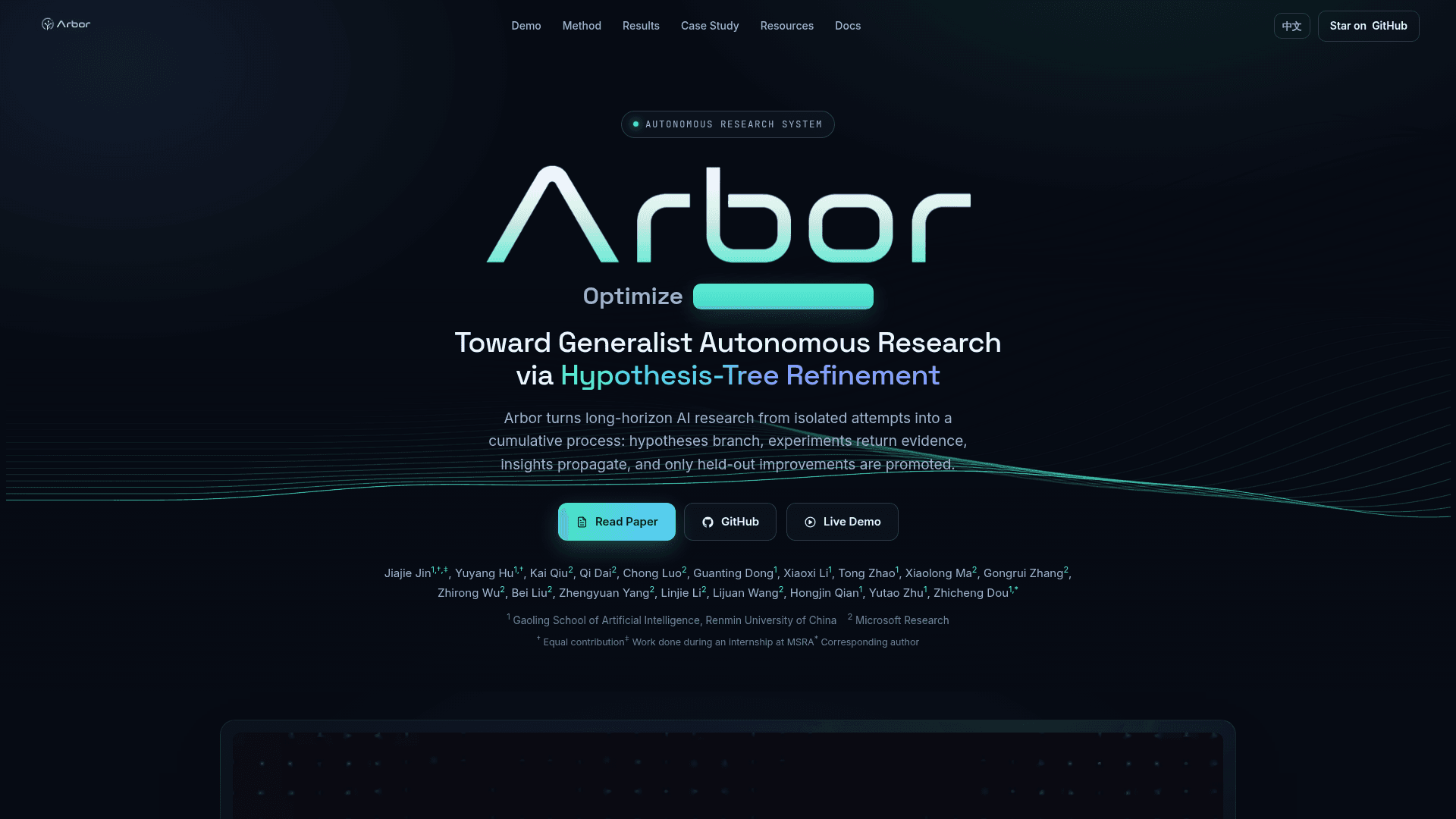
An open-source autonomous research agent that optimizes artifacts by growing a hypothesis tree and merging only gains that hold up on held-out data.
At a Glance
Arbor core autonomous research agent released under the Apache License 2.0; free to use, modify and distribute. Model provider/API keys are external costs.
Engagement
Available On
Listed Oct 2026
About Arbor
Arbor is an open-source autonomous research system from the Gaoling School of Artificial Intelligence at Renmin University of China and Microsoft Research. Given a benchmark and a goal, it proposes hypotheses, edits code, runs experiments, and keeps only improvements that survive held-out evaluation. It ships as a Python CLI (arbor) and as an Agent Skill Suite for Codex and Claude Code.
What It Is
Arbor targets what its authors call Autonomous Optimization: an agent receives an initial artifact, an objective, a development evaluator and a held-out evaluator, then improves the artifact through iterative experimentation. Typical targets named in the project include model training, harness engineering, and data synthesis.
Two cooperating agents do the work. A long-lived Coordinator maintains the hypothesis (Idea) tree, and short-lived Executors implement single ideas in isolated git worktrees and report evidence back. Verified improvements merge into a per-run trunk, and the user promotes the trunk into main.
How the Arbor Cycle Works
Each cycle has six steps: Observe, Ideate, Select, Dispatch, Backpropagate, and Decide. Results and distilled insights are written to tree nodes and propagated to ancestors, so later proposals are conditioned on what was validated, pruned, or shown to have boundary conditions. Executors iterate on a dev split, but a change merges only if it clears a configurable margin on the held-out test split.
The project's paper and README report held-out wins over Codex and Claude Code on six tasks and an 86.36% Any-Medal rate on MLE-Bench Lite with GPT-5.5. These are the authors' own reported results.
Setup and Ways to Use It
Install with pip install arbor-agent (Python 3.10 or later and Git). Run arbor replay --demo to watch a recorded run without an API key, arbor quickstart or arbor setup to configure a provider, then arbor to start an intake conversation that produces a Research Contract. A keyless mode (arbor install plus arbor mcp) lets Claude Code or Codex use their own model while Arbor supplies deterministic tools.
Models, Search, and Steering
Arbor supports Anthropic, OpenAI Responses, and OpenAI-compatible backends through LiteLLM. An optional alphaXiv-backed literature search and arbor idea-check command assess an idea's novelty before experiments run. A live dashboard, read-only web UI, optional human-in-the-loop review modes, domain plugins, and resumable sessions with REPORT.md output let users steer and audit runs.
Community Discussions
Be the first to start a conversation about Arbor
Share your experience with Arbor, ask questions, or help others learn from your insights.
Pricing
Open Source (Apache 2.0)
Arbor core autonomous research agent released under the Apache License 2.0; free to use, modify and distribute. Model provider/API keys are external costs.
- Apache License 2.0
- Native CLI runtime (pip install arbor-agent)
- Keyless harness integration via arbor install / arbor mcp for Claude Code and Codex
- Agent Skill Suite
- arbor replay --demo requires no API key
Capabilities
Key Features
- Hypothesis-tree (Idea Tree) refinement with a six-step cycle
- Coordinator and Executor agents with isolated git worktrees
- Dev/held-out evaluation with configurable merge margin
- Native CLI runtime with live dashboard and read-only WebUI
- Keyless integration for Claude Code and Codex via skills and MCP server
- Literature search and novelty checks via alphaXiv (arbor idea-check)
- Human-in-the-loop interaction modes
- Domain plugins such as Kaggle/MLE mode
- Checkpoint, resume, replay, and HTML session export
- Automatic REPORT.md generation
- Benchmark drafting via arbor benchmark add (experimental)