
Argus
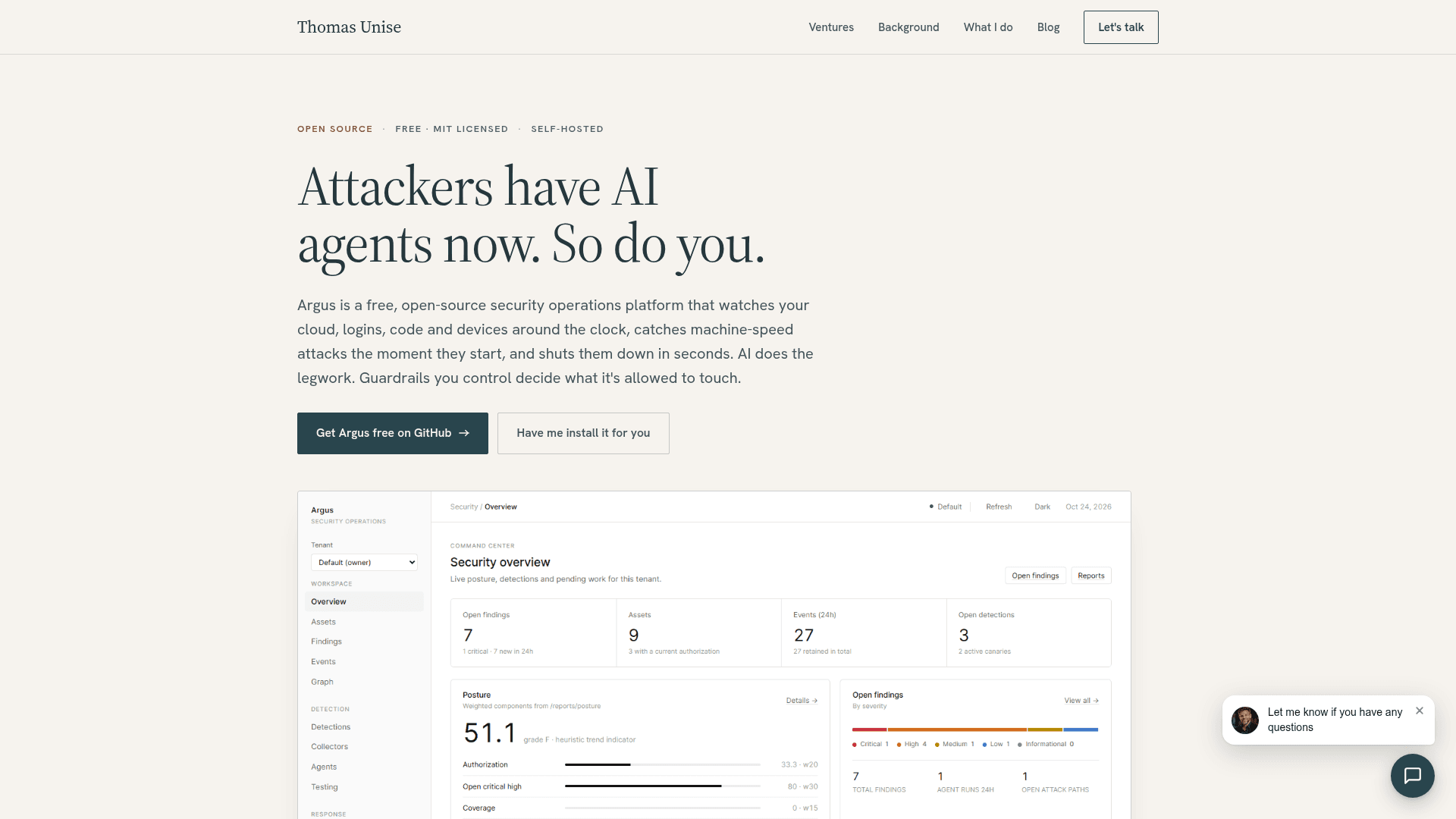
Open-source, self-hosted security operations platform that uses AI agents to detect, investigate and contain attacks through a policy-controlled action broker.
At a Glance
Self-hosted, MIT-licensed open-source security operations platform with no seats or usage fees; users pay only for their own infrastructure and any AI model they choose.
Engagement
Available On
Alternatives
Listed Oct 2026
About Argus
Argus is an open-source, MIT-licensed security operations platform created by Thomas Unise. It collects data from cloud, identity, code, endpoint, network and Kubernetes sources, detects attacks including machine-speed ones, investigates them with AI agents, and contains them through a controlled action broker. It is self-hosted and multi-tenant.
What It Is
Argus is a self-hosted security operations platform that links assets and events from AWS, Azure, GCP, Kubernetes, GitHub, Okta, Entra, osquery and netflow into an evidence graph showing attack paths. Detection rules cover swarms, identity abuse, cloud and Kubernetes exposure, code issues, canaries, anomalies and unsanctioned AI services. Findings are enriched with CISA Known Exploited Vulnerabilities and EPSS scores, and the enrichment works offline for air-gapped installs.
How Response and Autonomy Are Governed
Every change goes through an action broker with a catalog of 27 typed actions across AWS, Azure, GCP, Kubernetes, GitHub, Okta, Entra, Cloudflare, CrowdStrike and SentinelOne. Requests pass policy checks, approvals, a dry run with blast radius, execution and stored rollback, with an audit entry at each step. A kill switch halts actions globally or per tenant.
Seven specialist AI agents triage and investigate using read-only tools and can only propose actions. Autonomous response playbooks and autonomous pentesting are off by default and need both a global switch and a tenant opt-in. Playbooks start in shadow mode, use only reversible actions, are capped, and roll back automatically unless a human keeps the change. Approve, deny and roll back buttons are available in Slack.
AI Security Features
An AI gateway proxies OpenAI and Anthropic traffic with organization-held keys, model allowlists, data-loss prevention, prompt-injection flags, budgets and a usage log. Shadow-AI discovery finds unapproved AI services from network, cloud and SSO telemetry. Canaries aimed at AI agents include planted prompt injections, agent rules files, a fake MCP server and fake LLM API keys. An attack simulator replays 8 agent-driven scenarios in an isolated sandbox tenant and reports coverage.
Setup Path
Development runs on Python 3.11 or 3.12 with SQLite and uvicorn, no Docker needed, plus a seed script for synthetic demo data. For pilots there is Docker Compose, with a Helm chart for Kubernetes and Terraform for AWS and Azure. Production mode refuses to start without PostgreSQL, Redis, encryption keys, HTTPS, an external audit sink, and SSO or TOTP. The project states it is an open-source foundation and not a certified product, and recommends starting in monitoring-only mode. The author also offers a paid installation service.
Community Discussions
Be the first to start a conversation about Argus
Share your experience with Argus, ask questions, or help others learn from your insights.
Pricing
Free, forever
Self-hosted, MIT-licensed open-source security operations platform with no seats or usage fees; users pay only for their own infrastructure and any AI model they choose.
- MIT license: no seats, no usage fees, no vendor lock-in
- Architecture, threat model, runbooks and a step-by-step go-live guide
- Issues and contributions welcome on GitHub
- Self-hosted; infrastructure and chosen AI model costs are external
Capabilities
Key Features
- Evidence graph with attack paths and exposure scoring
- 13 detection rules and 12 canary kinds including AI-agent traps
- Seven read-only AI specialist agents that can only propose actions
- Action broker with 27 typed actions, dry run, approvals, rollback and kill switch
- Autonomous response playbooks with shadow mode, caps and automatic rollback
- Slack approve, deny and roll back buttons
- AI gateway with model allowlists, DLP, budgets and usage log
- Shadow-AI discovery
- Agentic attack simulator with 8 scenarios
- Autonomous pentesting through scope-checked harness
- CISA KEV and EPSS threat intel enrichment with offline mode
- Hash-linked signed audit chain with S3 Object Lock or Azure immutable sinks
- SOC 2, NIST 800-171 and ISO 27001 control mappings
- Multi-tenant RBAC with OIDC, TOTP and API keys