
Articraft
An agentic system for scalable articulated 3D asset generation using LLM-powered code generation workflows.
At a Glance
Fully free and open-source under Apache License 2.0. Self-hosted via GitHub.
Engagement
Available On
Alternatives
Listed May 2026
About Articraft
Articraft is an open-source agentic system that transforms the creation of articulated 3D assets into a programmatic, code-generation workflow powered by large language models. Built by Matt Zhou and collaborators from Oxford's Visual Geometry Group, it is designed for large-scale dataset generation and bypasses heavyweight manual 3D modeling tools. The project is accompanied by a research paper (arXiv:2605.15187) and is licensed under Apache 2.0.
What It Is
Articraft sits at the intersection of generative AI and 3D asset creation. Rather than requiring artists to manually rig and model objects, it uses LLMs to generate Python-based model definitions (model.py files) that describe articulated objects with semantic parts, robust geometry, and physical joints. The system is engineered specifically for producing large, diverse datasets of articulated 3D models — the kind needed to train and evaluate robotics, simulation, and computer vision systems.
How the Agentic Workflow Operates
The core workflow centers on a CLI command (articraft generate) that accepts a natural-language prompt and produces a structured dataset record. The system defaults to high-capability models (e.g., GPT or Gemini variants) and supports configurable cost caps and model selection. Key workflow steps include:
- Generate: Produce a new articulated asset from a text prompt
- Fork: Modify an existing record by branching it into a child record, leaving the parent unchanged
- Hydrate: Pull Git LFS-stored record payloads on demand by record ID, category, date range, or batch
- View: Browse and inspect the dataset through a local React frontend and API server
External AI agents (Claude Code, Codex, Cursor) can also contribute to the dataset by following a documented workflow, enabling crowdsourced dataset growth without requiring direct API key access.
Architecture and Dataset Design
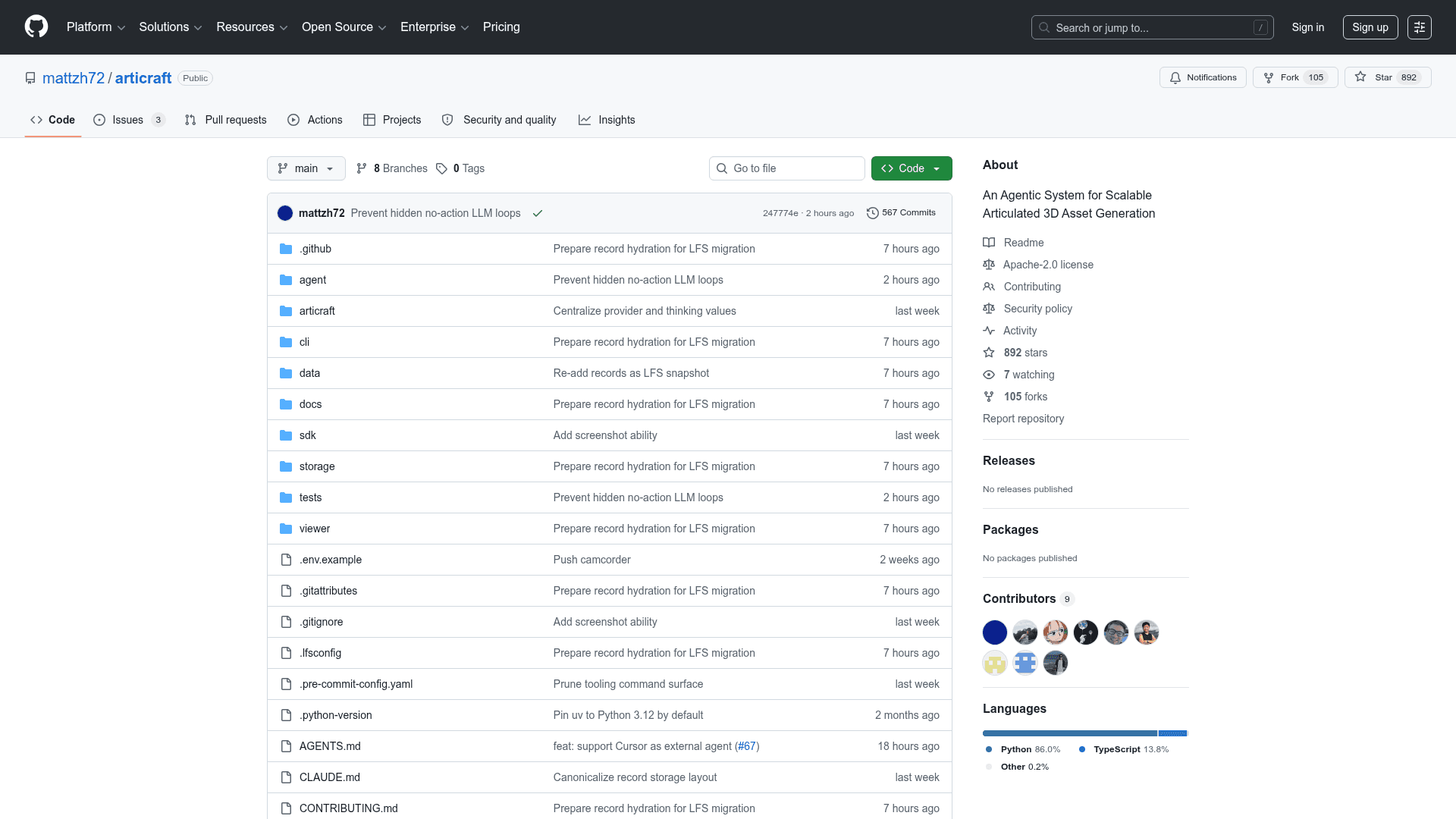
Articraft stores dataset records in a code-first format under data/records/, tracked via Git LFS with lazy hydration. A data/records_index.jsonl file indexes all records so the viewer can browse metadata without downloading full payloads. Each record contains a model.py file that is executed as Python code to compile and inspect the asset — the project notes this carries a security implication and advises running only trusted sources.
The project structure is documented across several guides covering architecture, record editing, batch dataset generation, and contribution standards.
Contribution and Data Licensing
A stated goal of Articraft is crowdsourcing a large, diverse dataset of articulated 3D models. Contributions via CLI, batch processing, or external AI agents are welcomed through pull requests. The project specifies that all contributed data is released under Creative Commons Attribution 4.0 International (CC-BY 4.0), and contributors agree their submissions may be used to build and evaluate machine learning models distributed publicly.
Current Status
The repository was created in March 2026 and last updated in May 2026, with 891 stars and 105 forks reported on GitHub. The project supports Python 3.11 and 3.12 (3.13+ is not currently supported). CI is active via GitHub Actions. The accompanying research paper is available as an arXiv preprint (arXiv:2605.15187).
Community Discussions
Be the first to start a conversation about Articraft
Share your experience with Articraft, ask questions, or help others learn from your insights.
Pricing
Open Source
Fully free and open-source under Apache License 2.0. Self-hosted via GitHub.
- Full CLI access (generate, fork, hydrate, view)
- Multi-provider LLM support
- Local React viewer
- Dataset contribution workflow
- Apache 2.0 license
Capabilities
Key Features
- LLM-powered articulated 3D asset generation from text prompts
- Code-generation workflow via model.py files
- CLI for generate, fork, hydrate, and view operations
- Git LFS-backed dataset with lazy hydration
- Local React viewer with dataset browsing and search
- Support for multiple LLM providers (OpenAI, Gemini, Anthropic)
- Configurable model selection and cost caps
- Record forking for non-destructive editing
- Batch dataset generation and processing
- External AI agent contribution support (Claude Code, Codex, Cursor)
- Semantic parts, robust geometry, and physical joints in generated assets