
Attentry
A VS Code extension and CLI that checks code written by Claude Code for security holes, crash risks, copied code and dead code, and feeds findings back to the agent.
At a Glance
Free and open source (MIT) Attentry extension and CLI; runs locally on your machine.
Engagement
Available On
Listed Nov 2026
About Attentry
Attentry is an open-source tool made by Aarv Singh Chauhan that sits beside an AI coding agent and checks every edit it makes. It works with Claude Code through a VS Code extension, and the README describes it as in preview. It reads JavaScript, TypeScript (including JSX and TSX), Python and Astro, and runs locally on the user's machine.
What It Is
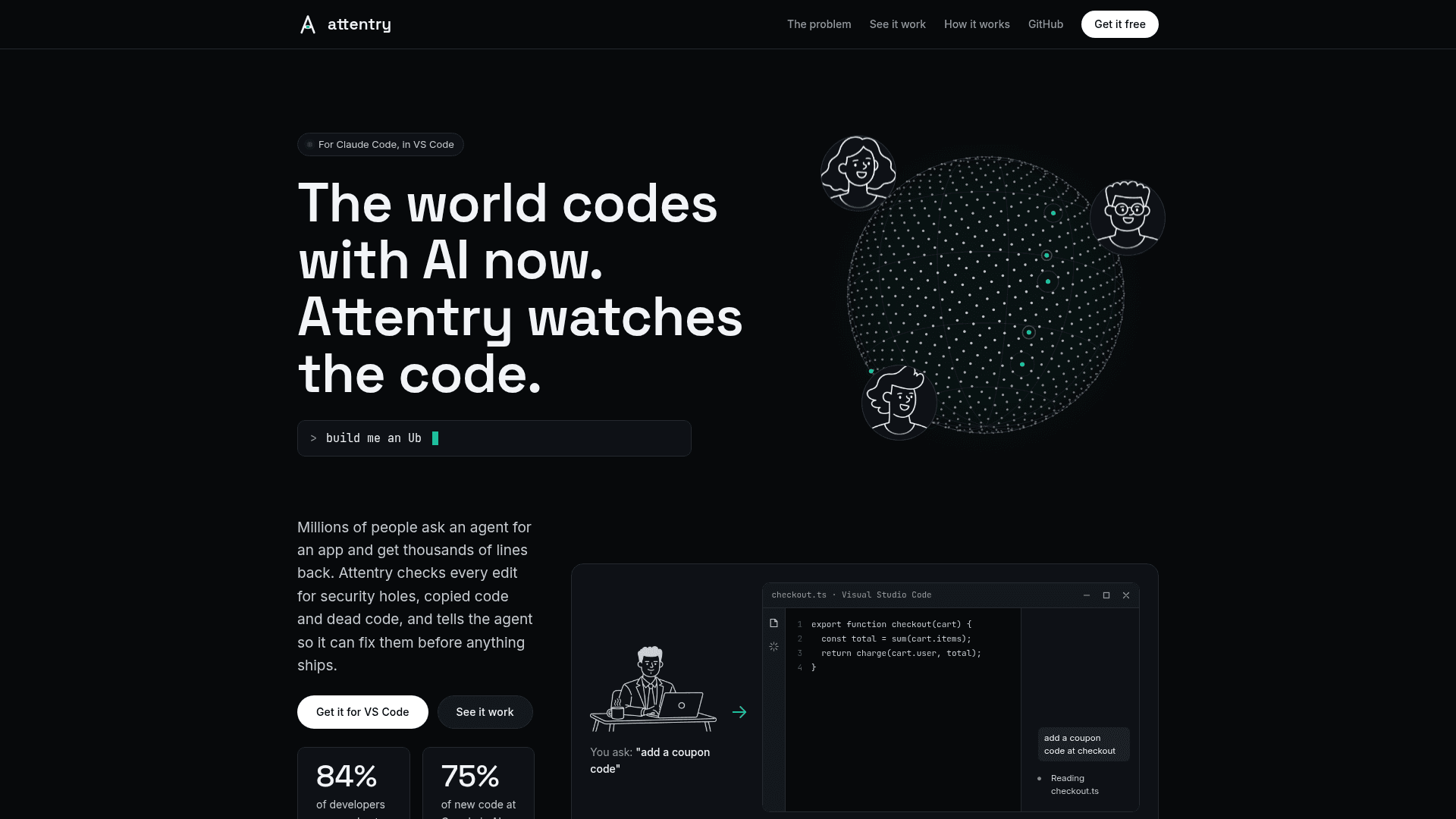
Attentry is a static-analysis companion for AI-generated code. When Claude Code is about to write a function the repo already has, Attentry points to the existing one. After each edit, it reports security holes or crash risks that the edit added, so the agent can fix them right away. Copies and unused code surface in a check-in every 10 edits, and a short change card at the end of a task summarizes the changed files, problems added or fixed, and test results.
How It Works During a Session
Attentry speaks up at a few specific moments and stays quiet on clean edits. It tells Claude about matching code when a request is sent, reviews plans for duplicated helpers or existing routes, warns before duplicate functions are written, and reports only the problems an edit newly added. By default it only makes suggestions; in block mode it also refuses exact copies and won't let a task finish while it has added a security or crash problem. It also exposes four read-only MCP tools to Claude: find_existing, check, explain and check_plan.
What It Finds
The checks cover several categories:
- Security: routes, socket events, tRPC procedures, GraphQL resolvers and server actions lacking login, owner or rate-limit checks, plus injection, XSS, hardcoded secrets and weak JWT handling.
- Crash risks: unhandled async handlers, unguarded JSON.parse and process exits in handlers.
- Frontend/backend mismatches: calls to nonexistent routes or with the wrong method, and routes nothing calls.
- Database: money stored as floats, queries in loops, and similar patterns.
- Copies and dead code: exact and near copies, unused files, packages and functions.
- Hotspots: complex, frequently changed files, derived from git history.
Editor and Command Line Use
The extension underlines problems in the editor with explanations generated from the code itself, and works in VS Code, Cursor, Windsurf and Antigravity. Other editors can run attentry lsp as a language server. A CLI (requires Node 22 or newer) offers scan options such as --changed, --brief, --agent, --markdown and --json, plus explain and doctor commands. According to the README, Attentry runs locally and the code never leaves the machine.
Community Discussions
Be the first to start a conversation about Attentry
Share your experience with Attentry, ask questions, or help others learn from your insights.
Pricing
Open Source (MIT)
Free and open source (MIT) Attentry extension and CLI; runs locally on your machine.
- MIT licensed
- Runs locally; code never leaves your machine
- VS Code extension (also Cursor, Windsurf via Open VSX)
- Command line scan (requires Node 22 or newer)
- Currently in preview; reads JavaScript, TypeScript, Python and Astro
Capabilities
Key Features
- Points Claude to existing functions before it writes duplicates
- Reports security and crash problems added by each edit
- Detects copies, dead code, unused packages and files
- Change card summarizing files changed, problems and test results
- Optional block mode that refuses exact copies and unfinished security problems
- Four read-only MCP tools: find_existing, check, explain, check_plan
- Plan check via /attentry:plan
- Editor diagnostics with hover explanations and quick fixes
- Hotspot detection from git history
- CLI scan with brief, agent, markdown and JSON output
- Language server mode for other editors
- Runs locally; code does not leave the machine