
Aurict
An open-source, terminal-native AI coding agent with multi-agent orchestration, BYOK provider support, sandboxed tool execution, and explicit approval controls.
At a Glance
Fully free and open source under AGPLv3. Bring your own API keys for any supported provider.
Engagement
Available On
Alternatives
Listed Sep 2026
About Aurict
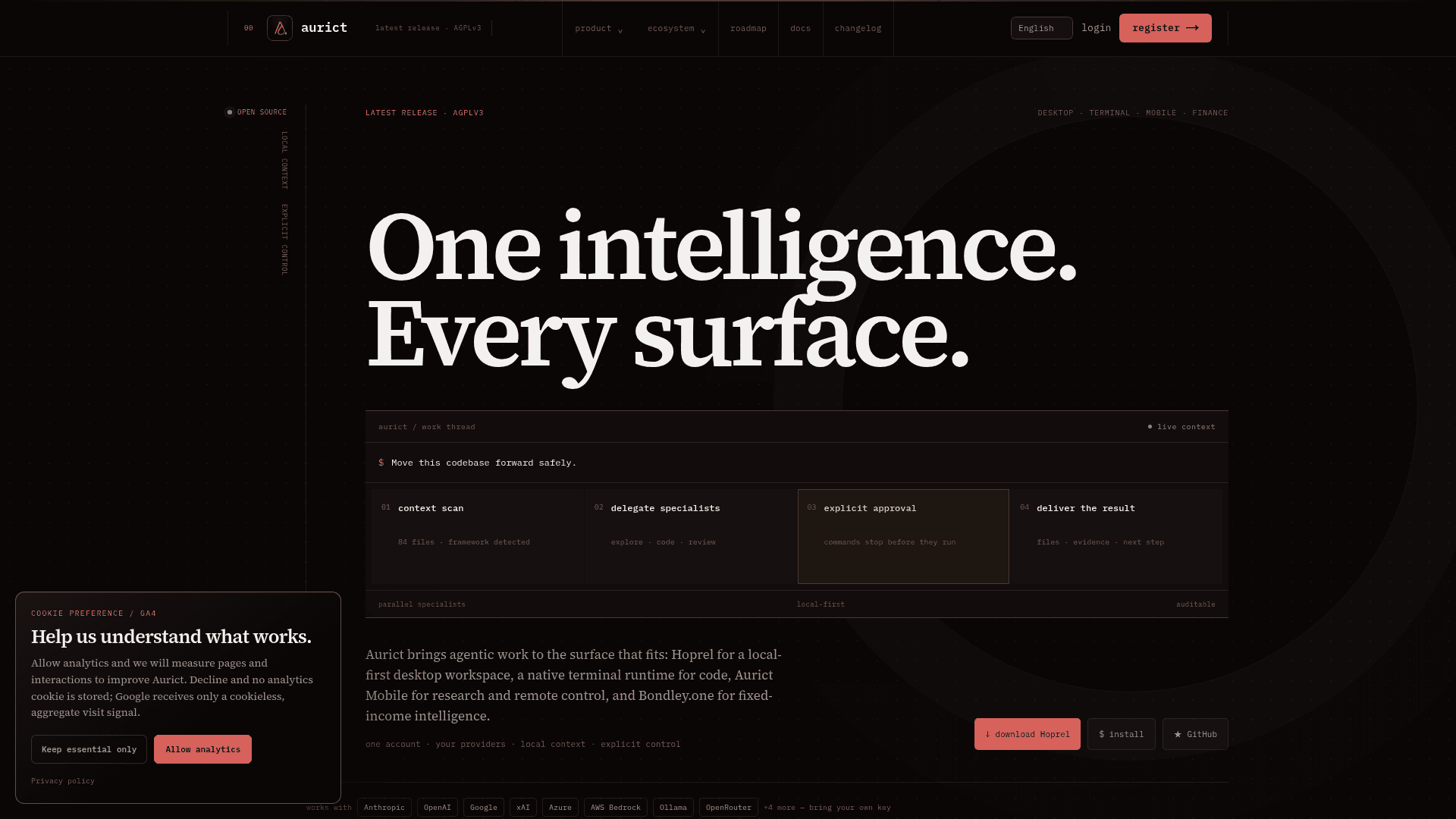
Aurict is an open-source terminal AI coding agent licensed under AGPLv3, built for developers who want agentic AI workflows without leaving their shell. It operates on a bring-your-own-key (BYOK) model, meaning users supply their own API keys for providers like Anthropic, OpenAI, Google, xAI, Azure, AWS Bedrock, Ollama, and OpenRouter. The wider Aurict system also includes a local-first desktop workspace (Hoprel), a Flutter-based mobile companion app, and a fixed-income research sub-product (Bondley.one).
What It Is
Aurict is a terminal-native multi-agent coding assistant that understands your project before you type a prompt. On first run it scans the repository — detecting framework, language, package manager, and config files — and injects that context automatically. It routes tasks to nine built-in specialist agents (explore, code, review, test, docs, security, debug, performance, analytics) that run in parallel worker threads, then surfaces results with a durable completion proof. The TUI is built on Ink (React for terminals), rendering cleanly without Electron overhead or browser tabs.
How the Safety Architecture Works
Every shell command passes through a three-tier bash classifier — safe, warning, or danger — before execution. Risky calls enter a policy sandbox with permission gates, protected paths, scrubbed environment variables, timeouts, output limits, and an audit trail. The "Project Auto" feature removes repeated prompts only for bounded write, edit, and apply_patch operations inside the active project for the current session; shell commands, secrets, paths outside the project, and broad deletions still require direct approval. Three security posture levels are available: Passive (defensive review only), Active Lite (Docker-backed scans against an allowlisted target), and Kali Full (full experimental image, requiring explicit approval every time).
Capability Architecture
- 218+ contextual skills — framework- and tool-specific context injected automatically when a stack is detected (Next.js, React, Vue, FastAPI, Rust, Go, Kubernetes, Terraform, and 200+ more combinations)
- Multi-agent coordinator — nine specialists in isolated worker threads; complex tasks decompose and run in parallel
- MCP client — imports compatible
claude_desktop_config.jsonservers; each connected server and its tools are inspectable before use - Design agent — 150+ design systems and 111 skill templates for UI implementation briefs
- Persistent memory — decisions and conventions stored locally in SQLite via Drizzle ORM, recalled per session
- Session management — checkpoints before every AI action,
/undofor N-step rollback,/fork,/branch, and/worktreefor parallel development - Local HTTP API — REST/SSE on
127.0.0.1:7777with bearer-token auth for scripting and CI integration - Token and cost tracking —
/costshows a full breakdown including cache reads at their discounted rate
Installation and Setup Path
Aurict ships as a self-contained compiled binary (approximately 103 MB with the Bun runtime embedded) for macOS arm64/x64, Linux x64/arm64, and Windows x64. Installation takes one command:
curl -fsSL https://aurict.com/install.sh | bash
or via npm:
npm install -g aurict
No Node.js runtime is required at execution time for the curl-installed binary. Building from source requires Bun 1.3+ and TypeScript 5.8+. The project structure separates a core package (agent engine, tools, providers, storage, HTTP server) from a cli package (Ink TUI, slash commands, keybindings), with 92 unit tests in core and 39 TUI component tests in cli.
Update: v1.2.23
The latest release is v1.2.23, published on September 5, 2026, according to the GitHub repository metadata. The repository was last pushed on September 12, 2026, indicating active development. The project describes itself as having moved from a bootstrapped hobby project toward a more clearly defined technology ecosystem, with a public roadmap and changelog available at aurict.com. The about page notes planned verticals including a cybersecurity platform, a visual/interface generation layer, and a MicroTarget.one integration for on-device ML and customer engagement workflows.
Community Discussions
Be the first to start a conversation about Aurict
Share your experience with Aurict, ask questions, or help others learn from your insights.
Pricing
Open Source
Fully free and open source under AGPLv3. Bring your own API keys for any supported provider.
- Full terminal agent with multi-agent orchestration
- 218+ contextual skills
- BYOK support for 12 providers
- MCP client
- Session memory and checkpoints
Capabilities
Key Features
- Multi-agent orchestration with 9 specialist agents (explore, code, review, test, docs, security, debug, performance, analytics)
- 218+ auto-injected contextual skills for frameworks and tools
- BYOK support for 12 providers: Anthropic, OpenAI, Google, OpenRouter, xAI, Azure, AWS Bedrock, Ollama, NVIDIA NIM, Z.AI, Alibaba, OpenCode
- Three-tier bash classifier (safe/warning/danger) before shell execution
- Policy sandbox with permission gates, protected paths, scrubbed env, timeouts, and audit logs
- Project Auto for session-scoped bounded file change approvals
- MCP client compatible with claude_desktop_config.json
- 150+ design systems and 111 skill templates via Design Agent
- Persistent SQLite-backed session memory with full restore
- Checkpoint and undo system for N-step rollback
- Session forking, branching, and git worktree management
- Local HTTP/SSE API on 127.0.0.1:7777 with bearer-token auth
- Token and cost tracking with cache read discounts
- Context compaction with configurable thresholds
- Custom tools via ESM .js files in .aurict/tools/
- Custom agents via JSON in .aurict/agents/
- Hooks system for lifecycle events (pre-tool, post-tool, pre-response, post-response, session-start, session-end)
- Completion proof with changed files, verification evidence, and waivers
- LSP diagnostics for TypeScript, Python, and 30+ languages before edits
- Pipe mode for non-interactive single queries
- Architecture decision records via /adr
- Background task execution in separate worker threads
- Web search and HTTP fetch tools
- Semantic workspace search and package API inspection