
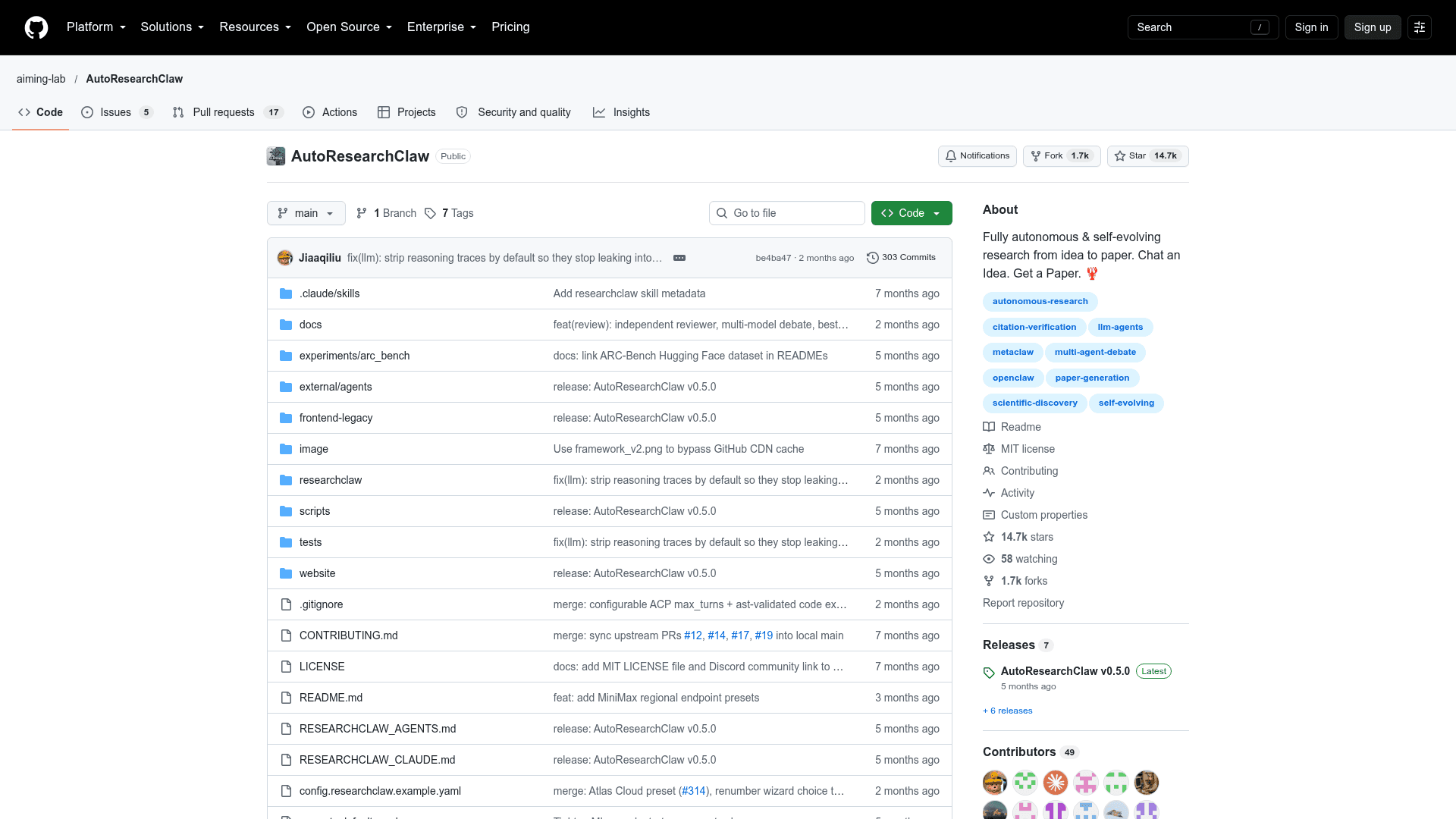
AutoResearchClaw
Open-source Python pipeline that turns a research topic into a full academic paper with literature search, sandboxed experiments, peer review, and LaTeX output.
At a Glance
Self-hosted AutoResearchClaw core released under the MIT License; free to use, copy, modify, and distribute.
Engagement
Available On
Listed Oct 2026
About AutoResearchClaw
AutoResearchClaw is an open-source research automation pipeline from Aiming Lab. Given a research topic, it runs a 23-stage workflow that collects literature, designs and runs experiments, analyzes results, and writes a conference-style paper. The latest listed release is v0.5.0, published 2026-05-20.
What It Is
AutoResearchClaw is a command-line, Python-based system for autonomous scientific paper generation. A user supplies a topic via researchclaw run, and the pipeline moves through eight phases: scoping, literature discovery, knowledge synthesis, experiment design, execution, analysis and decision, paper writing, and finalization. It can run fully autonomously or with human-in-the-loop guidance.
Outputs include a markdown paper draft, conference-template LaTeX (NeurIPS, ICLR, ICML), a BibTeX file, a citation verification report, experiment code with results, generated charts, peer-review notes, and a deliverables folder intended to be compile-ready for Overleaf.
How the Workflow Operates
Literature is gathered from OpenAlex, Semantic Scholar, and arXiv, and citations pass a four-layer verification (arXiv ID, CrossRef/DataCite DOI, title match, LLM relevance scoring). Experiments run in a hardware-aware sandbox that auto-detects GPU, Apple MPS, or CPU, with options for Docker and SSH remote execution. When experiments fail the pipeline attempts self-repair, and a decision stage can proceed, refine, or pivot the research direction. Version 0.5.0 adds domain-specialist execution agents for high-energy physics, biology, and statistics, plus the ARC-Bench benchmark of 55 topics.
Human-in-the-Loop and Integrations
Since v0.4.0 the project offers several intervention modes, from full-auto to step-by-step, including a co-pilot mode with an Idea Workshop, Baseline Navigator, and Paper Co-Writer. CLI commands such as attach, status, approve, reject, and guide let users steer a paused run. It works with OpenClaw, can use ACP-compatible coding agents (Claude Code, Codex CLI, Copilot CLI, Gemini CLI, OpenCode, Kimi CLI) as the LLM backend, and optionally integrates MetaClaw for cross-run learning that converts lessons into reusable skills.
Skills and Extensibility
The project ships 20 built-in skills and loads custom skills from SKILL.md files or configured directories. Configuration is handled through a YAML file covering LLM providers, experiment mode, export target conference, and bridge options.
Community Discussions
Be the first to start a conversation about AutoResearchClaw
Share your experience with AutoResearchClaw, ask questions, or help others learn from your insights.
Pricing
Open Source (MIT)
Self-hosted AutoResearchClaw core released under the MIT License; free to use, copy, modify, and distribute.
- MIT License
- Python 3.11+
- 23-stage autonomous research pipeline
- Co-Pilot mode with human-in-the-loop
- Self-hosted; LLM provider/API costs are external
Capabilities
Key Features
- 23-stage, 8-phase autonomous research pipeline
- Multi-source literature search (OpenAlex, Semantic Scholar, arXiv)
- 4-layer citation verification
- Hardware-aware sandbox experiments with self-healing repair
- PIVOT/REFINE decision loop
- Multi-agent debate and peer review
- Conference LaTeX export (NeurIPS, ICLR, ICML templates)
- Human-in-the-loop co-pilot with six intervention modes
- SmartPause, cost budget guardrails, and claim verification
- Anti-fabrication VerifiedRegistry
- Branch exploration of parallel hypotheses
- Domain-specialist experiment agents (HEP, biology, statistics)
- ARC-Bench autonomous-research benchmark
- Loadable custom skills and 20 built-in skills
- Optional MetaClaw cross-run learning