
babyseat
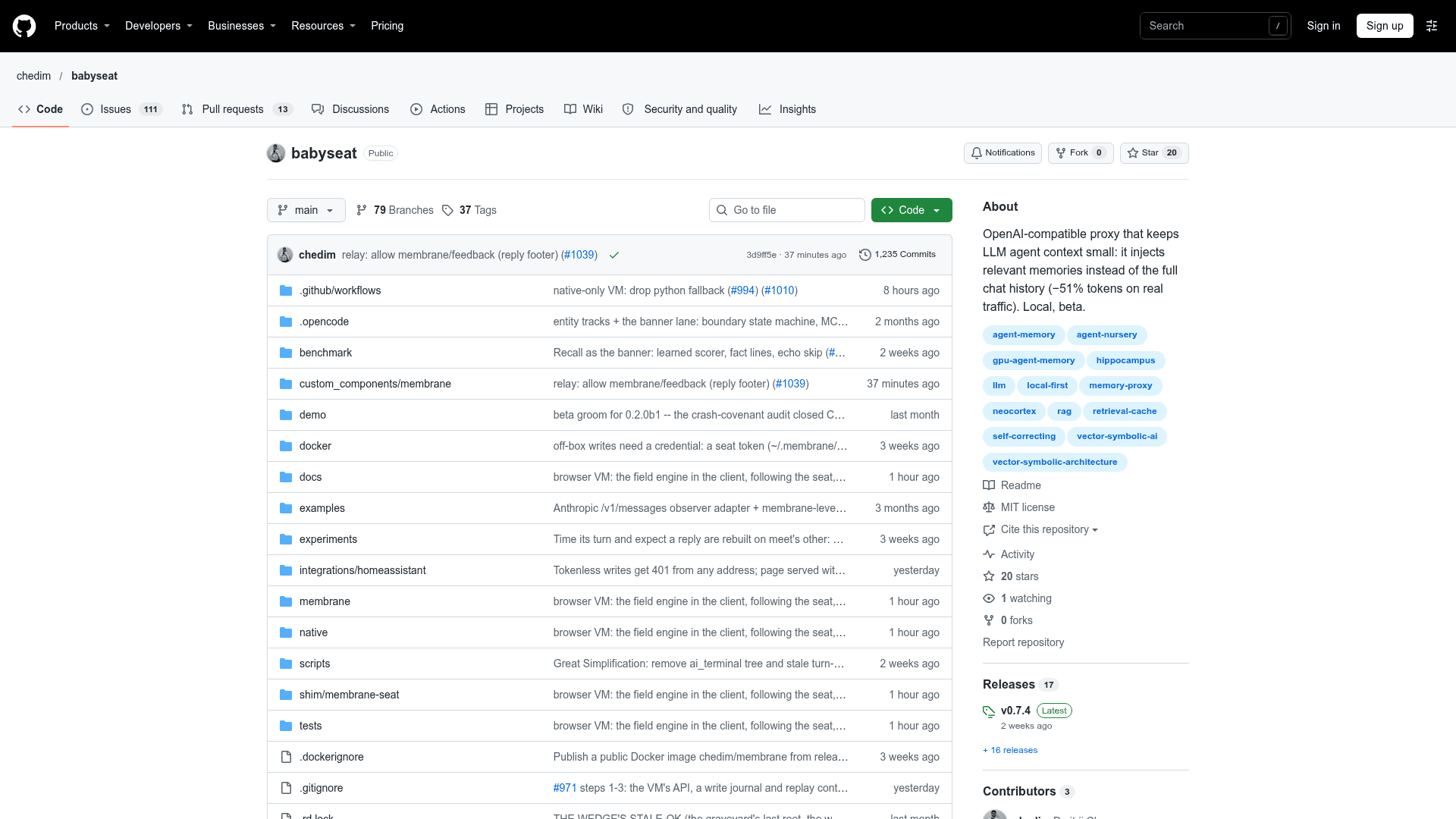
A local, OpenAI-compatible memory proxy and AI seat that learns in real time from the messages passing through it and injects relevant memories instead of full chat history.
At a Glance
Local-first babyseat/membrane core released under the MIT License; runs on your own machine or Docker with no account, cloud or telemetry.
Engagement
Available On
Listed Nov 2026
About babyseat
babyseat is an open-source (MIT) AI seat with a memory that learns in real time, built by chedim. It runs locally in front of Ollama, OpenAI-compatible cloud APIs, or Claude through the Claude Code engine, and learns from every message that passes through it. The latest release listed is v0.7.4, and the README describes it as a working lab whose API and flag surfaces may still change.
What It Is
babyseat is a memory proxy and runtime for LLM agents. Its memory component, called membrane, parses the text passing through it into entities (people, files, words, commands) and measures what is new as surprise. According to the README, learning needs only an embedding model, with no LLM step to summarize, extract or tag. Instead of replaying the transcript, each turn gets the entities the field holds about what was named, plus what changed since the last message.
How It Works
- Entities have positions, mass, relations and life stages (nursery, live, dormant), and
membrane stateprints the shape of a running field. - A conversation block and a RECALL block of top-ranked rows are injected each turn; an optional reranker can reorder candidates.
- With tools, the model reads the field via
queryandstate, writes with guardedlearn, and uses entity tools and Cliffhanger method tools. Writes pass dedup, variety, length and junk guards and are audited. - Background loops (a thinker and a dreamer) keep working while the user is away, on a local model by default.
Models, Clients and Surfaces
It works with Ollama chat models (local or cloud), OpenAI-compatible providers via membrane auth, and Claude rungs via the Claude Agent SDK. OpenAI-compatible clients, Ollama clients and MCP clients (including Claude Code) can connect, and membrane opencode attaches the opencode TUI. It runs standalone with a web UI (field drawn in 3D, chat, voice), in Docker, or inside Home Assistant through HACS as an Assist agent. Ollama is required for embeddings.
Team Sharing and Measurements
Each seat keeps its own field on local disk (SQLite by default, or Couchbase Lite). Seats can publish chosen entities to an optional Couchbase bucket, or opt into a merged team field. The README reports from its operator's live seat a 51% net token reduction versus full-context replay, and LoCoMo retrieval results (hit@8 74.0% versus 65.4% for plain cosine, with cosine ahead at hit@20 and hit@50); these are the author's own measurements.
Community Discussions
Be the first to start a conversation about babyseat
Share your experience with babyseat, ask questions, or help others learn from your insights.
Pricing
Open Source (Self-hosted)
Local-first babyseat/membrane core released under the MIT License; runs on your own machine or Docker with no account, cloud or telemetry.
- MIT License (OSI-approved)
- Runs locally, no account, no cloud, no telemetry
- Docker image chedim/babyseat (amd64 + arm64)
- OpenAI-compatible proxy, web UI and serve API
- SQLite store by default; optional Couchbase Lite (Enterprise free for development and evaluation only)
Capabilities
Key Features
- Real-time memory proxy that learns from passing messages
- Surprise-based learning needing only an embedding model
- Entity field with life stages and measurable geometry
- OpenAI-compatible and Ollama-compatible endpoints
- MCP tools for recall, learn, entities and methods
- Guarded and audited memory writes
- Standalone web UI with 3D field view, chat and voice
- Background thinker and dreamer loops
- Optional team sharing via Couchbase
- Local-first with no account or telemetry
- Docker image and Home Assistant integration
- Optional reranker for recall