
Bear. CTXPM
An open-source protocol and CLI for managing AI resources—Skills, Rules, Prompts, Memories, and MCP configs—as versioned project dependencies or packages.
At a Glance
Fully open-source protocol and CLI, free to use and self-host.
Engagement
Available On
Alternatives
Listed Sep 2026
About Bear. CTXPM
Bear. CTXPM (Context Package Manager) is an open-source protocol created by Bear. Best, an indie developer, for organizing AI resources in software projects. It treats the skills, rules, prompts, memories, and MCP configurations that AI coding agents rely on as first-class project assets with clear ownership, versioning, and lifecycle rules. The project is actively maintained on GitHub and reached v0.1.16 as of September 2026.
What It Is
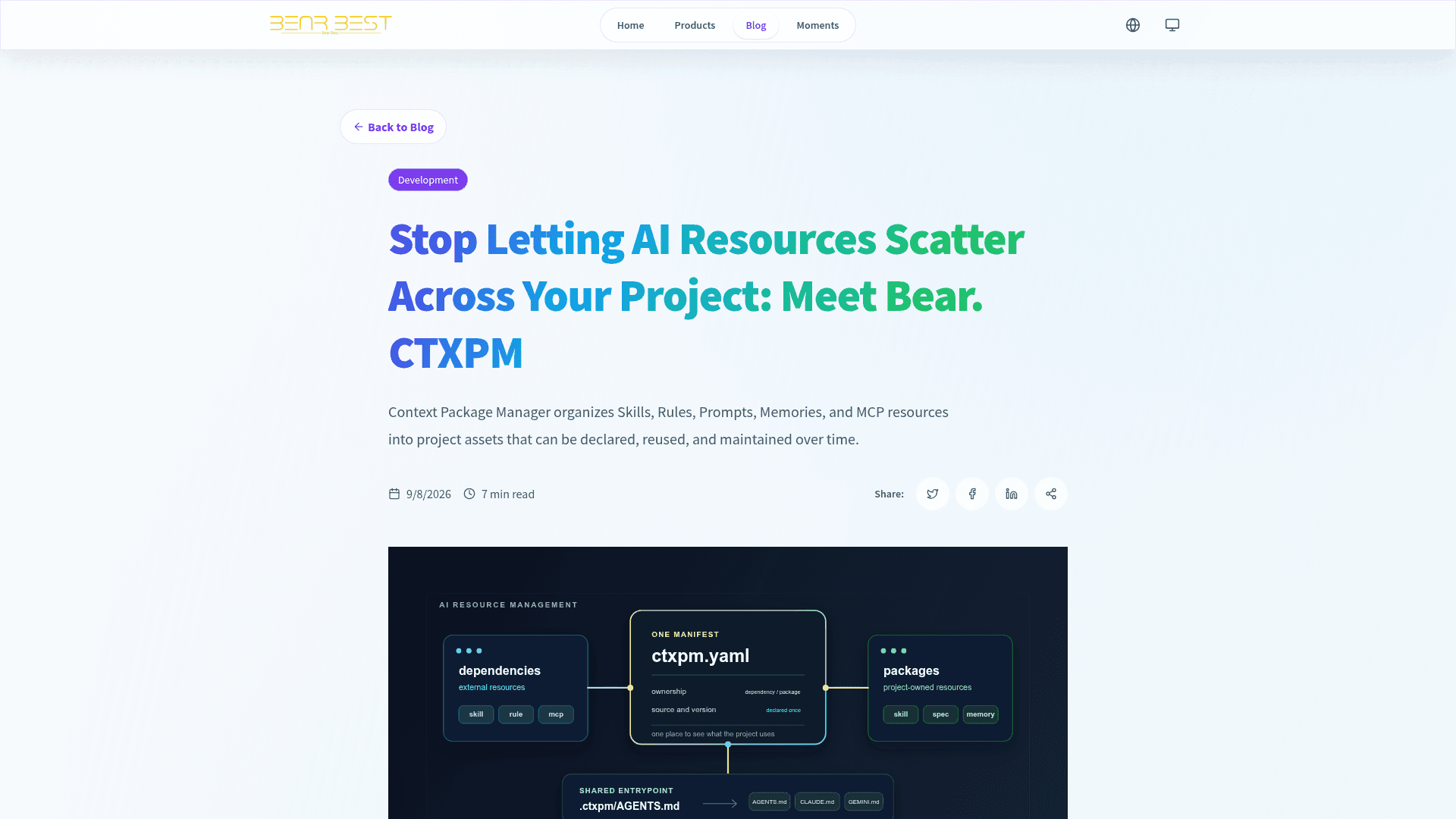
Bear. CTXPM is a protocol-first system for managing AI resources in development projects. As AI coding agents become part of everyday engineering workflows, projects accumulate two kinds of AI resources: external shared resources (team-wide or third-party) and project-local resources tightly coupled to the codebase. Without a convention, these files scatter across the project with no clear ownership or update boundary. Bear. CTXPM solves this by introducing unified dependency / package semantics, a standard directory structure under .ctxpm/, a ctxpm.yaml manifest, and a companion ctxpm CLI for repeatable operations.
Two Ownership Concepts
The protocol exposes exactly two ownership terms to users:
- dependency: an external AI resource the project uses but does not maintain. Its source, path, and version are recorded in
ctxpm.yaml; the content typically lives outside version control. - package: an AI resource maintained by the current project, committed to version control, and reviewed alongside source code.
Each resource also has a type—skill, rule, spec, prompt, memory, or mcp—which describes its content shape independently of ownership. This combination (e.g., dependency + skill or package + rule) makes it immediately clear who maintains a resource and where to make a fix.
Protocol-First Architecture
Bear. CTXPM is designed so a project does not depend on a binary before an AI can understand its working environment. The protocol lives in three places:
ctxpm.yaml— the project manifest declaring all resources, their sources, types, and agent profiles.ctxpm/— the directory structure separatingdependencies/(gitignored) frompackages/(committed)- Agent entrypoint documents — a canonical
.ctxpm/AGENTS.mdfile, with root-level symlinks (AGENTS.md,CLAUDE.md,GEMINI.md, etc.) pointing to it so each agent reads consistent instructions
The CLI handles fixed, repeatable steps: ctxpm init, ctxpm add, ctxpm list, ctxpm validate, ctxpm detect, ctxpm check-updates, and ctxpm update. Discovery and reporting are always separated from applying changes, so AI can surface a problem while the user decides whether to act.
Standard AI Workflow
When an AI agent enters a Bear. CTXPM project, the recommended workflow is:
- Read the root entrypoint (
AGENTS.mdor equivalent symlink) andctxpm.yaml - Scan
.ctxpm/packages/first, then.ctxpm/dependencies/ - Identify resources from explicit declarations and directory structure
- Load
memoryresources on demand when a task depends on project history - Maintain the managed
ctxpmblock in.ctxpm/AGENTS.mdand keep symlinks current - Report safely when an operation cannot be completed, and provide migration suggestions
For version tracking, Bear. CTXPM records the last commit that changed a resource path rather than the repository's latest HEAD, preventing misleading update signals when unrelated directories change.
Update: v0.1.16
The latest release is v0.1.16, published on September 11, 2026. The repository was created in July 2026 and has seen active iteration through the v0.1.x series. The project is written primarily in Go and is hosted on GitHub under the gBearBest account. The GitHub README notes that v0.1 explicitly does not require a self-hosted registry, a lockfile mechanism, or dedicated metadata files per resource—keeping the protocol lightweight and agent-agnostic.
Who It Is For
Bear. CTXPM is aimed at developers and teams who use AI coding agents on projects that need long-term maintenance. It is most useful when multiple agents need to read the same project rules, when teams want to reuse shared skills without copying them into every repository, when project-owned prompts and specs need code review, or when old AI files are scattered and need inventorying before migration. One-off AI demos may not need it, but any project with ongoing AI resource accumulation benefits from the explicit ownership and lifecycle model it provides.
Community Discussions
Be the first to start a conversation about Bear. CTXPM
Share your experience with Bear. CTXPM, ask questions, or help others learn from your insights.
Pricing
Open Source
Fully open-source protocol and CLI, free to use and self-host.
- Full ctxpm protocol
- ctxpm CLI (Go)
- Unlimited projects
- All resource types: skill, rule, spec, prompt, memory, mcp
- Git and OCI registry dependency sources
Capabilities
Key Features
- Unified dependency/package semantics for AI resources
- Manages Skills, Rules, Specs, Prompts, Memories, and MCP resources
- ctxpm.yaml project manifest for declaring all resources
- Standard .ctxpm/ directory structure separating external and project-owned resources
- Shared agent entrypoint via .ctxpm/AGENTS.md with root-level symlinks
- CLI commands: init, add, list, validate, detect, check-updates, update
- Detect and migrate unmanaged AI resource files
- Version tracking by resource path commit, not repository HEAD
- Agent-agnostic: works with Codex, Claude, Gemini, and others
- Protocol usable without CLI—AI can understand project from manifest alone
- Separation of discovery from change application
- Support for multiple agent profiles in ctxpm.yaml