Beever Atlas
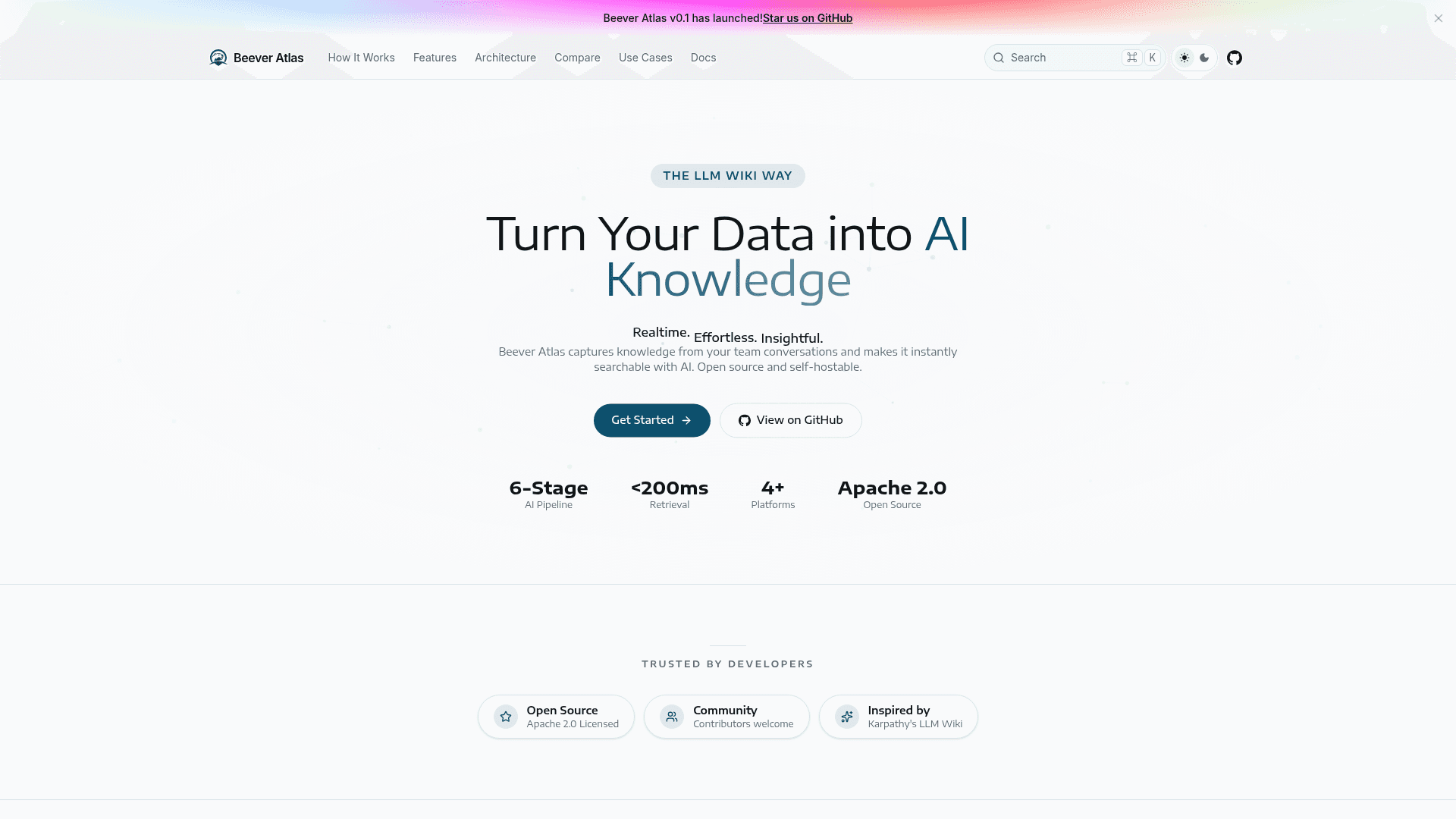
An open-source, self-hostable LLM wiki that turns Slack, Discord, Teams, and Mattermost conversations into a self-maintaining knowledge base with AI-powered Q&A and MCP support.
At a Glance
Fully open-source under Apache 2.0. Free to use, modify, and self-host.
Engagement
Available On
Listed May 2026
About Beever Atlas
Beever Atlas is an open-source knowledge base built by Beever AI that continuously distils team chat conversations into a structured, auto-maintained wiki. Licensed under Apache 2.0, it is self-hostable via Docker Compose and ships with a 6-stage AI ingestion pipeline, dual-memory architecture, and a Model Context Protocol (MCP) server for integration with AI coding assistants like Claude Code and Cursor.
What It Is
Beever Atlas sits in the category of LLM-first knowledge management tools, specifically targeting teams that generate institutional knowledge through chat platforms. Rather than retrieving raw message snippets at query time (the standard RAG approach), Atlas continuously distils conversations into deduplicated, citation-bearing wiki pages — one per channel — and answers questions against that pre-digested knowledge. The project describes this approach as "Wiki-First RAG," directly inspired by Andrej Karpathy's observation that LLMs reason far better over curated encyclopedic content than over raw chat logs.
Dual-Memory Architecture
Atlas maintains two complementary memory systems that work in parallel:
- 3-tier semantic store (channel / topic / atomic fact): powered by Weaviate vector embeddings, handles approximately 80% of queries in under 200ms via hybrid search.
- Graph store: powered by Neo4j, extracts entities and relationships for multi-hop reasoning — answering relational questions like "who worked on X with Y?" that pure vector RAG struggles with.
A smart query router selects the appropriate retrieval strategy per question, keeping latency low and context precise.
The 6-Stage Ingestion Pipeline
Built on Google's Agent Development Kit (ADK), the ingestion pipeline processes messages through six stages: Sync (fetch from platforms), Extract (LLM extracts facts, entities, relationships), Validate (quality gates filter low-confidence extractions at ≥0.5 threshold), Store (write to Weaviate and Neo4j via outbox pattern), Cluster (group related facts by cosine similarity), and Wiki (generate structured wiki pages with citations and diagrams). The pipeline is resumable and rate-limit aware.
Platform Support and MCP Integration
Atlas connects natively to Slack, Discord, Microsoft Teams, and Mattermost, with Telegram listed as coming soon. File imports (PDFs, Markdown, documents) are also supported for a unified knowledge layer. The MCP server at /mcp exposes 16 tools covering discovery, retrieval, graph traversal, and long-running operations, with per-agent authentication and principal-keyed rate limits. Ready-to-use .mcp.json templates are provided for Claude Code and Cursor.
Update: v0.2.0 — Wiki Narrative Engine and Pluggable Embeddings
The GitHub repository shows v0.2.0 was published on May 18, 2026, titled "Wiki narrative engine, Obsidian-style graph, pluggable embeddings." The initial open-source release (v0.1.0) launched in April 2026. The project notes that all /api/* endpoints are marked UNSTABLE in 0.1.0, with a /api/v1/* prefix planned for v0.2.0. The repository had accumulated 359 stars and 41 forks as of late May 2026, per the GitHub project metadata.
Deployment and Setup
Atlas ships as a Docker Compose stack comprising three application services (backend FastAPI + ADK agents, bot platform bridge, React web frontend) backed by four data stores (Weaviate, Neo4j, MongoDB, Redis). Three deployment paths are available:
- One-line install (
./atlas): guided 5-step interactive installer that handles secrets generation, port-conflict preflight, and stack launch. - Manual Docker: explicit step-by-step control for CI/CD and ops environments.
- Local development: databases in Docker, app services running natively with hot-reload.
Two API keys are required to get started — a Google API key (for Gemini) and a Jina API key (for v4 embeddings). The installer supports non-interactive mode for CI pipelines. Atlas collects no telemetry; all LLM calls go through user-configured API keys and all data stays in user-controlled databases.
Community Discussions
Be the first to start a conversation about Beever Atlas
Share your experience with Beever Atlas, ask questions, or help others learn from your insights.
Pricing
Open Source
Fully open-source under Apache 2.0. Free to use, modify, and self-host.
- Full source code under Apache 2.0
- Dual-memory architecture (Weaviate + Neo4j)
- 6-stage AI ingestion pipeline
- Multi-platform support (Slack, Discord, Teams, Mattermost)
- Auto-generated wiki pages with citations
Capabilities
Key Features
- Auto-generated, self-maintaining wiki pages per channel
- 6-stage AI ingestion pipeline (Sync, Extract, Validate, Store, Cluster, Wiki)
- Dual-memory architecture: 3-tier semantic store (Weaviate) + graph store (Neo4j)
- Smart query router selects semantic or graph retrieval per question
- Natural language Q&A with cited answers traced to source messages
- MCP server with 16 tools for Claude Code and Cursor integration
- Multi-platform support: Slack, Discord, Microsoft Teams, Mattermost
- File import: PDFs, Markdown, and documents
- Knowledge graph with entity extraction and relationship mapping
- Resumable, rate-limit-aware channel sync
- Per-agent MCP authentication and rate limiting
- Docker Compose deployment with one-line installer
- No telemetry — all data stays in user-controlled databases
- Pluggable embedding providers (Jina, OpenAI, Cohere, Voyage, Gemini, Mistral, Ollama)
- Pluggable LLM providers for agents (Google Gemini, OpenAI, Anthropic, Mistral, DeepSeek, Groq, MiniMax, Ollama)