
Beszel
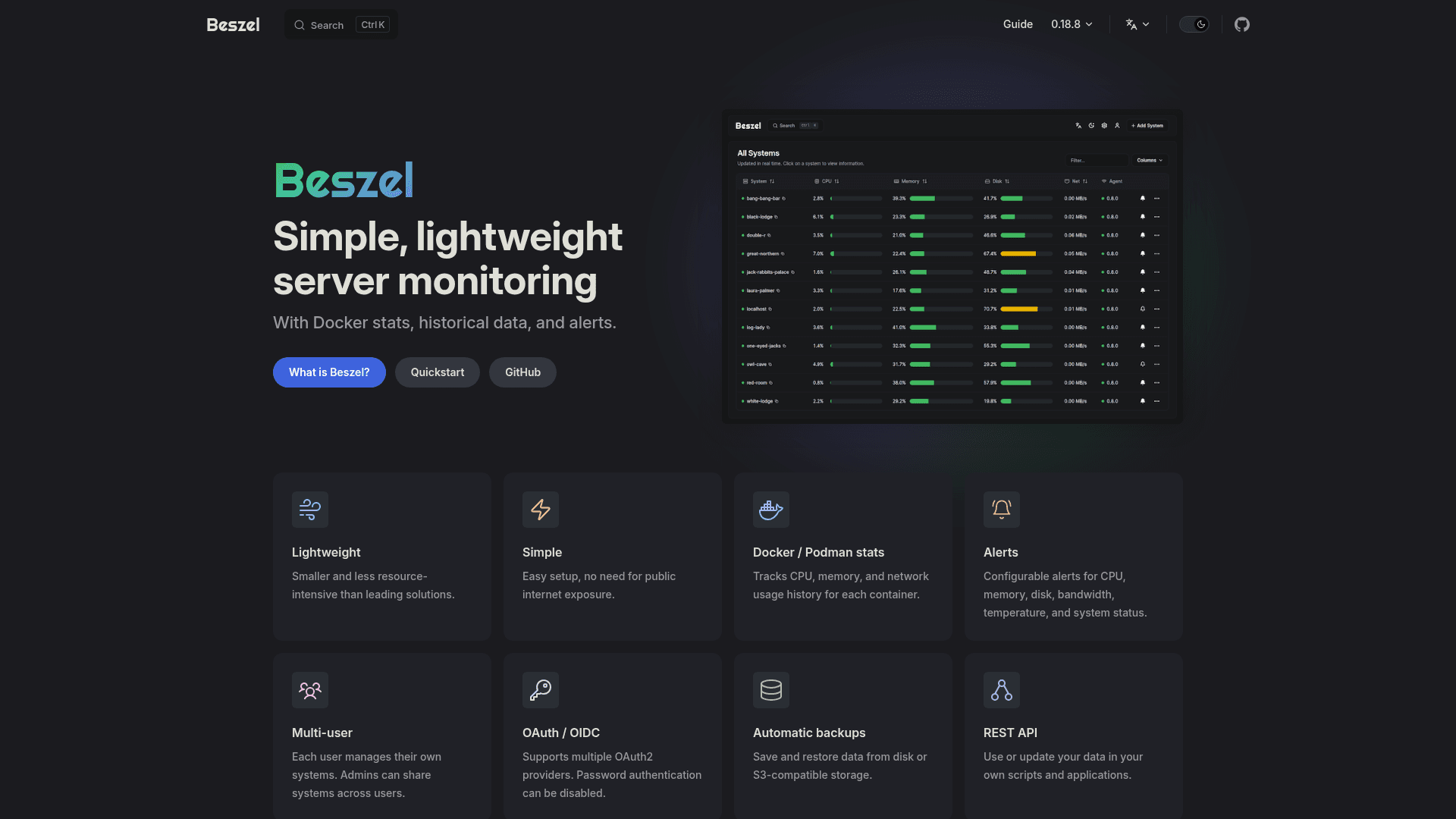
Lightweight, self-hosted server monitoring platform with Docker/Podman stats, historical data, configurable alerts, and multi-user support.
At a Glance
Fully free and open-source under the MIT License. Self-host with no restrictions.
Engagement
Available On
Alternatives
Listed Aug 2026
About Beszel
Beszel is a lightweight, open-source server monitoring platform built by henrygd and released under the MIT License. It provides a friendly web dashboard for tracking system metrics across multiple servers, with full support for Docker and Podman container statistics, historical data retention, and configurable alerting. The project is written primarily in Go and has accumulated over 24,000 GitHub stars since its creation in July 2024.
What It Is
Beszel is a self-hosted monitoring solution designed to be simpler and less resource-intensive than comparable tools. It targets homelab operators, self-hosters, and sysadmins who want visibility into their servers without exposing infrastructure to the public internet. The platform ships as two components — a hub and an agent — that communicate over SSH-style connections, keeping setup minimal and avoiding the need for inbound firewall rules on monitored systems.
Architecture: Hub and Agent
Beszel's two-component design separates concerns cleanly:
- Hub: A web application built on PocketBase that hosts the dashboard, stores historical metrics, manages users, and handles authentication.
- Agent: A small binary (or Docker image) deployed on each system to be monitored. It collects metrics locally and pushes them to the hub.
Both components are available as Docker images, and the agent Docker image is notably small. The hub can back up its data to disk or S3-compatible storage automatically.
Supported Metrics
Beszel covers a broad range of system and container metrics out of the box:
- CPU, memory (including swap and ZFS ARC), disk usage, disk I/O, and network usage for the host and containers
- Load average, temperature sensors, and fan speed (Linux, via
/sys/class/hwmon) - GPU usage and power draw for Nvidia, AMD, and Intel GPUs
- Battery charge, S.M.A.R.T. disk health (including eMMC wear/EOL and Linux mdraid array health)
- Status and metrics for all running Docker and Podman containers
Access Control and Authentication
Beszel supports multi-user deployments where each user manages their own set of systems, and admins can share systems across users. Authentication options include standard password login and multiple OAuth2/OIDC providers, with the ability to disable password auth entirely for organizations that prefer SSO.
Update: v0.18.8
The latest release is v0.18.8, published on August 17, 2026. The project has been actively maintained since its July 2024 launch, with 972 forks and 318 open issues reflecting a growing community. A community-run Matrix room (#beszel:matrix.org) and GitHub Discussions provide support channels alongside the issue tracker. Localization is managed via Crowdin, with a Simplified Chinese translation already available.
Community Discussions
Be the first to start a conversation about Beszel
Share your experience with Beszel, ask questions, or help others learn from your insights.
Pricing
Open Source
Fully free and open-source under the MIT License. Self-host with no restrictions.
- Unlimited servers/agents
- Docker and Podman container monitoring
- Historical metrics data
- Configurable alerts
- Multi-user support
Capabilities
Key Features
- Lightweight server monitoring dashboard
- Docker and Podman container stats (CPU, memory, network)
- Historical metrics data
- Configurable alerts for CPU, memory, disk, bandwidth, temperature, fan speed, load average, and status
- Multi-user support with admin system sharing
- OAuth2 / OIDC authentication
- Password authentication can be disabled
- Automatic backups to disk or S3-compatible storage
- REST API access
- GPU usage and power draw monitoring (Nvidia, AMD, Intel)
- S.M.A.R.T. disk health monitoring
- Battery charge monitoring
- Fan speed monitoring via Linux hwmon
- ZFS ARC and swap memory tracking
- Multi-partition and multi-device disk support
- Hub-and-agent architecture (no public internet exposure required)