
Boltz
Open-source family of models for predicting biomolecular complex structures and binding affinities.
At a Glance
About Boltz
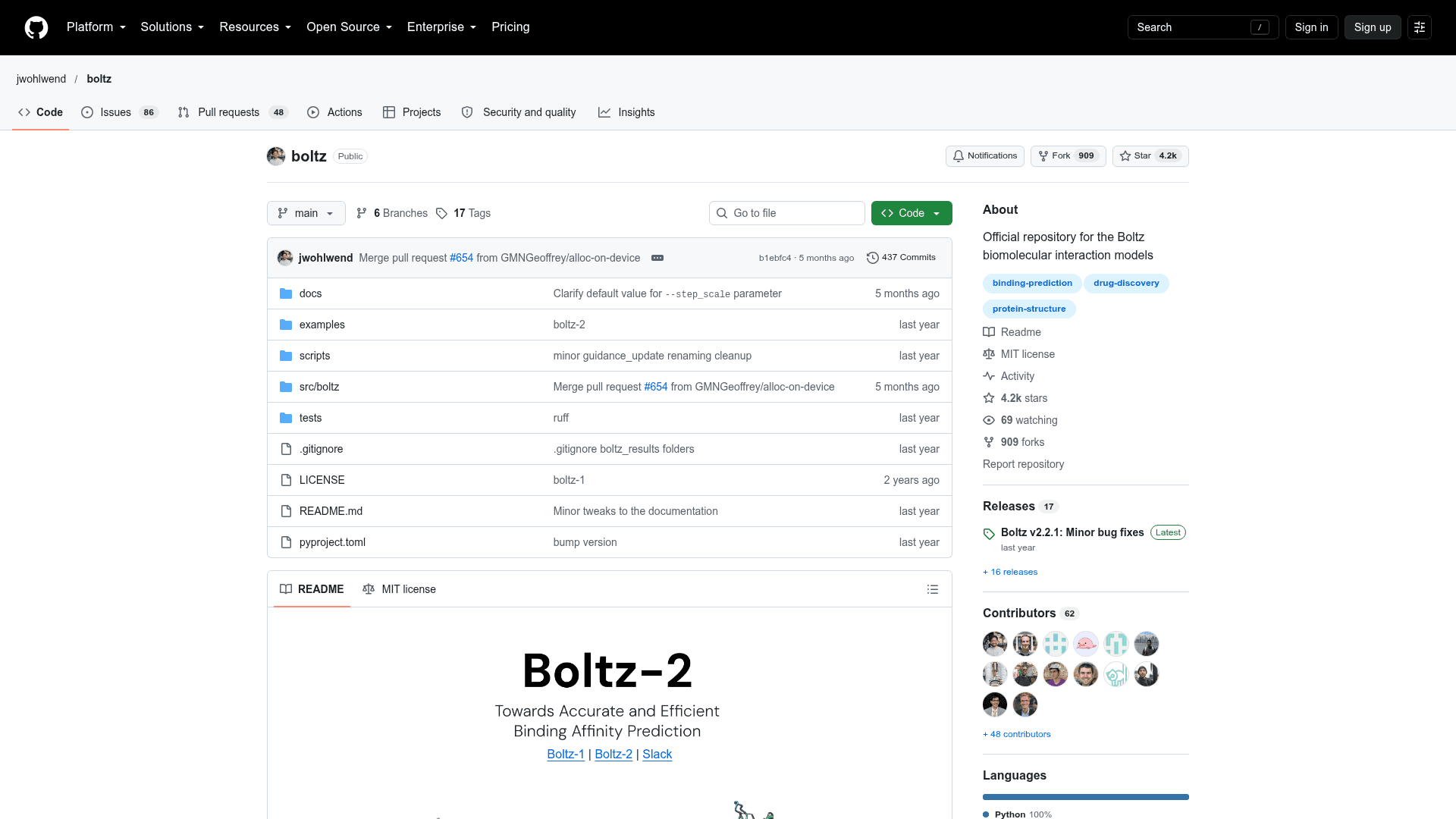
Boltz is a family of biomolecular interaction prediction models distributed as an open-source Python package and command-line tool. Boltz-1 and Boltz-2 are described in technical reports, and the code and weights are released under the MIT license. The latest listed release is v2.2.1, published 2025-09-08.
What It Is
Boltz predicts the 3D structures of biomolecular complexes from YAML input files describing the molecules to model. Boltz-2, the latest model, jointly models complex structures and binding affinities. The authors say it approaches the accuracy of physics-based free-energy perturbation methods while running 1000x faster, which they present as making in silico screening practical for early-stage drug discovery.
How Prediction Works
Users run boltz predict on a single YAML file or a directory of YAML files for batch processing. An option enables an MSA server for automatic multiple sequence alignment generation, with optional authentication. Affinity output has two values:
affinity_probability_binaryseparates binders from decoys, for example in hit discovery.affinity_pred_valuereports log10(IC50) and is meant for ligand optimization stages such as hit-to-lead and lead optimization.
Setup and Hardware
Install from PyPI with the CUDA extra, or from GitHub source. A CPU-only install is supported but significantly slower. On recent NVIDIA GPUs, Boltz uses cuEquivariance kernels. A community fork runs it on Tenstorrent hardware.
Current Status
The README says updated Boltz-2 evaluation and training code is coming soon. Boltz-1 training instructions are available now.
Community Discussions
Be the first to start a conversation about Boltz
Share your experience with Boltz, ask questions, or help others learn from your insights.
Pricing
Open Source (MIT)
Boltz code and model weights released under the MIT License, free for academic and commercial use.
- MIT-licensed code and weights
- Free for academic and commercial use
- Install via pip (pip install boltz[cuda])
- Runs on CPU or GPU (CPU version significantly slower)
Capabilities
Key Features
- Biomolecular complex structure prediction
- Binding affinity prediction
- Binder vs decoy probability output
- Batch inference from YAML files
- Automatic MSA generation via MSA server
- MSA server authentication
- CUDA acceleration with cuEquivariance kernels
- CPU-only mode
- MIT-licensed code and weights