
brainless
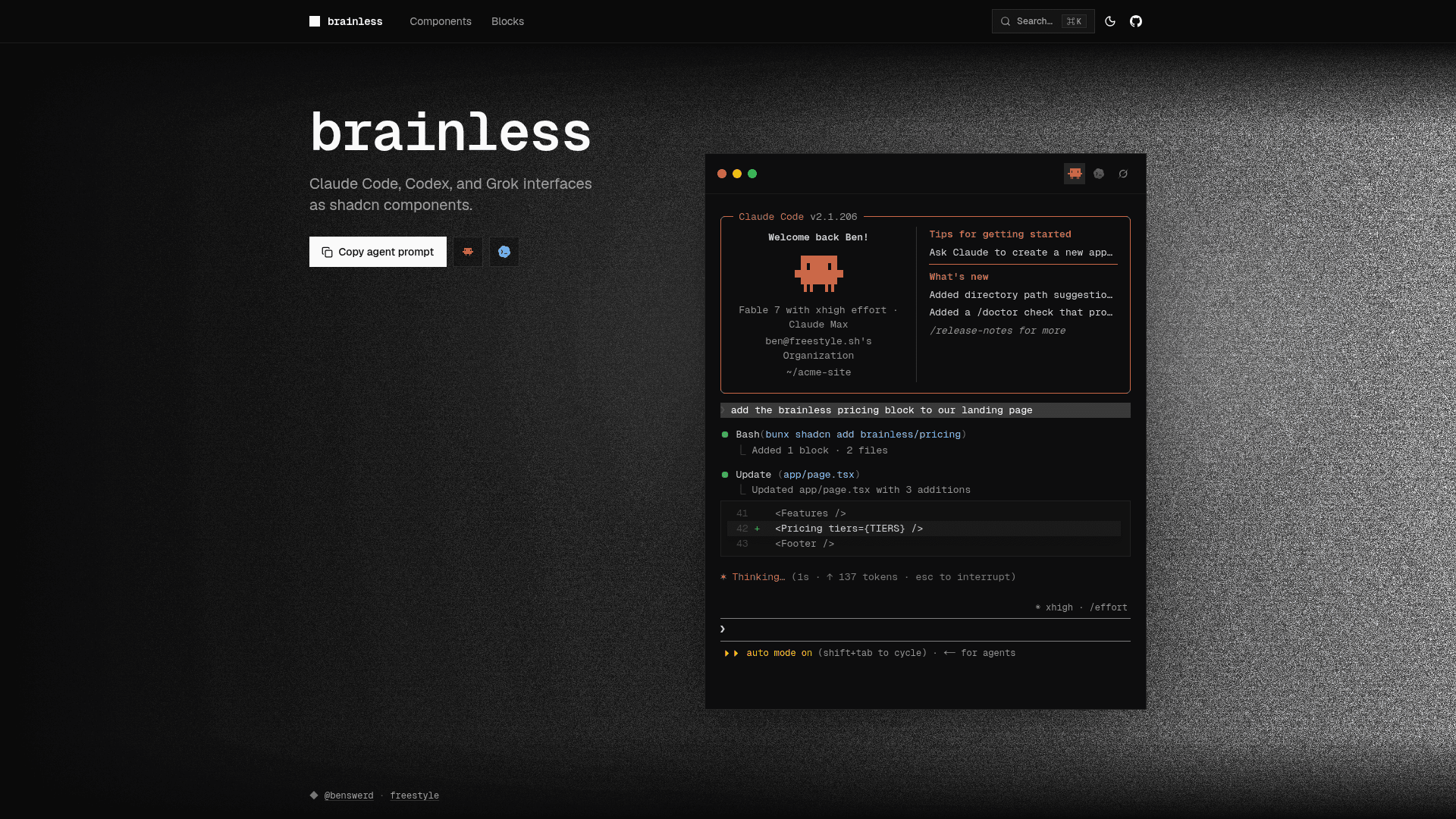
A shadcn/ui registry of accessible React components that recreate the terminal UIs of Claude Code, OpenAI Codex, and Grok for use in docs, demos, and product UI.
At a Glance
About brainless
brainless is an open-source shadcn/ui component registry built by Ben Swerdlow that recreates the terminal interfaces of Claude Code, OpenAI Codex, and Grok as accessible React components. It is licensed under MIT and hosted on GitHub, making it free to use, modify, and distribute.
What It Is
brainless lets developers drop pixel-faithful coding-agent terminal UIs into their own docs, demos, marketing pages, and product interfaces — without relying on screenshots or iframes. Components are built for fidelity against real terminal captures (ANSI/HTML/text frames from actual CLI sessions) and shipped as copy-pasteable shadcn registry items. The project covers three agent families — Claude, Codex, and Grok — each with a matching set of sub-components.
Component Coverage
The registry is organized by agent family and block type:
- Claude: header, message, thinking, tool call, diff, permission, prompt, slash menu, todo list
- Codex: header, message, working, exec, diff, permissions, prompt, slash menu
- Grok: status, header, message, thinking, thought, tool, write, turn end, prompt, slash menu, and more
- Blocks:
claude-session,codex-session,grok-session,grok-session-active— full assembled session views
How Installation Works
brainless integrates with the standard shadcn CLI. The recommended path registers a namespace once in components.json, then individual components or full session blocks can be added with a single command. Three install paths are supported:
- Namespace: register
@brainlesspointing to the registry URL, thenbunx shadcn@latest add @brainless/claude-session - URL:
bunx shadcn@latest add https://brainless.swerdlow.dev/r/claude-session.json - GitHub shorthand:
bunx shadcn@latest add theswerd/brainless/claude-session
After install, components are imported from @/components/brainless/... (e.g., ClaudeSession, CodexHeader, GrokThinking).
Capture Harness and Fidelity Approach
Fidelity starts from real terminal output. The repo includes a capture harness under tools/capture/ that drives agents inside tmux, dumps frames as ANSI, HTML, and plain text, and stores them in references/captures/ for side-by-side review during component development. This approach means the components reflect actual CLI behavior rather than approximations.
Repo Architecture
The repository is structured as a monorepo combining the component registry and a Next.js documentation site:
registry/brainless/— TypeScript source components (claude / codex / grok / blocks / ui)public/r/— built registry JSON consumed byshadcn addreferences/captures/— ANSI/HTML/text frames from real CLI sessionstools/capture/— tmux capture harnessapp/— Next.js docs site with component previews and block catalog
Current Status
The project was created in July 2026 and has accumulated 132 stars and 5 forks on GitHub as of mid-July 2026. It is actively maintained with zero open issues. The homepage includes a prompt that can be sent directly to Claude Code or Codex to bootstrap usage in a project, and the site provides live previews at /components and /blocks.
Community Discussions
Be the first to start a conversation about brainless
Share your experience with brainless, ask questions, or help others learn from your insights.
Pricing
Open Source
Fully free and open source under the MIT License. Use, modify, and distribute freely.
- All Claude, Codex, and Grok UI components
- Full session block components
- shadcn/ui registry integration
- MIT License
- Source code access on GitHub
Capabilities
Key Features
- Claude Code terminal UI components
- OpenAI Codex terminal UI components
- Grok terminal UI components
- Full session block components
- shadcn/ui registry integration
- Namespace-based install via shadcn CLI
- URL and GitHub shorthand install paths
- Accessible React components with ARIA semantics
- Real terminal capture harness for fidelity
- Copy-pasteable registry items
- Next.js documentation site with live previews
- MIT licensed and open source