
Browserr
A Servo-based browser engine for AI agents with a 42-tool MCP server, human handoff, and an evidence trail.
At a Glance
Free, open source Servo-based browser engine under the Apache-2.0 license; no account, no telemetry.
Engagement
Available On
Listed Nov 2026
About Browserr
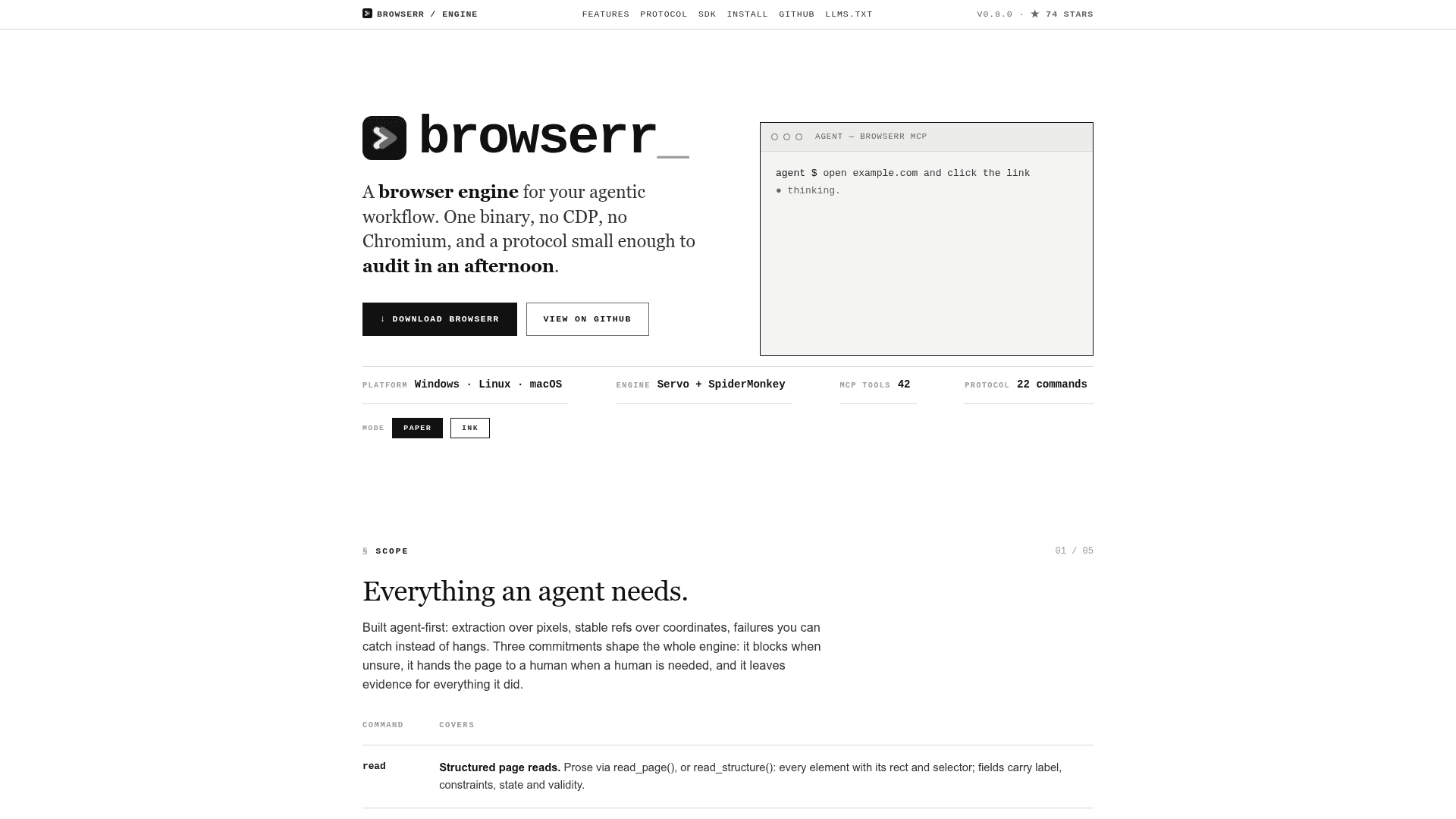
Browserr is an open-source browser engine built for AI agents, published by Omodaka9375 under the Apache-2.0 license. It is a single Rust + Servo binary that renders pages, blocks ads, and exposes a small loopback JSON protocol instead of embedding Chromium and CDP. The latest release shown is v0.8.0.
What It Is
Browserr is a headless-by-default browser for agentic workflows, with an optional native window for human handoff. It is organized around three commitments: block when unsure, hand the page to a human when needed, and leave evidence for every action. Agents drive it through an MCP server with 42 tools, a dependency-free Python SDK, or by writing JSON lines to a socket.
How the Agent Workflow Works
Agents read pages with token-cheap prose extraction or a structured inventory of interactive elements, each with a selector, rect and stable ref such as e7. They then act through selector or ref-based clicks, React/Vue-safe value writes, and whole-form fills. Submit actions run the page's own validation and report the resulting URL, alerts and invalid fields. Screenshots, console capture, downloads, a fetch/XHR evidence ring buffer and frame listing support observation.
Trust, Handoff and Network Control
- Intercepted requests are held for an allow, deny or respond decision and are denied after 5 seconds if unanswered.
- Auth challenges with no stored credentials fail closed, and payment or CAPTCHA submits need an explicit human confirm.
- Handoff detection flags CAPTCHAs, one-time codes and payment fields. Pause and resume let a person take over in a native window started with headed mode.
- Evidence consists of timestamped screenshots and an append-only action log per profile; credentials are never logged.
- Upstream proxy routing is supported, along with a document-status probe that distinguishes a blocked page from a dead one.
Setup Path and Limits
MCP clients can add a single uvx browserr-mcp entry; the engine is downloaded and sha256-verified on first run. Archives are available for Windows x64, Linux x64/ARM64 and macOS Apple Silicon, and Python 3.10+ is required. A bundled terminal browser, browserr-term, renders pages in-pane using Sixel or Kitty graphics. Web compatibility is bounded by Servo 0.8: DRM video, WebRTC and service-worker offline apps are unsupported. The README also documents that Cloudflare Turnstile, hCaptcha and reCAPTCHA v2 challenges do not work.
Community Discussions
Be the first to start a conversation about Browserr
Share your experience with Browserr, ask questions, or help others learn from your insights.
Pricing
Open Source
Free, open source Servo-based browser engine under the Apache-2.0 license; no account, no telemetry.
- Apache License 2.0
- 42 MCP tools
- 22 protocol commands
- Python SDK (driver.py)
- No account, no telemetry
Capabilities
Key Features
- Servo + SpiderMonkey engine with CPU rendering by default and optional GPU
- MCP server with 42 tools
- 22-command JSON loopback protocol
- Structured page reads with stable element refs
- Type-aware form filling and submit/outcome reporting
- Fail-closed request interception
- Net evidence ring buffer for fetch/XHR
- Built-in EasyList adblock
- Human handoff via native headed window with pause/resume
- Handoff detection for CAPTCHAs, OTP and payment fields
- Annotated screenshots
- Persistent and ephemeral profiles
- Evidence screenshots and append-only action log
- Credential store and payment confirm gate
- Upstream proxy routing
- Terminal browser (browserr-term) with Sixel/Kitty graphics
- Python SDK