
Cairn
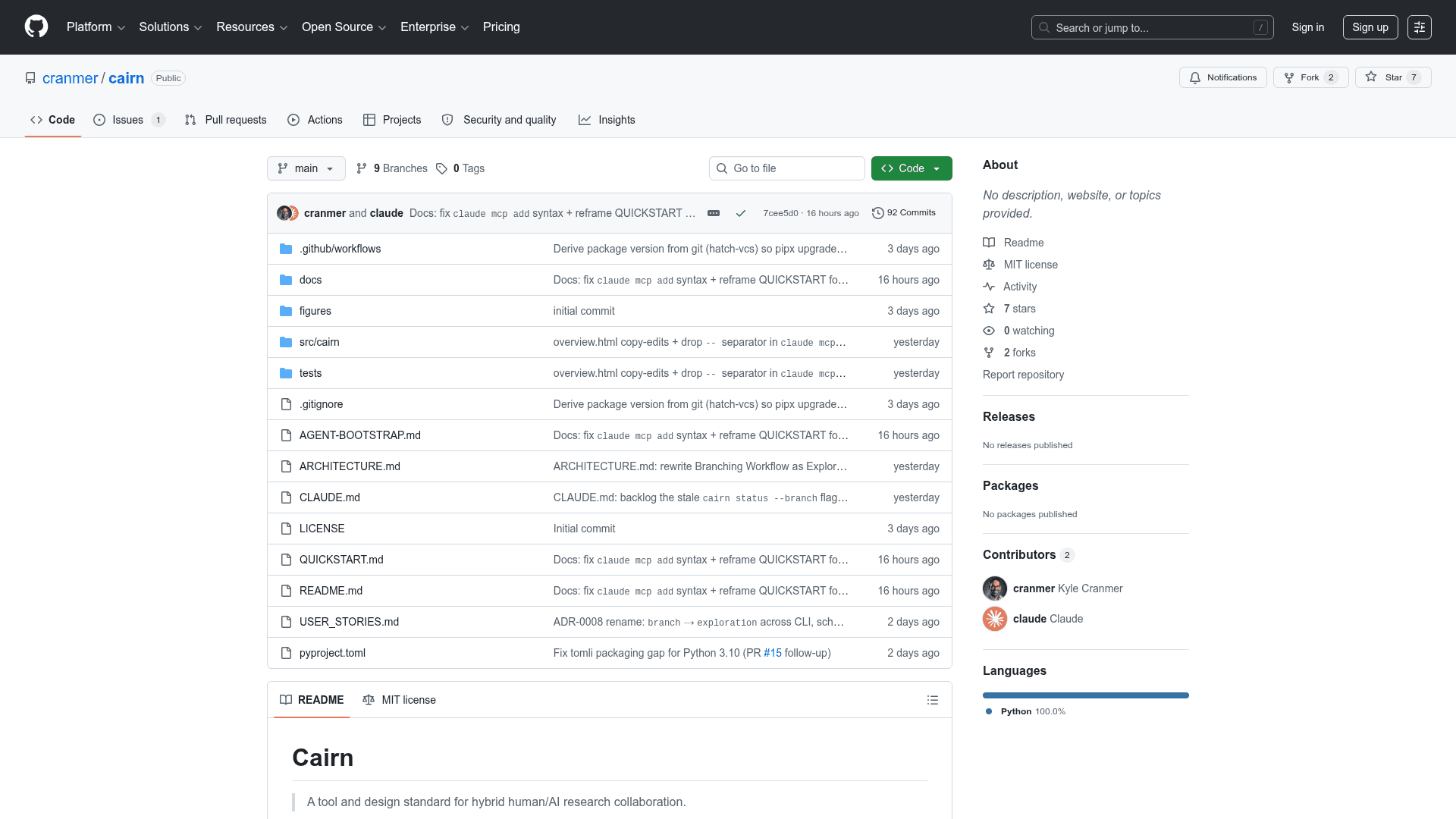
A framework and Python package for maintaining a research group's shared project memory, designed for hybrid human/AI collaboration via git repositories and MCP servers.
At a Glance
Free and open-source under the MIT License. Install via pipx from GitHub.
Engagement
Available On
Listed May 2026
About Cairn
Cairn is an open-source framework and Python package created by Kyle Cranmer for managing shared research project memory in a world where AI agents collaborate alongside humans. It defines a repository structure, file schemas, and conventions that sit on top of a plain git repository, making the substrate itself the source of truth. The project was created in May 2026 and is actively being developed using Claude Code.
What It Is
Cairn (capitalized) is the framework — the GitHub repository, the Python package, and the conventions. A cairn (lowercase) is an instance: one research project's repository organized following Cairn's conventions. A research group runs one cairn per project as a separate repo alongside their existing code, analysis, and paper repositories. The cairn holds the group's shared memory — decisions, open questions, findings, action items, and meeting notes — that doesn't naturally fit inside any single code repo.
Core Design Principles
Cairn is built around two foundational commitments:
- Substrate-as-specification: state lives in files in git, not in a proprietary database or service. Everything else (agents, indices, dashboards, MCP servers) is a replaceable layer on top.
- Augmentation, not replacement: collaborators keep using their normal tools — git, Zoom, Slack, email — at their normal rhythm. An agent listens in those native channels and writes structured notes into the cairn as a side effect, so others can catch up on the structured view without having been in the room.
MCP-First Architecture
The primary integration surface is an MCP server (cairn mcp) that exposes approximately 28 read and write tools to any Claude Code session. A single server serves all of a user's cairns; each MCP tool accepts a cairn parameter naming the target. The design follows two access modes:
- Client mode: a Claude Code session opened in a project's code repo, with the cairn as a transparent backend called via MCP — the everyday case.
- Server mode: a session opened inside the cairn directory itself, used for occasional maintenance, deep debriefs, restructuring, or planning meetings.
What It Enables
Cairn's structured memory layer supports several research collaboration patterns:
- Persistent shared memory across meetings, decisions, findings, and discussions
- Async contribution and recall — collaborators and their agents can query what was decided or discussed without attending the original conversation
- Parallel exploration tracking — rationale for alternative inquiries, methodology choices, and comparative analyses can be preserved as tracked explorations
- Uniform interface for human and AI collaborators with attributed identities
- Reproducible artifact export into emerging community standards including ASTRA, ARA, and RO-Crate
Current Status and Roadmap
The project self-describes its status as: Phase 0–2 mostly shipped, Phase 3 (MCP server) shipped and being UX-tested. The Python package scaffolds new cairns, manages collaborators, decisions, findings, actions, and open questions, validates state, exposes MCP tools, and supports retroactive bootstrap from existing project repos. Phases 4–6 on the roadmap include meeting capture via Whisper and pyannote diarization, an AI collaborator runtime for literature monitoring, and a long-term voice-mode meeting participant. The project sits in an ecosystem alongside peer specifications ASTRA (Agentic Schema for Transparent Research and Analysis) and ARA (Agent-Native Research Artifact), which capture crystallized research outputs that a cairn can export to when work is ready to share.
Community Discussions
Be the first to start a conversation about Cairn
Share your experience with Cairn, ask questions, or help others learn from your insights.
Pricing
Open Source
Free and open-source under the MIT License. Install via pipx from GitHub.
- Full Python CLI
- MCP server with ~28 tools
- Git-backed project memory
- Pydantic v2 schemas
- Bundled agent skills
Capabilities
Key Features
- MCP server exposing ~28 read/write tools to Claude Code sessions
- Git-backed shared project memory (decisions, findings, actions, open questions)
- Python CLI for scaffolding and managing cairn repositories
- Pydantic v2 schemas for structured state files
- Retroactive bootstrap from existing project repos
- Bundled agent skill files (orient, log-finding, log-decision, debrief, etc.)
- Single MCP server serving multiple cairns via registry
- cairn.toml project-repo pairing
- Artifact export to ASTRA, ARA, and RO-Crate standards
- Tracked explorations for alternative lines of inquiry
- Collaborator registry supporting human, AI, group, and unknown types
- cairn validate for schema and cross-reference checks
- cairn status for compact project-state summary with JSON output
- Backdating and structured PR/commit provenance
- SessionStart hook for auto-orientation in Claude Code