
Canary
A QA harness built for Claude Code that reads code diffs, identifies affected UI flows, and tests them in real browser instances with full session recordings.
At a Glance
Fully free and open-source under the MIT license. Install via npm and use without restrictions.
Engagement
Available On
Alternatives
Listed Jun 2026
About Canary
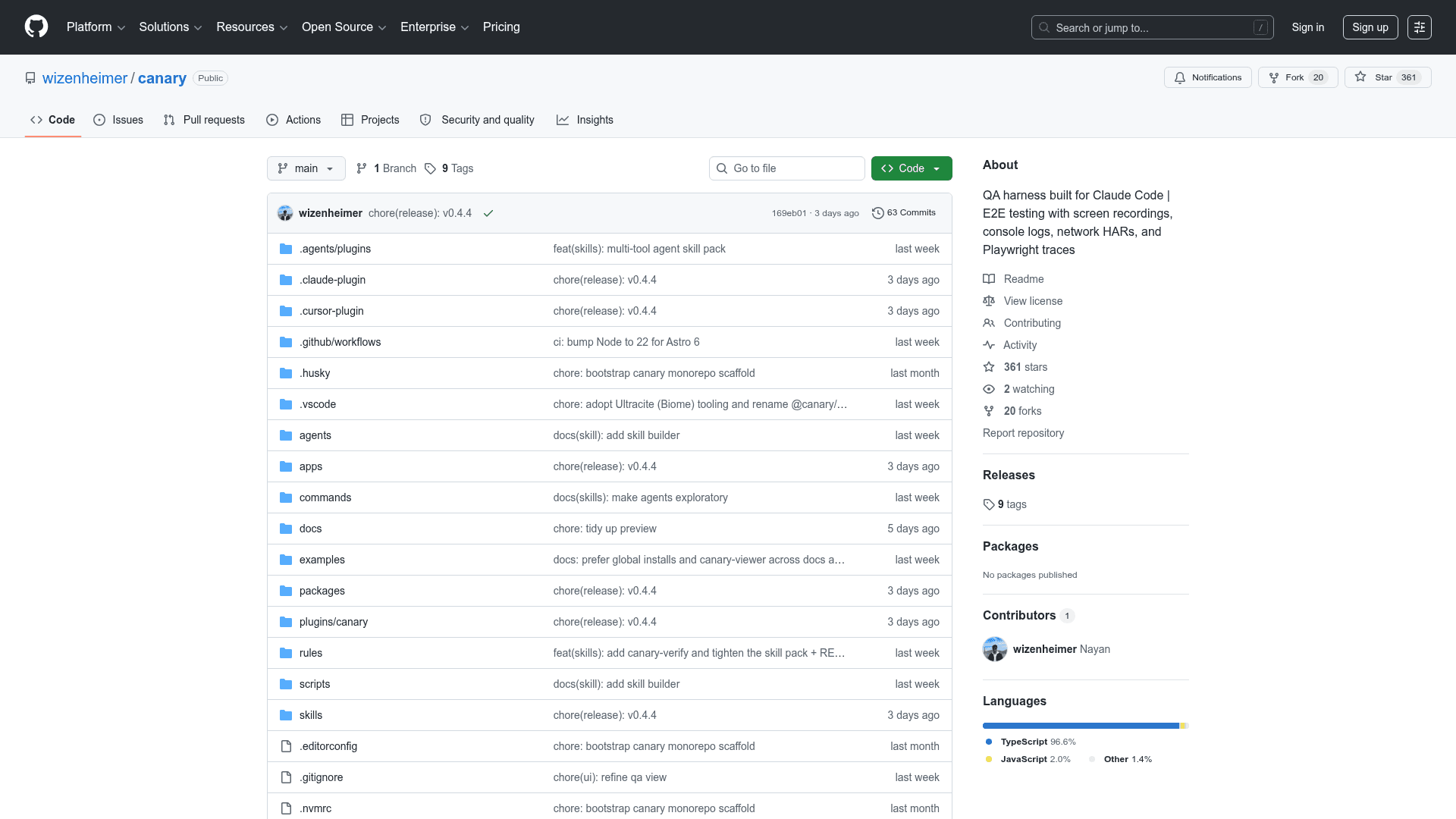
Canary is an open-source QA harness purpose-built for coding agents like Claude Code, Cursor, and Codex. It reads code diffs, identifies affected UI flows, and drives real browser instances using a QuickJS WASM sandbox that exposes the full Playwright API. The project is MIT-licensed and hosted on GitHub under the wizenheimer/canary repository.
What It Is
Canary sits at the intersection of browser automation and AI coding agents. Rather than forcing a choice between opaque agent runs you can't reproduce and raw Playwright scripts you have to write and maintain by hand, Canary does both: the agent performs the QA and hands back a reproducible Playwright script. Every session captures screen recordings, console logs, network requests, HAR files, and Playwright traces in a self-contained report.html that requires no server or build step to open.
How the Agent Workflow Works
The core loop is straightforward: describe a UI flow in plain language, and the agent drives a real browser, then returns both a human-readable report and the exact Playwright script behind it. In Claude Code, Canary registers as a first-class plugin with slash commands (/canary:verify, /canary:session, /canary:run, /canary:review) and subagents. Cursor and Codex integrations are also available via their respective plugin marketplaces, all pointing at the same shared skills/, agents/, and commands/ directories.
Architecture: Three Tools, One Runtime
Canary ships as a pnpm + Turborepo monorepo with three user-facing tools sharing a single background daemon:
@usecanary/cli(canary) — the main session orchestrator; records capture-enabled QA sessions and renders reports@usecanary/browser(canary-browser) — a lightweight engine for quick, one-off browser automation with no recording overhead@usecanary/ui(canary-viewer) — a local Astro-based viewer for browsing, searching, and replaying recorded sessions
The daemon runs Playwright and a QuickJS WASM sandbox. Scripts execute in a sandboxed environment with no arbitrary host access — no Node.js module system, no direct filesystem or network access from script context, and enforced memory and CPU limits.
What Gets Captured
Every Canary session records a comprehensive evidence trail by default:
- Video replay with a per-step filmstrip and scrubbing
- Playwright trace (
trace.zip) decodable withnpx playwright show-trace - Network HAR with per-request headers, payloads, and response inspection
- Console log filterable by level (errors, warnings, info, logs) with source URLs
- Reproducible Playwright script — the exact calls (
goto,waitForSelector,evaluate,screenshot) with params and timing - Self-contained
report.html— one file, no server, committable and shareable
Individual capture streams can be disabled with --no-trace, --no-video, --no-har, or --no-console.
Setup Path
Installation requires Node 20+ and pnpm. The quickest path is:
npm i -g @usecanary/cli @usecanary/ui
canary install   # one-time: downloads Chromium + runtime (~150 MB) into ~/.canary
A guided wizard (npm create canary@latest) handles the full setup interactively. All commands also run one-off via npx without a global install. Agent plugin installation uses each agent's own marketplace mechanism — Claude Code via /plugin marketplace add wizenheimer/canary, Cursor via its Marketplace UI, and Codex via codex marketplace add wizenheimer/canary.
Current Status
The repository was created in June 2026 and had 344 stars and 19 forks as of mid-June 2026, with active development reflected in recent pushes. The project is MIT-licensed, with portions derived from MIT-licensed work by Sawyer Hood. The license file in the repository is listed as "NOASSERTION" in GitHub metadata, though the LICENSE file itself is a standard MIT license text.
Community Discussions
Be the first to start a conversation about Canary
Share your experience with Canary, ask questions, or help others learn from your insights.
Pricing
Open Source
Fully free and open-source under the MIT license. Install via npm and use without restrictions.
- Full CLI session orchestration
- Browser automation engine
- Local session viewer
- Claude Code, Cursor, and Codex plugin integrations
- Playwright trace, video, HAR, and console capture
Capabilities
Key Features
- Reads code diffs and identifies affected UI flows
- Drives real browser instances via Playwright
- QuickJS WASM sandbox with full Playwright Page API
- Full session recordings with video replay
- Playwright trace capture and decoding
- Network HAR capture with per-request inspection
- Console log capture filterable by level
- Reproducible Playwright scripts generated from every run
- Self-contained report.html with no server required
- Claude Code plugin with slash commands and subagents
- Cursor and Codex plugin integrations
- Background daemon with automatic lifecycle management
- One-off browser automation via canary-browser
- Local session viewer via canary-viewer
- Sandboxed script execution with memory and CPU limits
- CI-ready script replay with zero inference cost
- Attach to existing Chrome via remote debugging port