
Chainlit
An open-source Python package for building production-ready conversational AI applications with a built-in UI, authentication, data persistence, and multi-step reasoning visualization.
At a Glance
Free to use, modify, and distribute under the Apache License 2.0.
Engagement
Available On
Alternatives
Listed Jul 2026
About Chainlit
Chainlit is an open-source Python package licensed under Apache 2.0 that lets developers build and deploy production-ready conversational AI applications. Created by the Chainlit organization and first published in March 2023, it provides a full-stack framework — from a chat UI to backend lifecycle hooks — so teams can go from prototype to production without assembling separate UI and infrastructure pieces.
What It Is
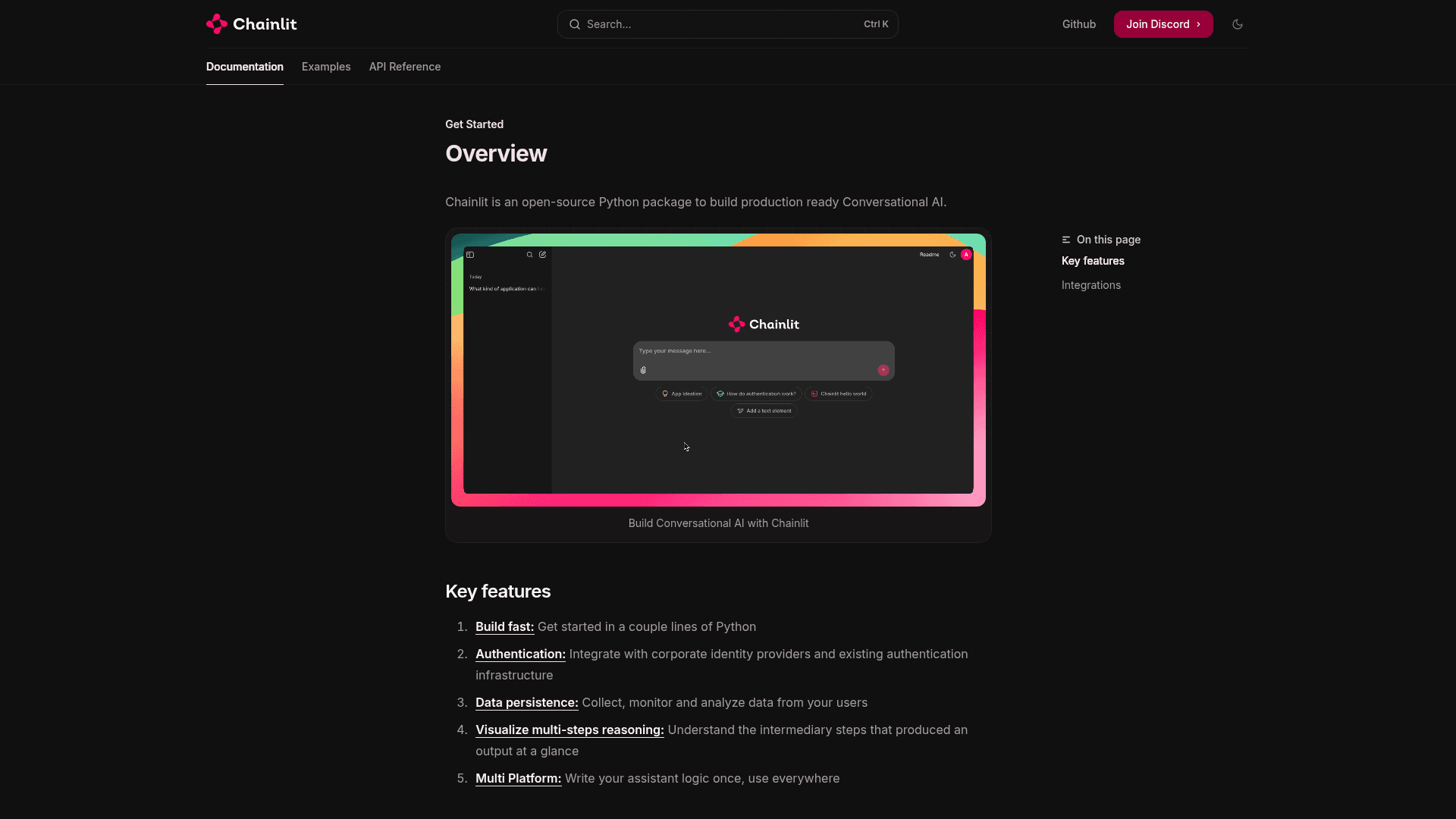
Chainlit is a Python-first framework for building conversational AI interfaces. It sits in the category of AI application frameworks: developers write Python code using Chainlit's lifecycle hooks and decorators, and the framework automatically renders a chat UI, handles streaming, manages user sessions, and exposes authentication and data-persistence layers. The core value proposition is that a working chat interface can be launched in a few lines of Python, while the same codebase scales to enterprise deployments with OAuth, corporate identity providers, and persistent chat history.
How the Framework Works
Chainlit is structured around a set of core concepts that map directly to the chat experience:
- Chat Lifecycle —
on_chat_start,on_message, and related hooks let developers control what happens at each stage of a conversation. - Steps — intermediate reasoning steps (e.g., tool calls, retrieval results) are surfaced in the UI so users can inspect how an answer was produced.
- Elements — rich content types (images, files, dataframes) can be attached to messages.
- Actions and Commands — interactive buttons and slash-command inputs can be embedded in the chat.
- Modes — the UI can be configured for different interaction patterns.
Integrations and Ecosystem
Chainlit is compatible with any Python program or library. The documentation lists first-class integrations with:
- LangChain — run any LangChain agent inside a Chainlit UI
- OpenAI and OpenAI Assistants — explore and visualize OpenAI API calls
- Mistral AI — use Mistral models with full step visualization
- Semantic Kernel — integrate Microsoft's Semantic Kernel orchestration
- Llama Index — connect retrieval-augmented generation pipelines
- Autogen — run multi-agent Autogen workflows
The advanced features section also documents MCP (Model Context Protocol) support and multi-modal input handling.
Deployment and Authentication
Chainlit includes a deployment overview covering multiple target platforms, and a built-in authentication system that supports password-based login, header-based auth, and OAuth — enabling integration with corporate identity providers and existing authentication infrastructure. Data persistence features cover chat history storage, human feedback collection, and open-source data layer options, with tags and metadata support for filtering and analysis.
Update: Version 2.11.1
The latest release is version 2.11.1, published on April 22, 2026. The migration guides in the documentation trace a series of breaking-change releases from v1.0.500 through v2.9.4, indicating active development and a maturing API surface. The repository shows 12,270 stars and 1,724 forks on GitHub as of the data collected, with the last push in June 2026, signaling an actively maintained project. The project is written primarily in Python and is available under the Apache License 2.0.
Community Discussions
Be the first to start a conversation about Chainlit
Share your experience with Chainlit, ask questions, or help others learn from your insights.
Pricing
Open Source
Free to use, modify, and distribute under the Apache License 2.0.
- Full framework source code
- Chat UI
- Authentication
- Data persistence
- All integrations
Capabilities
Key Features
- Build conversational AI UI in a few lines of Python
- Chat lifecycle hooks (on_chat_start, on_message, etc.)
- Multi-step reasoning visualization
- Streaming support
- Authentication (password, header, OAuth, corporate IdP)
- Data persistence and chat history
- Human feedback collection
- Multi-modal input support
- MCP (Model Context Protocol) support
- Chat profiles and settings
- Customizable theme, CSS, JS, avatars, logo
- User session management
- Rich elements (images, files, dataframes)
- Actions and commands in chat UI
- Testing and debugging tools
- Multi-platform deployment