
chromem-go
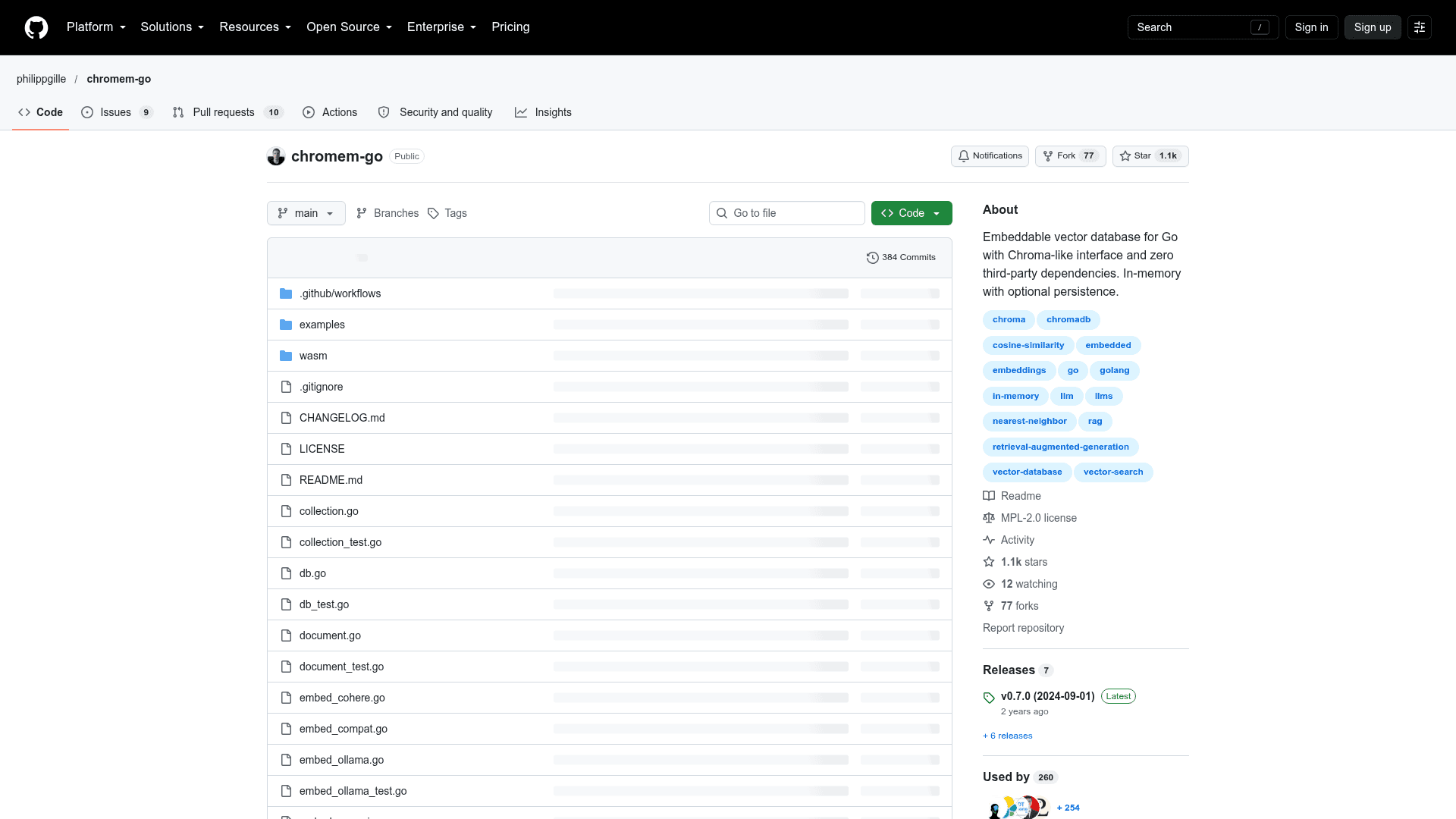
Embeddable vector database for Go with a Chroma-like interface, zero third-party dependencies, in-memory storage and optional persistence.
At a Glance
Embeddable vector database for Go, licensed under MPL-2.0 (OSI-approved). Free to use, modify and distribute under license terms.
Engagement
Available On
Listed Oct 2026
About chromem-go
chromem-go is an open-source embeddable vector database for Go, created by philippgille and licensed under MPL-2.0. It lets Go applications add retrieval augmented generation (RAG) and other embeddings-based features without running a separate database server, much like SQLite is used instead of PostgreSQL or MySQL. The latest listed release is v0.7.0 (2024-09-01), and the README marks the project as beta with possible breaking changes before v1.0.0.
What It Is
chromem-go is a standalone vector database written in Go, with an interface inspired by Chroma. It is not a client for Chroma and not a reimplementation of it. It stores documents and their embeddings in memory, with optional persistence, and runs inside the host application process. Its stated focus is simplicity and performance for common use cases rather than scale to millions of documents.
How the Workflow Works
You create a DB, create a collection, and add documents with optional metadata. Embeddings can be supplied by you or generated by the library. Querying runs an exhaustive nearest-neighbor search using cosine similarity, with optional document filters ($contains, $not_contains) and exact-match metadata filters. For RAG, the retrieved content is then passed to an LLM alongside the question. Adding and querying documents are multithreaded using Go concurrency.
Embedding Providers and Storage
Hosted embedding providers supported out of the box are OpenAI (the default), Azure OpenAI, GCP Vertex AI, Cohere, Mistral, Jina and mixedbread.ai. Local options include Ollama, llmman and LocalAI, and a custom EmbeddingFunc can be implemented. Storage is in-memory, with optional immediate persistence as gob-encoded files that can be gzip-compressed. The whole DB can be exported or imported to a single file, optionally gzip-compressed and AES-GCM encrypted, and generic io.Writer/io.Reader methods allow plugging in blob storage such as S3.
Performance and Roadmap
The README reports benchmarks on a 2020 Intel laptop CPU: about 0.3 ms to query 1,000 documents and about 40 ms for 100,000 documents. Planned work listed includes SIMD dot products, approximate nearest neighbor indexes (HNSW, IVFFlat), $and/$or filter operators, additional storage formats and support for images and videos. An experimental WebAssembly binding exists.
Community Discussions
Be the first to start a conversation about chromem-go
Share your experience with chromem-go, ask questions, or help others learn from your insights.
Pricing
Open Source
Embeddable vector database for Go, licensed under MPL-2.0 (OSI-approved). Free to use, modify and distribute under license terms.
- Licensed under Mozilla Public License 2.0 (MPL-2.0)
- Zero third-party dependencies
- Embeddable, in-memory with optional persistence
- Multiple embedding providers supported (OpenAI, Ollama, etc.); third-party embedding provider costs are external
- Project in beta; may introduce breaking changes before v1.0.0
Capabilities
Key Features
- Embeddable vector database with no separate server
- Zero third-party dependencies
- Chroma-like interface
- In-memory storage with optional persistence
- Multithreaded adding and querying of documents
- Exhaustive cosine-similarity nearest neighbor search
- Document and metadata filters
- Export and import of entire DB with optional gzip and AES-GCM encryption
- Built-in embedding providers and custom EmbeddingFunc
- Experimental WebAssembly binding