
Claude Managed Agents
Anthropic's pre-built agent harness that runs Claude as an autonomous agent in managed cloud containers, with built-in tools, skills, memory stores, multi-agent orchestration, and outcome-graded sessions.
At a Glance
About Claude Managed Agents
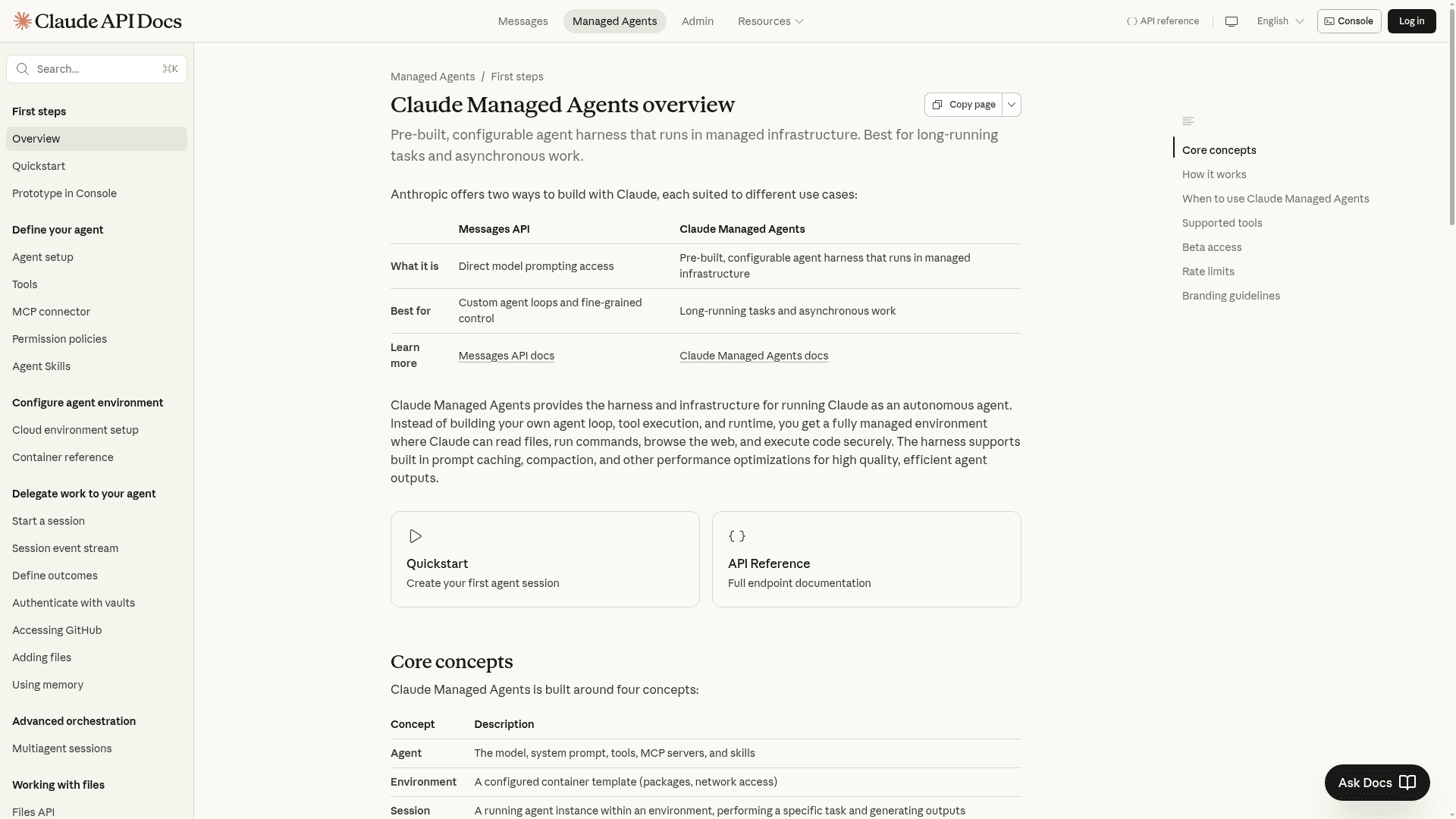
Claude Managed Agents is Anthropic's pre-built agent harness for running Claude as an autonomous agent without building your own agent loop, sandbox, or tool execution layer. Instead of orchestrating model calls, tool dispatch, and runtime infrastructure yourself, you get a fully managed environment where Claude can read files, run shell commands, browse the web, and execute code inside secure cloud containers. The harness includes built-in prompt caching, context compaction, and other performance optimizations aimed at high-quality, efficient agent outputs over long sessions.
The product is structured around four core concepts. An agent bundles the model, system prompt, tools, MCP servers, and skills, and is created once then referenced by ID across sessions. An environment is a configured container template with pre-installed packages (Python, Node.js, Go, and others) and network access rules. A session is a running agent instance executing a specific task inside an environment, with persistent file system state and conversation history. Events are the messages exchanged between your application and the agent — user turns, tool results, status updates, and outcome evaluations — streamed back over server-sent events.
The built-in toolset (agent_toolset_20260401) includes bash for shell execution, file operations (read, write, edit, glob, grep), web fetch, and web search. Individual tools can be enabled or disabled per agent. Custom tools are supported on top of the built-in set: Claude emits a structured request, your code executes it, and the result flows back into the conversation. The harness also supports MCP connectors for external tool providers, vault-based authentication for secrets, and direct GitHub access for repository operations.
Agent Skills are filesystem-based capability bundles that turn a general-purpose agent into a specialist. Each Skill is a directory with a SKILL.md file containing YAML frontmatter (name, description) plus optional bundled instructions, executable scripts, and reference materials. Skills load progressively: only metadata is loaded into context at startup, and full instructions or bundled files are read on demand via bash, which means a single agent can carry many specialized skills without paying the context cost upfront. Anthropic ships pre-built Skills for PowerPoint, Excel, Word, and PDF generation, and custom Skills can be uploaded organization-wide.
Memory stores give agents persistent memory that survives across sessions. A memory store is a workspace-scoped collection of text documents, mounted into the session container as a directory the agent reads and writes with its normal file tools. Stores can be seeded with reference material, attached read-only or read-write, and audited via immutable memory versions with 30-day version history. Limits include up to 1,000 stores per organization, 2,000 memories per store, 100MB per store, and 8 stores per session — making it practical to model per-user, per-project, or shared-reference memory cleanly.
Multi-agent sessions (research preview) let one orchestrator agent delegate work to specialized sub-agents inside the same container. Each agent runs in its own context-isolated thread with its own conversation history, model, system prompt, and toolset, while sharing the underlying filesystem. Threads are persistent, so the orchestrator can follow up with an agent it called earlier. Common patterns include a reviewer agent with read-only tools, a test-writer agent that runs tests in isolation, and a research agent with web tools that summarizes findings back to the coordinator. Only one level of delegation is supported.
Outcomes (research preview) elevate a session from open-ended conversation to graded work. You define a target deliverable plus a markdown rubric describing per-criterion scoring, and the harness automatically provisions a separate grader agent (with its own context window) to evaluate the agent's output against the rubric. The grader returns a per-criterion breakdown — either confirmation that criteria are satisfied or specific gaps — and hands that feedback back to the agent for the next iteration. The agent self-evaluates and iterates up to a configurable max (default 3, max 20) until the outcome is satisfied, max iterations is reached, the rubric fundamentally fails to match the task, or the session is interrupted.
Managed Agents can be created and operated from multiple surfaces: the Claude Console, raw HTTP/SDK calls (Python, TypeScript, Go, and others), and Anthropic's official Go-based ant CLI (brew install anthropics/tap/ant), which supports a GitOps-style YAML workflow for checking agent configs into Git and deploying them through CI. Notably, recent versions of Claude Code (v2.1.96+) ship with a Managed Agents skill that runs a conversational onboarding flow inside the local Claude Code session, asking clarifying questions about tools, permissions, model selection, and system prompt, then generating ready-to-run TypeScript setup and runtime files — so an agent can be scaffolded from local code context without manually clicking through the web console.
Claude Managed Agents is currently in beta and requires the managed-agents-2026-04-01 beta header on all requests; research preview features (outcomes, multiagent) require an additional managed-agents-2026-04-01-research-preview header and are gated behind a request-access form. Endpoints are rate-limited per organization at 300 create requests per minute and 600 read requests per minute, on top of standard tier-based limits. Pricing has two components: session runtime is billed at $0.08 per session-hour metered to the millisecond (idle time is free), plus standard Claude model token pricing for all inference. There is no separate Managed Agents subscription.
The Managed Agents API itself does not include native cron-style scheduling, automatic retries, fan-out, or webhook triggers — for that pattern, Claude Code Routines (a separate Anthropic feature on Pro/Max/Team/Enterprise plans) layer scheduled and event-driven execution on top of the broader managed-agents cloud, supporting cron schedules, API calls, and GitHub event triggers with a one-hour minimum cron granularity. Teams that need finer scheduling, retries, fan-out, approvals, and durable workflow orchestration still typically reach for a workflow platform like Trigger.dev alongside Managed Agents.
Community Discussions

What Anthropic shipped at Code with Claude 2026
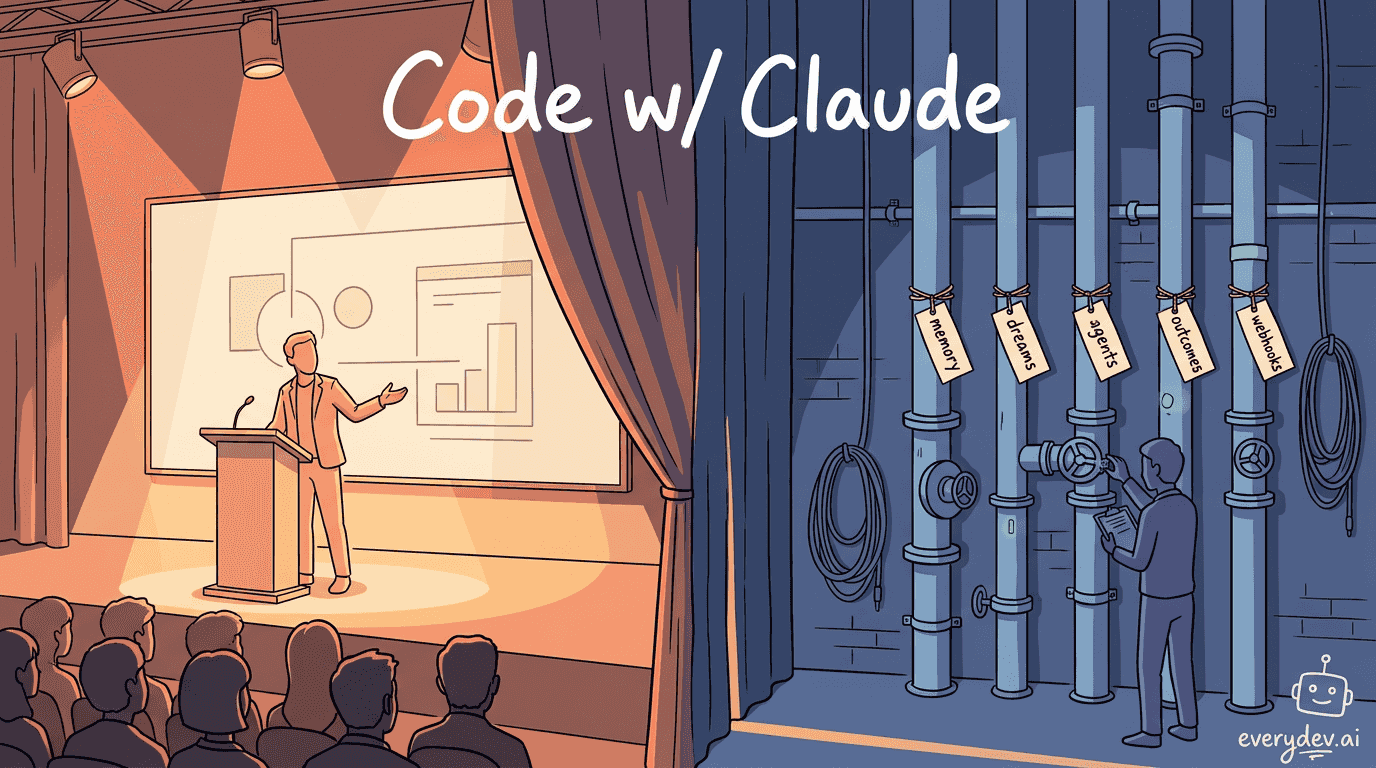
Ami Vora walked on stage at Code w/ Claude in San Francisco this morning and the first thing she said wasn't a model release. API volume was up 17x year-on-year. No new Claude. The framing for the day, per Vora: making our products work better for you. That's a strange keynote to give in 2026. Every…
Pricing
Session runtime
Container runtime cost while a session is active, billed to the millisecond. Idle time is free.
- $0.08 per session-hour, metered to the millisecond
- Idle time not billed
- Includes managed container, built-in tools, skills, memory store mounts
- Stacks with standard Claude model token pricing
Claude model token usage
Standard Claude API token pricing applies on top of session runtime for all inference inside the session.
- Claude Opus 4.7: $5 / input MTok, $25 / output MTok
- Claude Sonnet 4.6: $3 / input MTok, $15 / output MTok
- Claude Haiku 4.5: $1 / input MTok, $5 / output MTok
- Prompt caching and batch API discounts apply per the standard pricing page
- 300 create requests/min and 600 read requests/min per organization
- Beta header managed-agents-2026-04-01 required on all requests
- Research preview features (outcomes, multiagent) require additional access request
Capabilities
Key Features
- Pre-built agent harness with built-in agent loop and runtime
- Managed cloud containers with pre-installed packages (Python, Node.js, Go)
- Built-in toolset: bash, read, write, edit, glob, grep, web fetch, web search
- Custom tool support with structured input schemas
- MCP connector for external tool providers
- Agent Skills with progressive disclosure (metadata, instructions, bundled scripts/resources)
- Pre-built Skills for PowerPoint, Excel, Word, and PDF generation
- Memory stores with persistent cross-session memory and version-history audit trail
- Read-only and read-write memory mounts at the filesystem level
- Multi-agent orchestration with isolated session threads (research preview)
- Outcome-graded sessions with automatic rubric grader and iterative self-evaluation (research preview)
- Server-sent event streaming for tool calls, threads, and outcome evaluations
- Built-in prompt caching and context compaction
- Vault-based authentication for secrets
- Direct GitHub access for repository operations
- Files API for session inputs and downloadable deliverables (/mnt/session/outputs/)
- Steerable mid-execution via additional user events; interruptible at any time
- Persistent server-side event history per session
- Official ant CLI with GitOps-style YAML agent configs
- Conversational scaffolding from Claude Code (v2.1.96+) using local project context