
claude-thermos
A local reverse proxy that keeps your Claude Code prompt cache warm during long subagent runs, preventing expensive cache rebuilds and reducing API costs.
At a Glance
Fully free and open-source under the MIT license. No cost to use, modify, or distribute.
Engagement
Available On
Alternatives
Listed Jul 2026
About claude-thermos
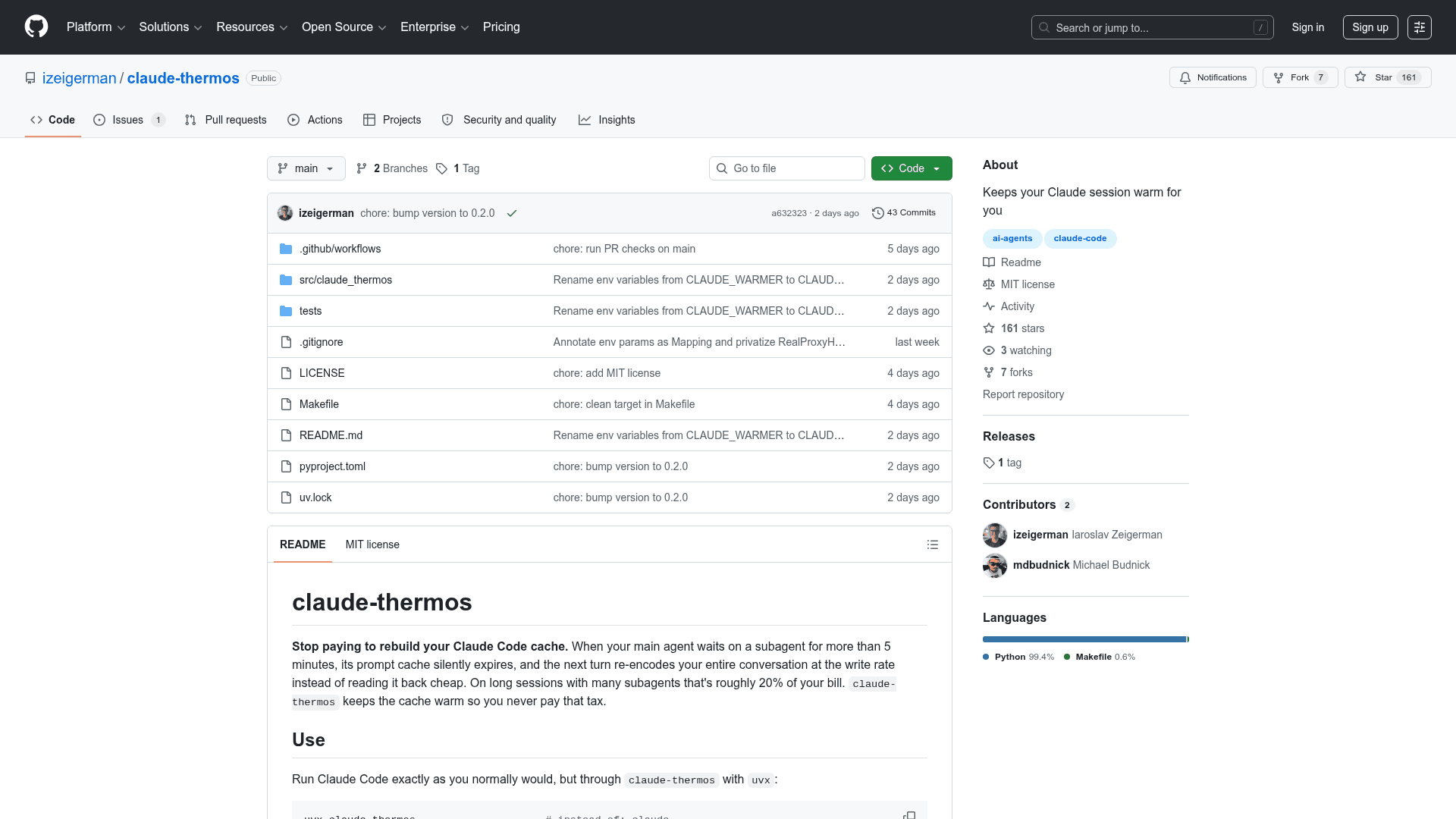
claude-thermos is an open-source Python tool by Iaroslav Zeigerman that wraps Claude Code behind a lightweight local reverse proxy to prevent prompt cache expiration during multi-agent sessions. It targets a specific and measurable cost problem: when a main Claude agent waits on a subagent for more than 5 minutes, the main agent's prompt cache silently expires, forcing a full re-encode at the write rate (1.25x) instead of the cheap cache read rate (0.1x). The README states that across roughly 185 local sessions, these rebuilds accounted for about 22% of total API spend.
What It Is
claude-thermos is a CLI wrapper and optional daemon that intercepts Anthropic API traffic on a loopback port, monitors session activity, and periodically replays the main agent's last real request with max_tokens: 1 to refresh the prompt cache prefix before it expires. It is written in Python, licensed under MIT, and distributed via uvx (no install required). The core product is the open-source tool itself — there is no hosted service or SaaS component.
How the Cache Warming Works
The proxy observes /v1/messages traffic and groups requests into sessions and lineages — one cache prefix per unique combination of model, tool set, and system text. The first tool-bearing lineage is treated as the main agent; subsequent ones are subagents. When the main lineage goes idle while a subagent is active, the tool enters a "danger window":
- On a configurable interval (default: 270 seconds, under the 5-minute TTL), it replays the main agent's last request as a warm request with
max_tokens: 1and no streaming. - The single output token is discarded; the goal is the prefill, which reads and refreshes the cached prefix.
- Warm requests go directly to the Anthropic API, never back through the proxy, so they cannot interfere with real traffic.
- Each warm costs a cache read (0.1x); each prevented rewrite would have cost a write (1.25x) on a much larger prefix.
Deployment Modes
claude-thermos supports two usage patterns:
- Launcher mode (
uvx claude-thermos): wraps a singleclaudeprocess, warming only that session. Any Claude arguments pass straight through. - Daemon mode (
claude-thermos serve): runs a standalone proxy on a fixed loopback port (default: 8787). Any client that setsANTHROPIC_BASE_URL=http://127.0.0.1:8787— including the VSCode/Claude Code extension — routes through the shared warmer. A single daemon serves all clients on the machine and evicts sessions idle longer than--session-ttl(default: 3600s).
Tunable flags include --idle, --interval, --max-cycles, and --subagent-window, all with sensible defaults.
Event Logs and Savings Tracking
Every session writes structured logs to ~/.claude-thermos/logs/<session_id>/:
events.jsonl: append-only stream of every request/response token count and warming decision (warm_fired,warm_result,cap_reached,resume_detected, etc.)summary.json: rollup totals includingwarms_fired,cache_read_total,rewrite_avoided_tokens,warm_cost,rewrite_avoided_cost, andnet_savingsin base-input-token units.
To convert net_savings to dollars, multiply by the model's input token price. The README gives an example: a net_savings of 1,200,000 at $3/1M tokens equals approximately $3.60 saved per session.
Current Status
The repository was created in July 2026 and last pushed on July 24, 2026, with 161 stars and 7 forks at time of indexing. It requires Python 3.11+ and the claude CLI on the system PATH. The project is actively maintained under the MIT license by Iaroslav Zeigerman.
Community Discussions
Be the first to start a conversation about claude-thermos
Share your experience with claude-thermos, ask questions, or help others learn from your insights.
Pricing
Open Source
Fully free and open-source under the MIT license. No cost to use, modify, or distribute.
- Prompt cache warming for Claude Code
- Launcher and daemon modes
- Structured session event logs
- Net savings tracking
- Configurable tuning flags
Capabilities
Key Features
- Keeps Claude Code prompt cache warm during subagent runs
- Local reverse proxy intercepting Anthropic API traffic
- Launcher mode wraps a single claude process
- Daemon mode serves multiple clients and terminals on one machine
- VSCode/Claude Code extension support via ANTHROPIC_BASE_URL
- Configurable idle, interval, max-cycles, and subagent-window flags
- Structured event logs (events.jsonl) per session
- Session summary with net savings calculation (summary.json)
- Warm requests use max_tokens:1 to minimize cost
- Session eviction via configurable --session-ttl
- CLAUDE_THERMOS_DISABLE=1 env var to skip warming for a run
- Requires no install via uvx