
Claw Orchestrator
A unified runtime that runs Claude Code, Codex, Antigravity, Grok Build, OpenCode and ACP agents as persistent sessions, verifying runs with checks the agent did not write.
At a Glance
Claw Orchestrator core runtime is released under the MIT License, free to use, copy, modify and distribute. Underlying engine usage (Claude Code, Codex, etc.) is billed separately by those vendors.
Engagement
Available On
Alternatives
Listed Nov 2026
About Claw Orchestrator
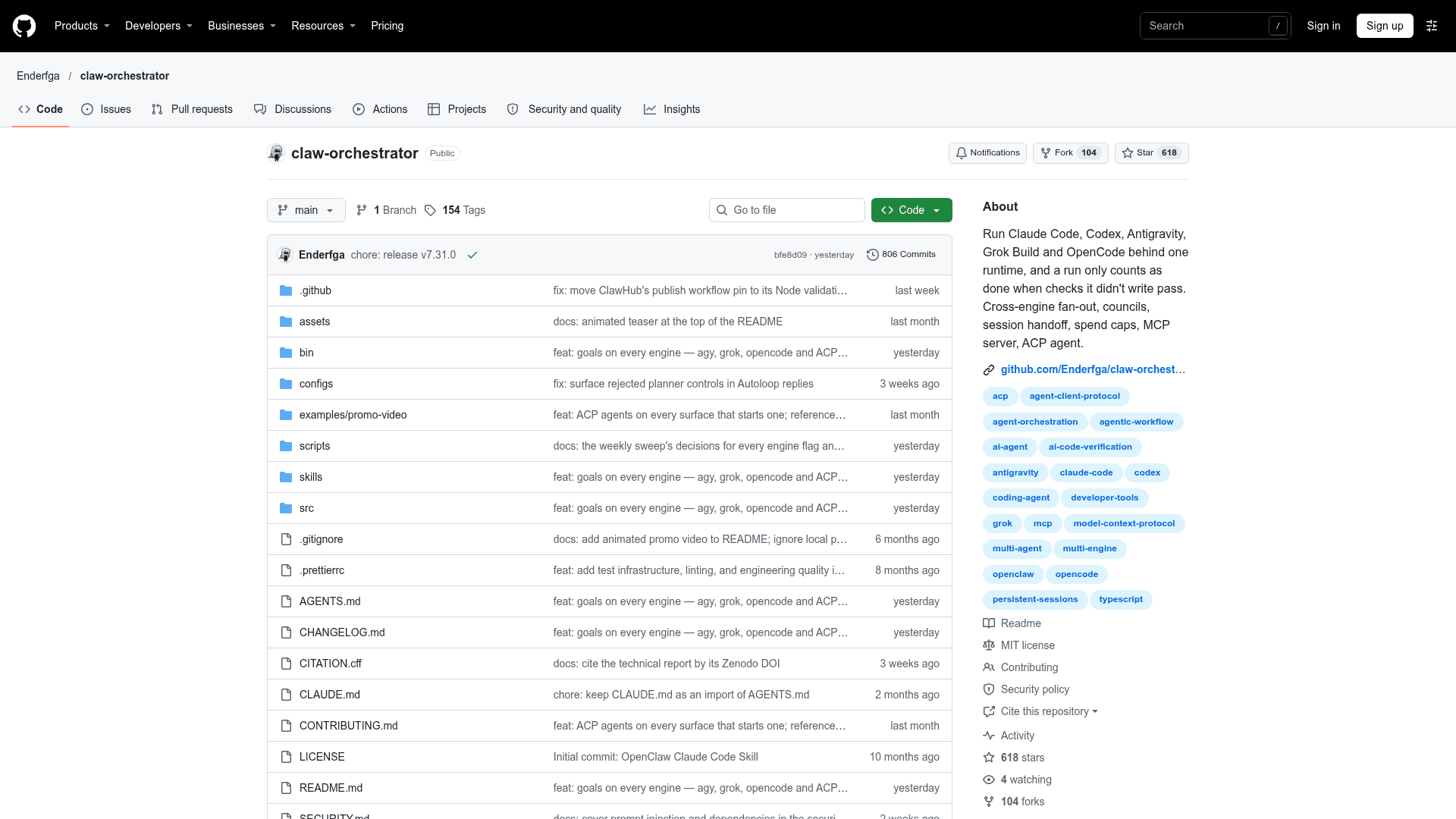
Claw Orchestrator is an open-source, MIT-licensed runtime published by Enderfga that runs coding agent CLIs as persistent sessions behind one API. It supports Claude Code, Codex, Antigravity, Grok Build, OpenCode and any Agent Client Protocol agent, and a run counts as done only when checks declared by the user pass. The latest release listed is v7.31.0.
What It Is
Claw Orchestrator is a headless runtime and CLI (clawo) that sits underneath coding agents from several vendors. You declare acceptance checks (commands, HTTP probes, screenshots, diff policy, file assertions), the runtime runs them and reads the exit codes, and the evidence is kept on disk. A run ends as verified, refuted or unverified, and editing the tests a contract runs refutes the run.
How a Run Works
A typical flow starts a local server with clawo serve, then uses clawo solve with a task, an engine flag and one or more --check commands. clawo verify shows each check, why it failed and which files changed, and clawo runs lists every turn with model, tokens, cost and verdict. Runs are checkpointed workflows that survive a crash, with resume, retry, timeout, cancel and steer controls.
Multi-Engine Orchestration
clawo fanout sends one task to several engines in parallel with an optional synthesis pass, and session handoff moves a live conversation to another engine in the same workspace. clawo goal keeps an agent working toward an objective unattended and resumes after usage limits within a bound. Other documented modes include council voting in isolated git worktrees, an autoloop of Planner, Coder and Reviewer, and a spend cap (maxBudgetUsd) enforced on every engine.
Ways to Run
It can be used as a CLI with a dashboard, an MCP server, an ACP agent for editors, an OpenAI-compatible /v1/chat/completions endpoint, a TypeScript SDK, or an OpenClaw plugin. It requires Node 22+ and at least one engine CLI installed and logged in.
Community Discussions
Be the first to start a conversation about Claw Orchestrator
Share your experience with Claw Orchestrator, ask questions, or help others learn from your insights.
Pricing
Open Source (MIT)
Claw Orchestrator core runtime is released under the MIT License, free to use, copy, modify and distribute. Underlying engine usage (Claude Code, Codex, etc.) is billed separately by those vendors.
- MIT License
- Unified runtime for Claude Code, Codex, Antigravity, Grok Build, OpenCode and ACP agents
- Acceptance contracts verified by the runtime
- Checkpointed workflows that survive crashes
- Per-turn recording of model, tokens and cost
Capabilities
Key Features
- Persistent sessions across multiple coding agent engines
- Acceptance contracts run by the runtime with on-disk evidence bundles
- Verdicts of verified, refuted or unverified
- Checkpointed durable workflows with resume, retry, timeout, cancel and steer
- Cross-engine fan-out with optional synthesis
- Session handoff between engines
- Long-running goals via clawo goal
- Council voting in isolated git worktrees
- Autoloop with Planner, Coder and Reviewer
- Per-turn run ledger and enforced spend caps
- Claude account rotation at usage limits
- OpenAI-compatible chat completions endpoint
- Dashboard with live event streams
- MCP server and ACP agent entry points
- TypeScript SDK