
Cloudy
A research agent that plans and runs ML experiments on cloud GPUs and returns the code, results and a written report.
At a Glance
Engagement
Available On
Listed Oct 2026
About Cloudy
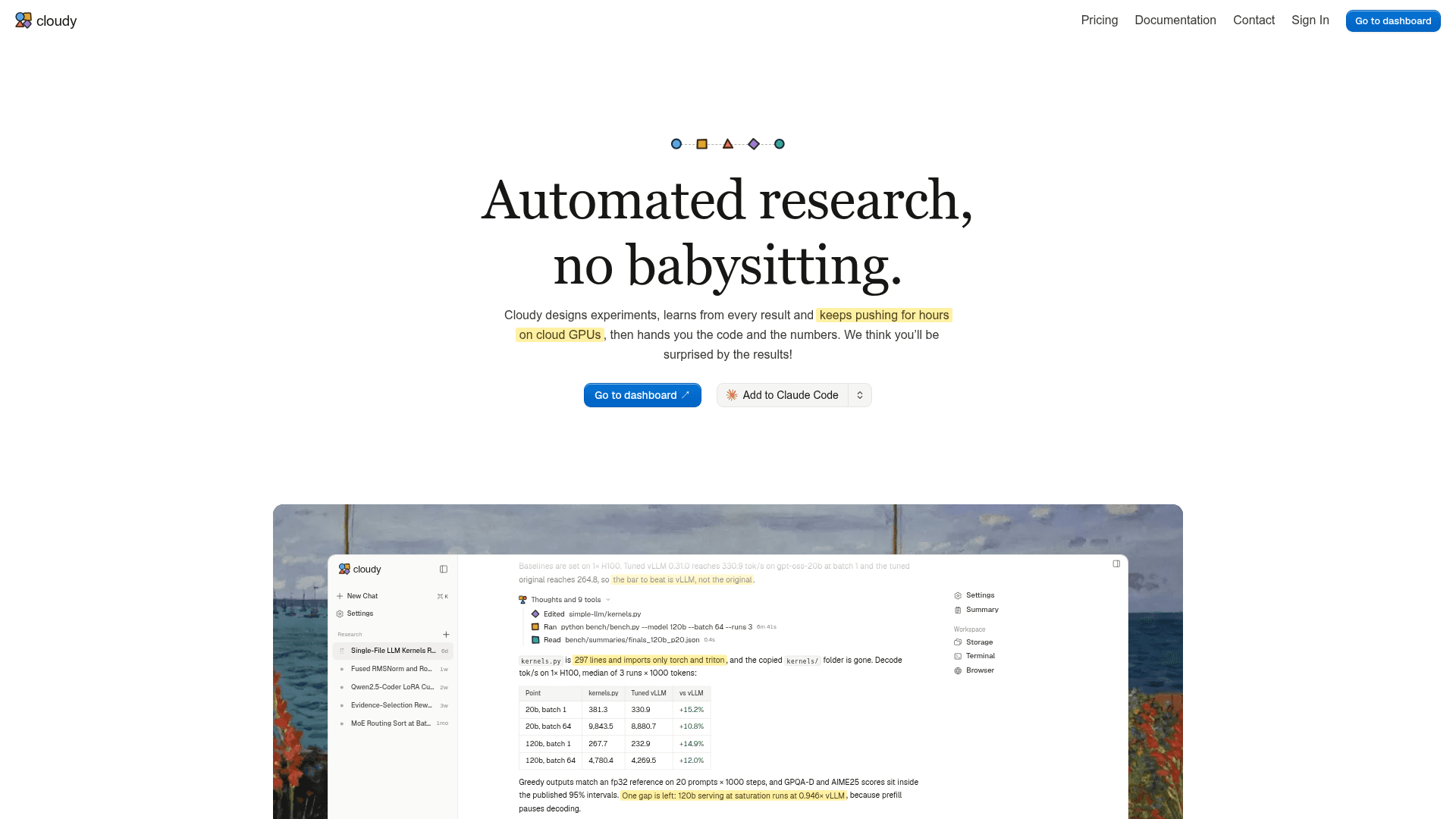
Cloudy, from Cloudy Softwares Inc., is a research agent that runs machine-learning experiments on cloud hardware. You give it a goal and your code or data, and it plans experiments, writes and runs the code, reads the results and decides what to try next, then reports back with the code and the numbers. It can be used from the dashboard, a CLI, or through a coding agent such as Claude Code.
What It Is
Cloudy treats a goal as a research question rather than a single coding task. Each chat has its own machine and saved files. The machine can be a CPU or up to eight NVIDIA GPUs (types listed in the docs are B300, B200, H200, H100 and A100-80GB), and compute is billed while the machine is on. Autoresearch can run from one minute to seven days, and the FAQ says Cloudy only calls a goal met when each success criterion has supporting evidence.
Workflow and Outputs
You attach a local folder through the app or with the CLI, then send a goal. Cloudy can also clone repositories and download datasets inside its cloud environment. Chats have four modes: chat, ask, plan and research. You can steer a running job with guidance messages, pause it, stop the machine, or cancel. Outputs include code, logs, measurements, plots, checkpoints, a written report and an acceptance record of which criteria were met. Negative results are kept as well. When the time limit is reached, Cloudy saves a checkpoint and shuts down compute, and you can resume the same conversation later.
CLI and Coding-Agent Use
The CLI installs with a shell script and requires Python 3.12+ with uv, pipx or pip; on Windows it runs in WSL. Every command accepts --json and avoids interactive prompts when given its flags, so coding agents can drive it. Commands cover logging in, uploading files, starting and monitoring chats, browsing saved files, running commands or opening a terminal on the machine, managing secrets, and viewing usage and billing. An Add to Claude Code link provides a setup prompt.
Model Access
The research model can run on a connected Claude plan (through Claude Code) or a ChatGPT plan (through Codex), or on prepaid Cloudy credits. Compute, search and storage are paid from Cloudy credits in each case. If a connected provider reports a limit, Cloudy pauses rather than switching to credits.
Community Discussions
Be the first to start a conversation about Cloudy
Share your experience with Cloudy, ask questions, or help others learn from your insights.
Pricing
Compute
Cloud compute billed by the millisecond (memory included), paid from prepaid Cloudy credits; starting rate shown is per CPU core hour.
- CPU core: $0.14 per hour
- NVIDIA B300 GPU: $7.10 per hour
- NVIDIA B200 GPU: $6.25 per hour
- NVIDIA H200 GPU: $4.54 per hour
- NVIDIA H100 GPU: $3.95 per hour
- NVIDIA A100 GPU: $2.50 per hour
- Prepaid credits from $5, shared by whole team; no subscription
Web search
Web search used as research needs it, paid from credits.
- $0.007 per search
Storage
Storage billed monthly per GiB from credits.
- $0.09 per GiB a month
- Live research summaries are free
Capabilities
Key Features
- Autonomous experiment planning, execution and iteration on cloud GPUs
- CPU to eight NVIDIA GPUs (B300, B200, H200, H100, A100-80GB)
- Chat, ask, plan and research modes
- Time-limited autoresearch from one minute to seven days with checkpoints and resume
- Folder upload with .gitignore and .cloudyignore support
- Written report, code, logs, plots, checkpoints and acceptance record
- Steering with guidance messages, pause, stop and cancel
- SSH and exec access to the chat machine
- Secrets management and team credit sharing
- Bring your own Claude or ChatGPT plan
- JSON output on all CLI commands for coding agents