
Clowder AI
An open-source platform layer that orchestrates multiple AI agents (Claude, GPT, Gemini) into a collaborative team with persistent identity, shared memory, and cross-model review.
At a Glance
Fully free and open-source under the MIT License. Use, modify, and distribute freely.
Engagement
Available On
Listed Sep 2026
About Clowder AI
Clowder AI is an open-source multi-agent orchestration platform built in TypeScript, licensed under MIT, and available on GitHub. It sits above individual AI agent CLIs — Claude Code, Codex CLI, Gemini CLI, opencode — and coordinates them as a persistent, collaborative team rather than isolated tools. The project originated from "Cat Cafe," described by the author as a production workspace where four AI agents collaborate daily on real software, with every feature battle-tested before extraction into this standalone platform.
What It Is
Clowder AI is a platform layer that turns separate AI models into a structured team. Where most agent frameworks focus on calling individual models, Clowder focuses on what happens between agents: routing tasks to the right model, passing context across sessions, enabling one agent to review another's output, and maintaining a shared memory store. The name "clowder" is the collective noun for a group of cats, and the project's tagline — "Hard Rails. Soft Power. Shared Mission." — reflects its design philosophy of enforcing structure while preserving each model's individual strengths.
Core Capabilities
- Multi-Agent Orchestration: Routes tasks to the appropriate agent — Claude for architecture, GPT for code review, Gemini for design — based on role assignment.
- Persistent Identity: Each agent retains its role, personality, and memory across sessions, not just within a single conversation.
- Cross-Model Review: Built-in workflow where one model (e.g., Claude) writes code and another (e.g., GPT) reviews it, without manual copy-pasting.
- A2A Communication: Asynchronous agent-to-agent messaging with @mention routing and structured handoff protocols.
- Shared Memory: An evidence store, lessons-learned log, and decision history that persists across the team.
- Plugin Framework: Supports MCP tools, IM adapters (Feishu, Telegram), and on-demand skills.
Architecture and Deployment
Clowder operates as a platform layer above existing agent CLIs rather than replacing them. The architecture places the operator at the top (vision, decisions, feedback), then the Clowder Platform Layer (identity, A2A router, skills, memory, SOP Guardian, MCP Bridge, plugins), and finally the individual model CLIs (Claude, GPT/Codex, Gemini, opencode) at the bottom. The project's own framing: "Models set the ceiling. The platform sets the floor."
It can be installed via a desktop installer (Windows .exe or macOS .dmg) from the Releases page, or run from source using Node.js 20+ and pnpm 9+. Redis 7+ is optional and can be skipped with a --memory flag. Running from source starts a local web server at http://localhost:3003.
Supported Agents
All four currently supported agent CLIs have shipped MCP support:
- Claude Code (Claude Opus / Sonnet / Haiku)
- Codex CLI (GPT / Codex)
- Gemini CLI (Gemini)
- opencode (multi-model)
Update: v0.13.0
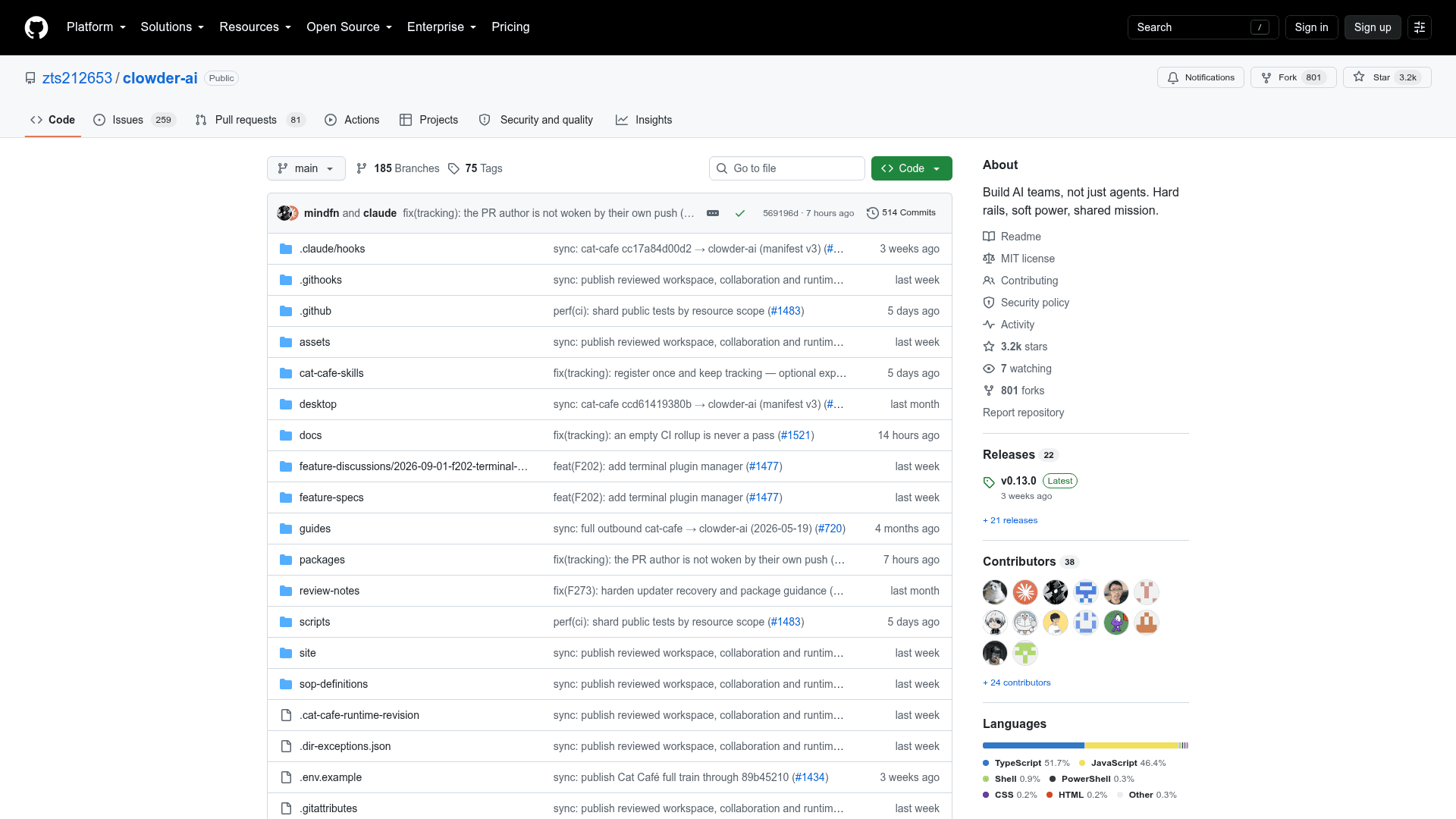
The latest release is v0.13.0, published in September 2026. The repository shows active development with 3,161 stars, 801 forks, and 340 open issues as of the last recorded update. The project accepts pull requests and has a CONTRIBUTING.md guide. Full documentation is hosted at the project's GitHub Pages site.
Community Discussions
Be the first to start a conversation about Clowder AI
Share your experience with Clowder AI, ask questions, or help others learn from your insights.
Pricing
Open Source
Fully free and open-source under the MIT License. Use, modify, and distribute freely.
- Multi-agent orchestration
- Persistent agent identity and memory
- Cross-model review workflows
- A2A communication with @mention routing
- Shared memory and decision logs
Capabilities
Key Features
- Multi-agent orchestration across Claude, GPT, and Gemini
- Persistent agent identity and memory across sessions
- Cross-model code review (Claude writes, GPT reviews)
- Agent-to-agent (A2A) async messaging with @mention routing
- Shared evidence store, lessons learned, and decision logs
- MCP tool support
- IM adapters for Feishu and Telegram
- SOP Guardian for workflow discipline
- Desktop installer for Windows and macOS
- Run from source with Node.js and pnpm
- Optional Redis integration for memory persistence
- Plugin framework for on-demand skills