
Co-Review
A desktop and browser review tool for reading whole repositories, changes, pull requests and designs together with your coding agent.
At a Glance
Co-Review core is released under the MIT License, permitting free use, copying, modification and distribution. Built on Eclipse Theia and other open-source components under their own licenses.
Engagement
Available On
Alternatives
Listed Nov 2026
About Co-Review
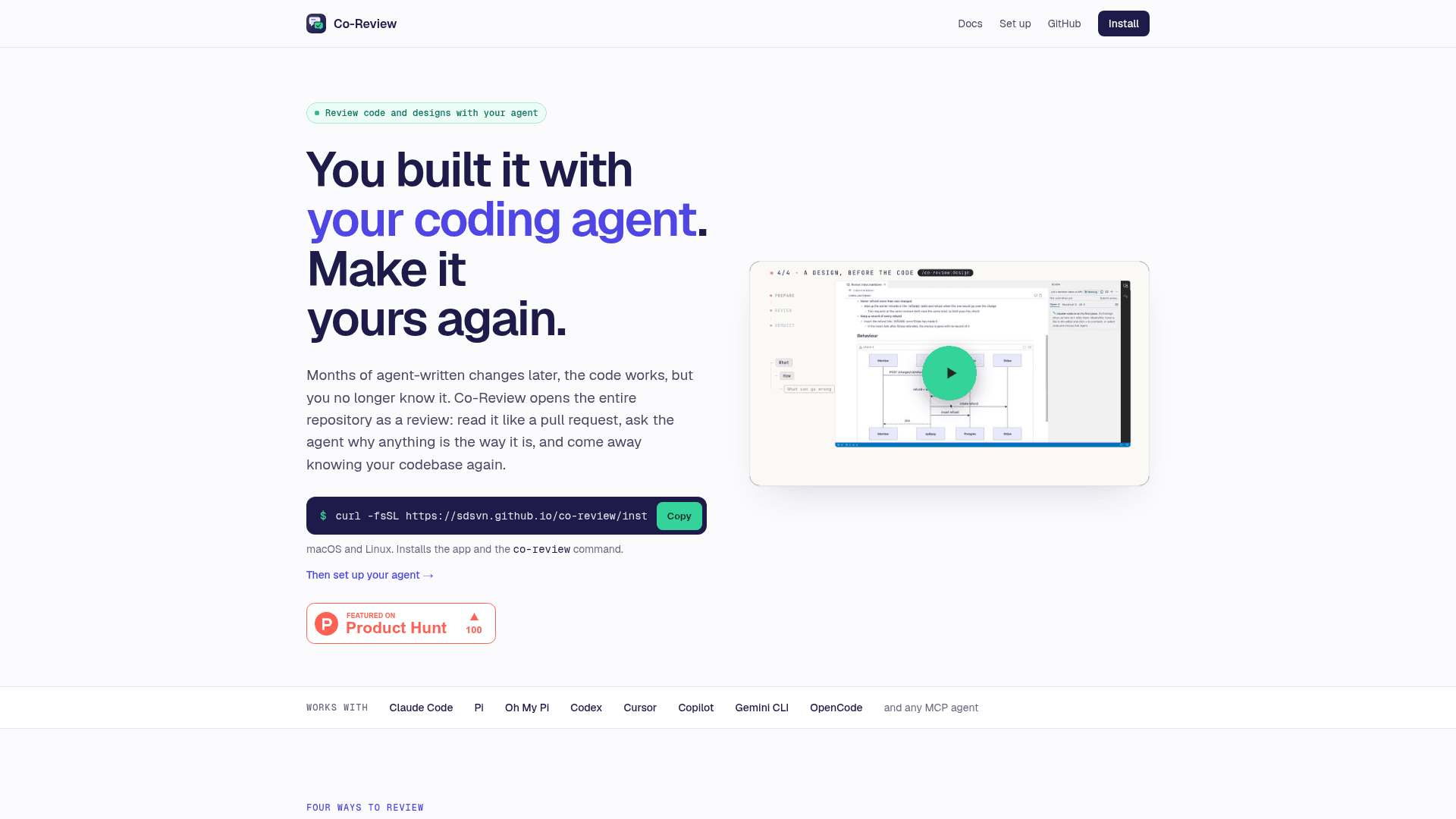
Co-Review is an open-source review tool for code written with coding agents. It opens an entire repository, a change, a pull request or a design document as a review, so you can read it like a pull request and ask the agent why things are the way they are. It runs as a desktop app and co-review command on macOS and Linux, with a Windows installer, and connects to agents through MCP.
What It Is
Co-Review is a review tool with IDE features, not an IDE. It is built on Eclipse Theia, so navigation, search, Git and language servers are available, while everything unrelated to reviewing is removed. The project states that its premise is that agent-built codebases drift beyond what the developer holds in mind, and that reviewing the whole repository together with the agent restores that understanding.
How a Review Works
You open the Review panel and choose what to review: the entire repository, the current file, a branch against its base, or a commit. An overview page shows where to start, and the agent can take a first pass with findings grouped by area, which arrive as proposed for you to accept or dismiss. Comments can be placed on a line, range, symbol, file, folder or the whole repository, and are anchored so they follow the code through edits and are marked outdated rather than drifting. Selecting code and choosing Ask Agent streams the answer into the thread. Coverage tracks which files you have marked as viewed, per area.
Review Modes
- Whole repository: the agent writes a guide to the map, vocabulary, flows, patterns and weak spots.
- Your change: the agent's diff opens as a pull-request page with line comments, suggested edits and one verdict.
- Someone else's pull request: the agent takes a first pass, and your verdict posts to GitHub as a review with line comments and suggestions via
gh. - Design before code: an L1 · L2 · L3 design tree with Mermaid diagrams, revised from your comments before anything is built.
Connecting Agents
Every agent reviews through the co-review mcp server. Claude Code has a plugin with slash commands such as /co-review:audit, /co-review:review, /co-review:pr and /co-review:design. Pi and Oh My Pi have native packages installed with co-review setup. Codex, Cursor, VS Code Copilot, Gemini CLI, OpenCode and other MCP clients add the MCP server to their config. Co-Review can also launch an ACP agent itself for quick questions.
Privacy and Storage
The project states that it collects no telemetry and needs no account. Reviews are stored in ~/.co-review outside the repository; code goes to the agent you choose, and to GitHub only when you post a review there.
Community Discussions
Be the first to start a conversation about Co-Review
Share your experience with Co-Review, ask questions, or help others learn from your insights.
Pricing
Open Source (MIT)
Co-Review core is released under the MIT License, permitting free use, copying, modification and distribution. Built on Eclipse Theia and other open-source components under their own licenses.
- MIT License
- Desktop app or browser
- Install via curl script on macOS and Linux; Windows also listed as a supported platform
- Works with Claude Code, Pi, Oh My Pi, and any MCP agent
- Third-party components under their own licenses
Capabilities
Key Features
- Whole-repository reviews with overview page and per-area coverage
- Agent first pass with proposed findings to accept or dismiss
- Inline threads on lines, ranges, symbols, files, folders or the repository
- Ask Agent answers streamed into review threads
- Tree-sitter repository map for agents
- Optional Graphify code graph
- Design review with L1 · L2 · L3 trees and Mermaid diagrams
- Patch and diff files opened as pull-request pages
- Single verdict posted to GitHub as a review with line comments and suggestions
- Phone view for reading and replying
- Claude Code plugin with slash commands, subagent and session hook
- Native Pi and Oh My Pi packages