EveryDev.ai
Subscribe
Home
Tools

3,995+ AI tools

  • New
  • Trending
  • Featured
  • Compare
  • Arena
Categories
  • Agents2782
  • Coding1973
  • Infrastructure825
  • Projects603
  • Marketing598
  • Research520
  • Analytics468
  • Design462
  • MCP419
  • Testing346
  • Security323
  • Data305
  • Integration224
  • Prompts220
  • Communication210
  • Extensions196
  • Learning179
  • Voice175
  • Commerce160
  • DevOps135
  • Web95
  • Finance31
AI Tools by Topic
  • AI Coding Assistants
  • Agent Frameworks
  • MCP Servers
  • AI Prompt Tools
  • Vibe Coding Tools
  • AI Design Tools
  • AI Database Tools
  • AI Website Builders
  • AI Testing Tools
  • LLM Evaluations
Follow Us
  • X / Twitter
  • LinkedIn
  • Reddit
  • Discord
  • Threads
  • Bluesky
  • Mastodon
  • YouTube
  • GitHub
  • Instagram
Get Started
  • About
  • Editorial Standards
  • Corrections & Disclosures
  • Community Guidelines
  • Advertise
  • Contact Us
  • Newsletter
  • Submit a Tool
  • Start a Discussion
  • Write A Blog
  • Share A Build
  • Terms of Service
  • Privacy Policy
Explore with AI
  • ChatGPT
  • Gemini
  • Claude
  • Grok
  • Perplexity
Agent Experience
  • llms.txt
Theme
With AI, Everyone is a Dev. EveryDev.ai © 2026
    1. Home
    2. Tools
    3. Compare

    jeff vs Jev vs Jevlike vs Von

    All four tools return structured, probabilistic decisions without autoregressive text generation, but they split sharply on hosting model, latency target, and how much you want to own the training pipeline. The real choice is between calling a managed API, self-hosting a drop-in replacement for that API, training your own small classifier, or running a fully local non-autoregressive model with sub-25ms guarantees.

    How to choose

    Decision axis: Managed API vs self-hosted vs train-your-own decision model

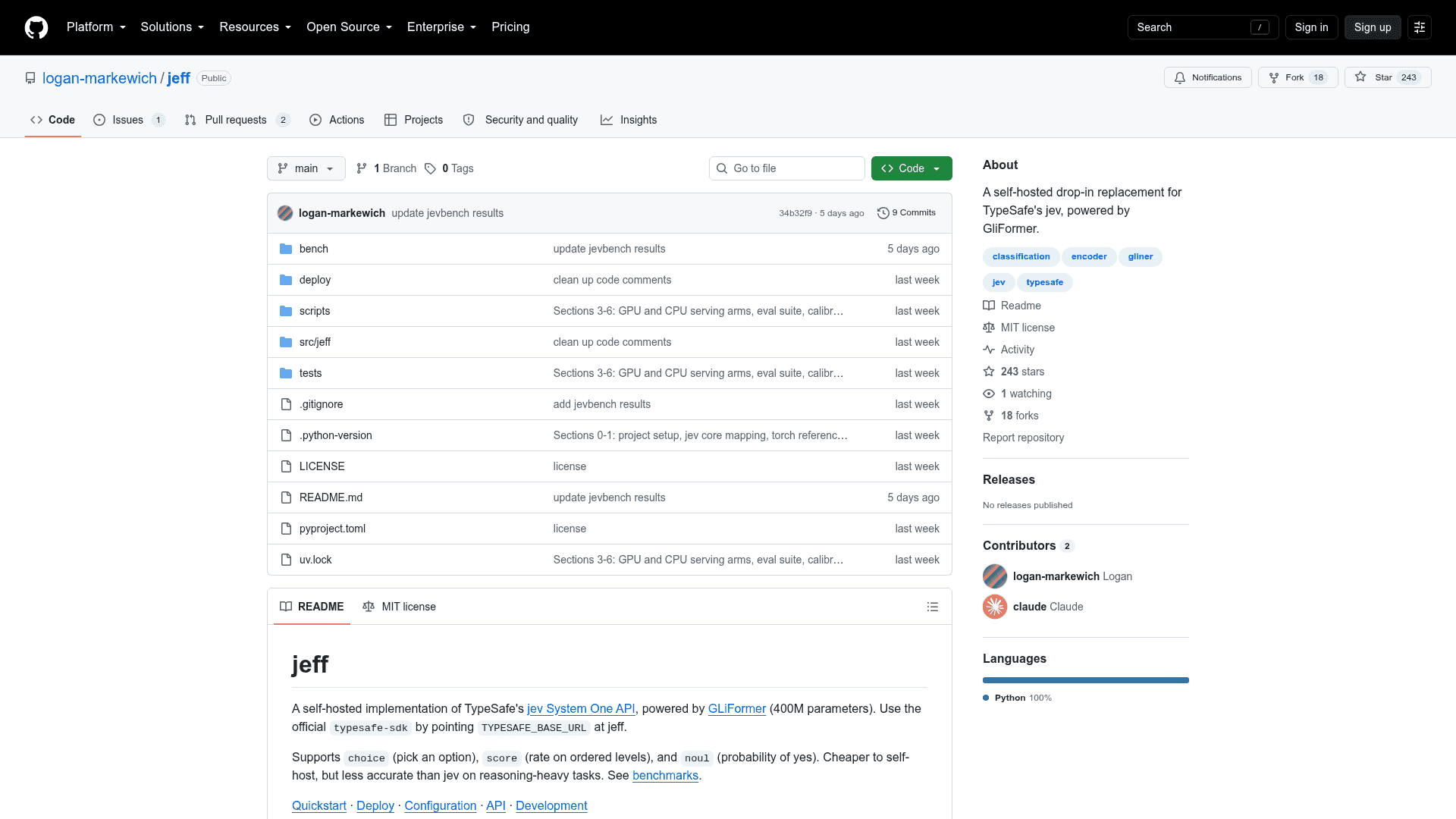
    Pick jeff if you are already using the Jev API and need to move inference on-premises, whether for data-residency, cost, or offline requirements, and you are comfortable running it from source.

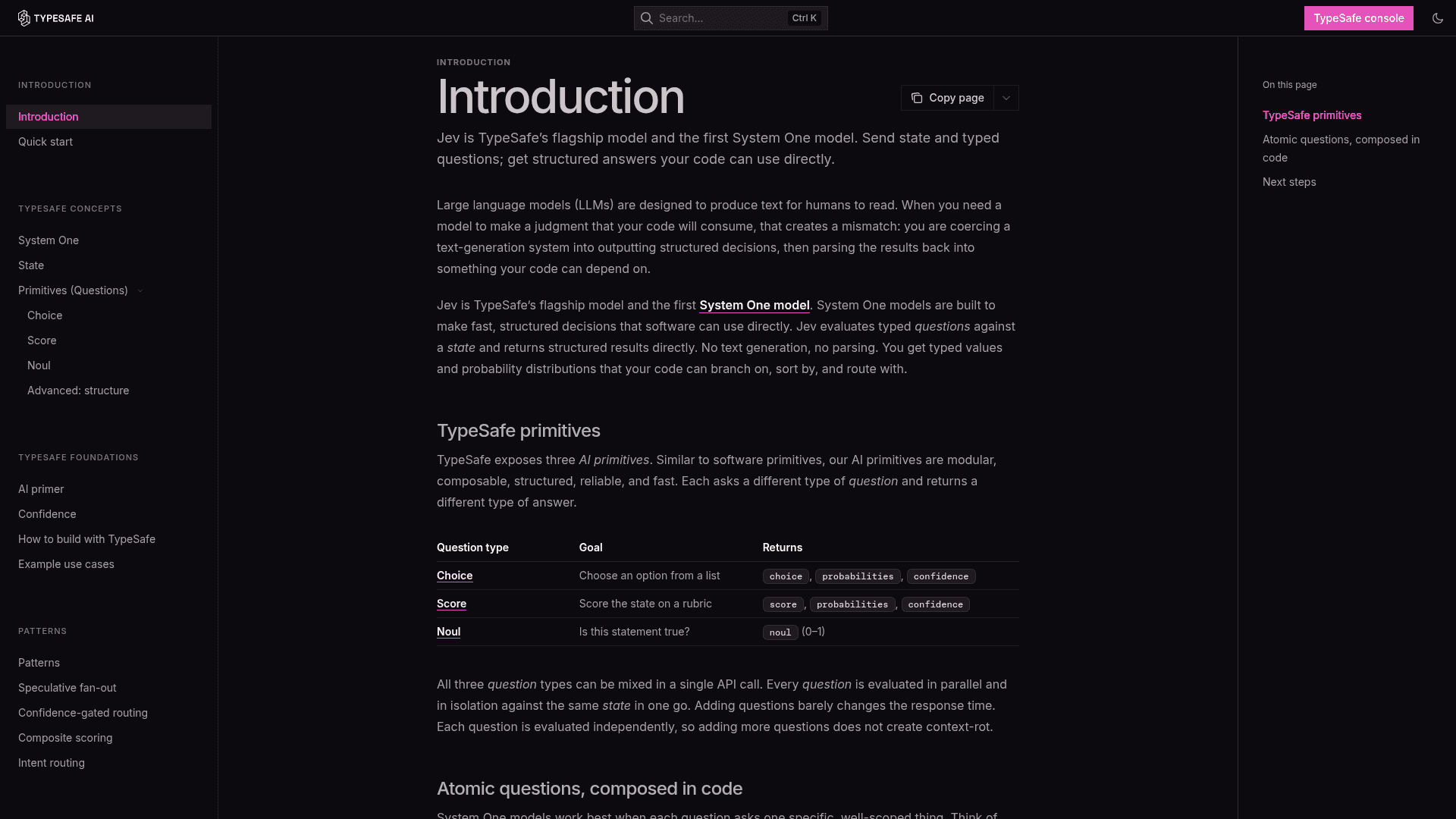
    Pick Jev if you want a production-ready, managed decision API with a free tier and can accept a 70–500ms round-trip latency, and you do not want to operate any infrastructure yourself.

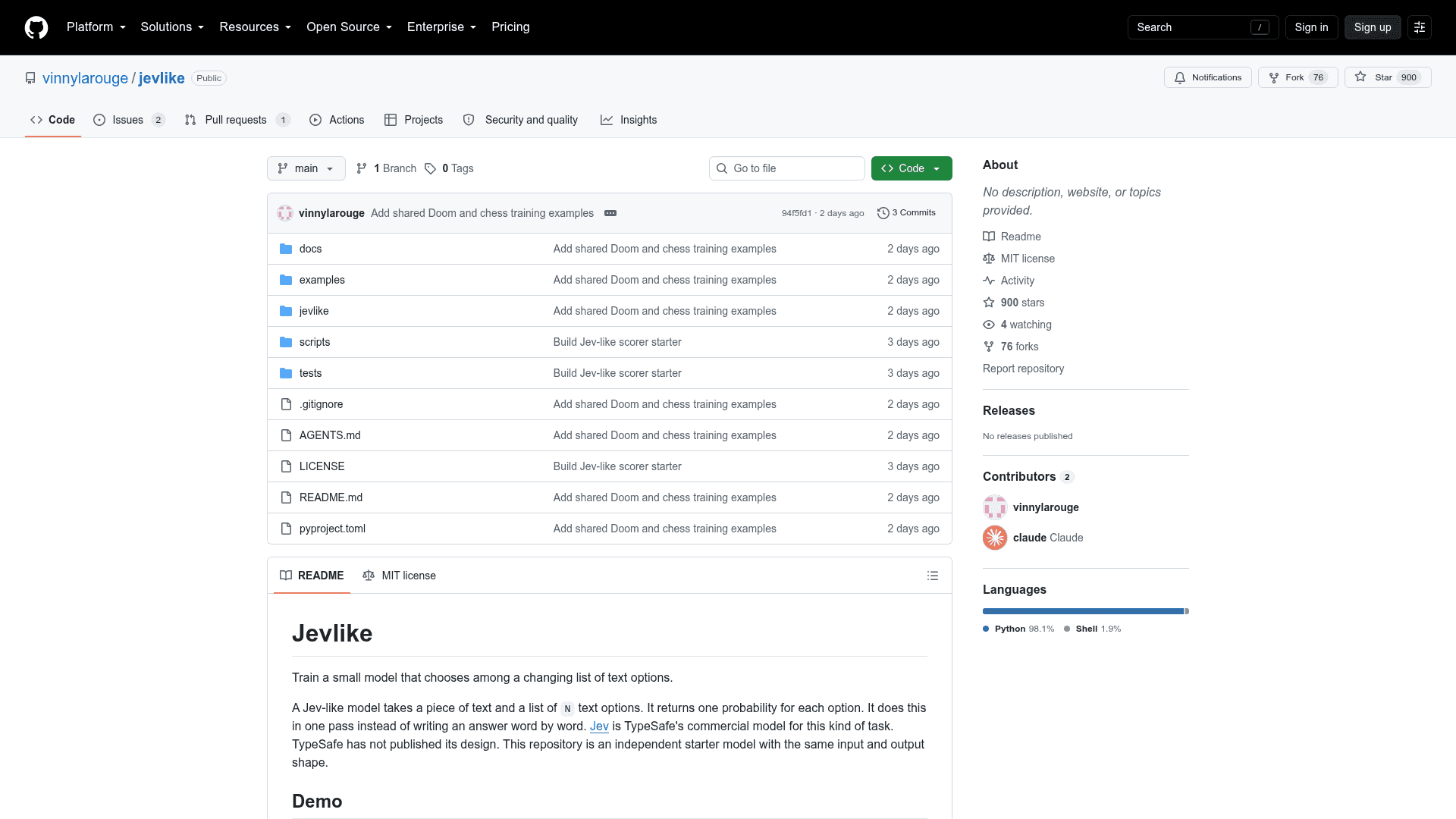
    Pick Jevlike if your use case involves a list of options that changes frequently and you want to train a small, task-specific model that handles selection in a single forward pass rather than calling any external service.

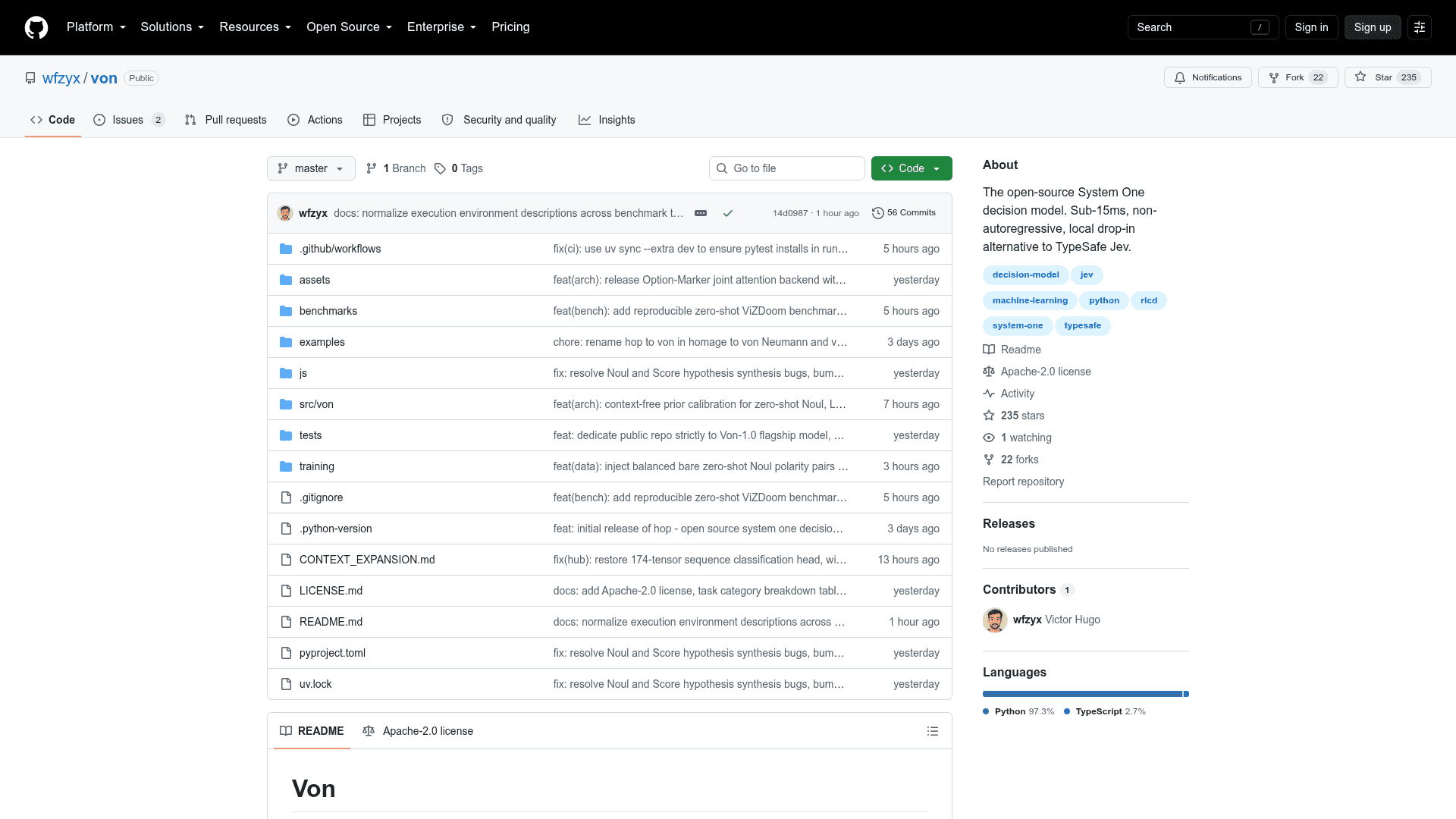
    Pick Von if you need discrete, probabilistic, or ordinal inference to run locally under 25ms and you want a model that is not tied to the Jev API surface or its encoder architecture.

    Attribute
    jeff
    jeff screenshot
    Jev
    Jev screenshot
    Jevlike
    Jevlike screenshot
    Von
    Von screenshot
    SummarySelf Hosted TypeSafe jev APIStructured Decision AI ModelSingle Pass Option Scoring ModelModernBERT Intent Routing Model
    Community Score0/1008/1001/1005/100
    Pricing✓ Open Source✓ Early Access✓ Open Source✓ Open Source
    —Pay-As-You-Go$0 usage-based——
    —Contact SalesContact Sales——
    View pricing →View pricing →View pricing →View pricing →
    PlatformMACOS, API, CLIMACOS, Web, API, SDK, CLIWINDOWS, MACOS, API, SDK, CLILINUX, API, SDK, CLI
    API / SDKAPI + SDKAPI + SDKAPI + SDKAPI + SDK
    Docs / Source
    DocsSource
    DocsSource
    Source
    DocsSource
    DeveloperLogan MarkewichTypeSafe AIMinimal Labswfzyx
    Features
    • Self-hosted TypeSafe jev System One API compatibility
    • GLiFormer large (400M parameter) encoder model
    • Three question types: choice, score, and noul
    • Automatic device selection: CUDA, MPS, or CPU
    • Configurable request batching for throughput optimization
    • ONNX Runtime backend with int8 quantization support
    • Three AI primitives: Choice, Score, and Noul
    • Parallel question evaluation in a single API call
    • Typed, structured outputs with no text generation
    • Calibrated probability distributions with every answer
    • Confidence scores for confidence-gated routing
    • 70–500ms end-to-end latency
    • Single-pass option scoring (no token-by-token generation)
    • Variable-length option lists per inference call
    • Default byte-level encoder trained from scratch
    • Optional frozen Hugging Face pretrained encoder integration
    • CLI tools: jevlike-data, jevlike-train, jevlike-eval, jevlike-predict
    • JSONL data format with per-row variable option counts
    • Non-autoregressive single forward pass inference
    • Sub-25ms GPU latency
    • Choice: categorical classification with calibrated probability distribution
    • Noul: binary probability verification with dual positive/negative framing
    • Score: ordinal continuous rating via expected value
    • system_one fan-out: evaluate multiple heterogeneous questions in one pass
    Integrations
    • TypeSafe SDK (typesafe-sdk)
    • GLiFormer (knowledgator/gliformer-large-v1)
    • Hugging Face Hub
    • Modal
    • ONNX Runtime
    • uv (Python package manager)
    • LangChain (langchain-typesafe)
    • Vercel AI Gateway
    • Python SDK (typesafe-sdk)
    • JavaScript/TypeScript SDK (@typesafe-ai/sdk)
    • Claude agent skill marketplace
    • Browser Use
    • Hugging Face Transformers (optional frozen encoder)
    • Qwen2.5-0.5B (example encoder)
    • ViZDoom (Doom game example)
    • Chess engine (chess example)
    • Playwright (film rendering)
    • SNAP Wikispeedia dataset
    • Hugging Face
    • Python
    • TypeScript
    • Node.js
    • Bun
    • NVIDIA CUDA
    Use Case Fit
    • Text classification
    • Binary yes/no probability (noul)
    • Multi-class choice selection
    • Ordered score rating
    • Structured classification (Choice)
    • Continuous scoring (Score)
    • Binary probability estimation (Noul)
    • Parallel multi-question evaluation
    • Option-attention scoring
    • Single-pass classification over variable option lists
    • Byte-level text encoding
    • Frozen pretrained encoder integration
    • Non-autoregressive classification
    • Intent routing
    • Guardrail validation
    • Calibrated probabilistic inference
    System Requirements
    • Linux
    • macOS
    • Windows
    • Any OS with a modern web browser or Python 3.10+ / Node 20+ runtime
    • Windows
    • macOS
    • Linux
    • Windows
    • macOS
    • Linux
    Data refreshedSep 25, 2026Sep 21, 2026Sep 22, 2026Sep 21, 2026