
Jev
Jev is TypeSafe AI's System One model that returns typed, probabilistic decisions instead of generated text, evaluating structured questions against program state in 70–500ms.
At a Glance
About Jev
Jev is TypeSafe AI's flagship model and the first publicly available System One model, launched September 15, 2026, with $40M in funding led by DCVC. Built by Diogo Almeida — who co-invented RLHF and InstructGPT at OpenAI — Jev is designed to make fast, structured decisions that software can use directly, without generating text. It is currently available in early access via a waitlist at typesafe.ai.
What It Is
Jev is a frontier AI model that occupies a fundamentally different category from large language models. Where LLMs generate text tokens sequentially, Jev evaluates typed questions against a state and returns structured, probabilistic answers in parallel — all in a single API call. TypeSafe AI calls this class of model a System One model, named after Daniel Kahneman's concept of fast, intuitive thinking. The core idea is that most decisions inside software — routing, classification, scoring, triage — are System 1 judgments that do not require the full generative machinery of an LLM.
Jev accepts unstructured state (text, JSON objects, or arrays) and a set of typed questions, then returns typed values and calibrated probability distributions. There is no text generation, no parsing step, and no risk of returning a value outside the defined schema.
The Three Primitives
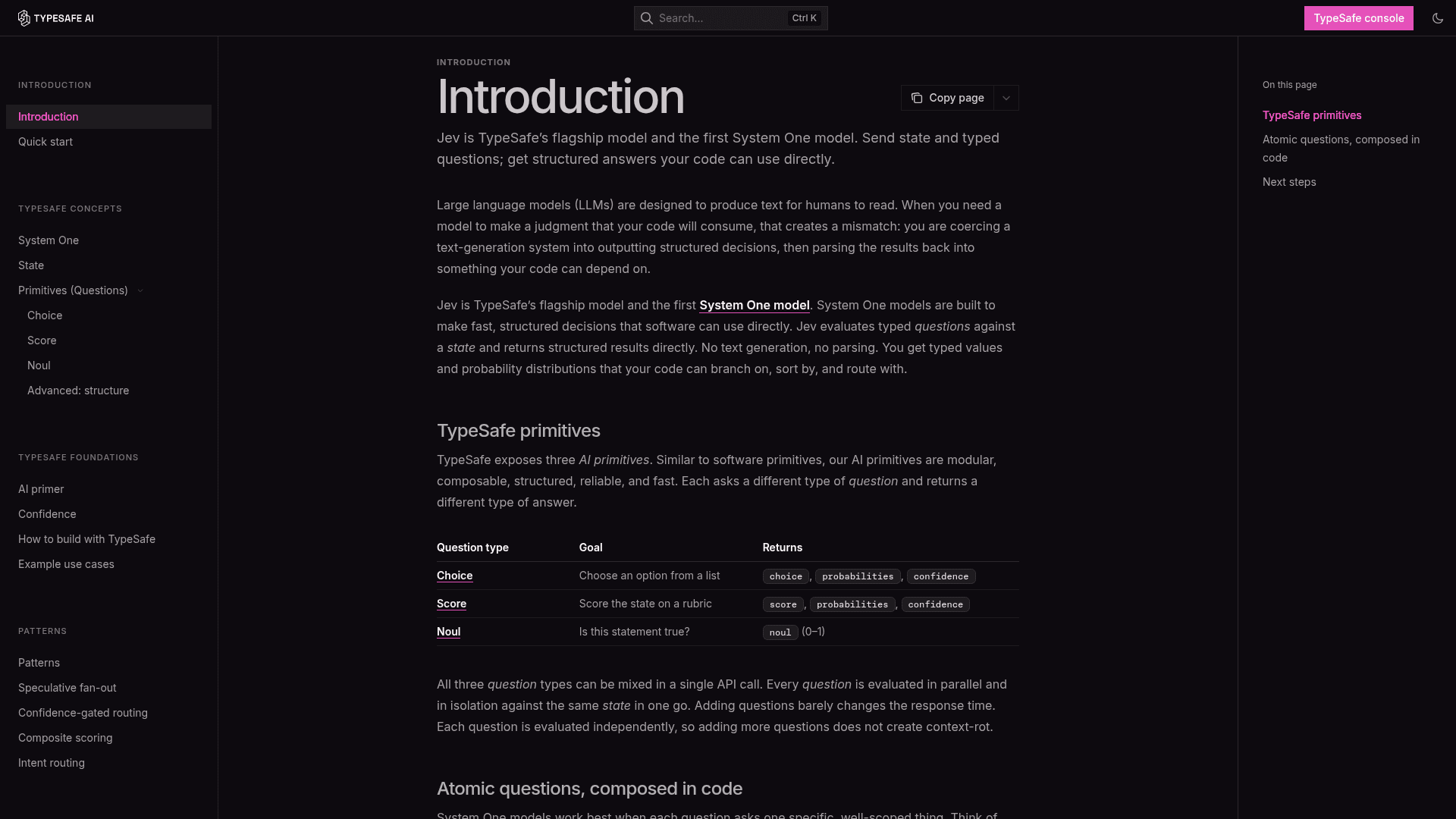
TypeSafe exposes three AI primitives, each representing a different question type:
- Choice — Select one option from a list of up to 255 labeled criteria. Returns
choice,probabilities(one per option), andconfidence. - Score — Rate the state against 2–10 ordered levels described in plain language. Returns a continuous
score(which can land between levels),probabilities, andconfidence. - Noul — Answer a yes/no question as a probability from 0 to 1. Returns a single
noulvalue representing the belief that a statement is true.
All three question types can be mixed in a single API call. Every question is evaluated in parallel and in isolation against the same state, so adding more questions barely changes response time and costs only the tokens for the additional question text.
Training Method and Calibration
Jev is trained using Reinforcement Learning for Calibrated Decisions (RLCD), a method TypeSafe developed specifically to optimize for epistemically honest probabilities on structured decision tasks — rather than human preference (RLHF) or verifiable rewards (RLVR). According to TypeSafe's published claims, this calibration means higher confidence scores genuinely correlate with higher accuracy, enabling confidence-gated routing architectures where different confidence thresholds trigger different downstream actions.
TypeSafe publishes workflow evaluations at evals.typesafe.ai comparing Jev against frontier LLMs on four production-representative workflows. According to TypeSafe's self-run benchmarks, Jev achieves similar accuracy to GPT-5.6 Terra and Claude Sonnet 5 on these tasks while being significantly faster and cheaper. TypeSafe acknowledges these evaluations are self-run, use consensus labels from GPT-6 Astra and Fable 5.1 as reference, and have not been independently reproduced.
Architecture and Design Tradeoffs
Jev's parallel sampler generates all outputs in a single forward pass rather than autoregressively token by token. This architecture enables the 70–500ms end-to-end latency TypeSafe reports. The tradeoffs are explicit and documented:
- Jev cannot generate text, code, or summaries — it is not a cheaper LLM replacement
- It reads state literally and does not perform arithmetic, date math, or counting reliably
- Accuracy degrades when state contains irrelevant material ("context rot"), so filtering state before the call is recommended
- State is not treated as hostile — user-controlled content in state is a threat model the caller must handle
- Context limits are 64k tokens for state and all questions combined, 32k for state plus the single longest question
TypeSafe publishes a "jaggedness" page listing known failure modes for jev-1.13, which the dev.to guide describes as "unusually honest for a launch."
Update: Launch and Early Ecosystem (September 2026)
Jev launched September 15, 2026. Within 48 hours, the dev.to guide documents several community projects built on the model:
- 1kpapers.com classified 1,018 research papers using Jev for $0.08 in classification costs alongside a generative summarization step
- browser-use/jev-ultrafast built a browser agent completing a flight booking on Google Flights in 7.1 seconds
- awlevin/typesafe-computer-use drove a Mac toward plain-English goals at reported cost of $0.0002 per decision step
- jarrodwatts/jev-trader built a market-making bot operating on ~300ms Monad block cycles
- RomanSlack/jev-drone integrated Jev as a 2.5Hz tactical judgment layer in an autonomous drone stack
LangChain published a blog post on September 17, 2026 describing a langchain-typesafe integration that exposes Jev through TypeSafeClassifier, enabling model routing middleware and tool-risk gating (AutoModeMiddleware) within LangChain agent loops. The current model version is jev-1.13.0; jev-latest resolves to this version and will advance with new releases. TypeSafe recommends pinning the versioned model ID when tuning confidence thresholds.
Where It Fits in the Stack
TypeSafe and the LangChain integration both describe Jev as a complement to, not a replacement for, frontier LLMs. The recommended pattern is a cascade: Jev classifies and routes cheaply at the front of a pipeline, ordinary code handles deterministic branches, and a frontier LLM takes the minority of requests requiring open-ended reasoning or text generation. Rate limits for jev-1.13 are published as 250,000 tokens/second and 1,200 requests/minute, with both SDKs implementing exponential backoff on 429 responses. TypeSafe notes these limits are subject to change as GPU capacity scales.
Community Discussions
Be the first to start a conversation about Jev
Share your experience with Jev, ask questions, or help others learn from your insights.
Pricing
Early Access
Waitlisted early access to Jev for developers.
- Access to jev-latest (resolves to jev-1.13.0)
- Python and JavaScript SDKs
- REST API access
- Console and playground access
Usage-Based
Pay per input token. Output tokens are free.
- $0.042 per million input tokens
- Output tokens free
- 250,000 tokens/second rate limit
- 1,200 requests/minute rate limit
- Access to all three primitives: Choice, Score, Noul
- Parallel question evaluation
Capabilities
Key Features
- Three AI primitives: Choice, Score, and Noul
- Parallel question evaluation in a single API call
- Typed, structured outputs with no text generation
- Calibrated probability distributions with every answer
- Confidence scores for confidence-gated routing
- 70–500ms end-to-end latency
- Zero structured-output type errors by construction
- Up to 255 options per Choice question
- Continuous Score values that can land between defined levels
- 64k token context window for state and questions
- Python and JavaScript/TypeScript SDKs
- Direct REST API endpoint (POST /v1/systemone)
- Agent skill integration for coding agents
- Vercel AI Gateway support
- Model version pinning