EveryDev.ai
Subscribe
Home
Tools

3,965+ AI tools

  • New
  • Trending
  • Featured
  • Compare
  • Arena
Categories
  • Agents2782
  • Coding1973
  • Infrastructure825
  • Projects603
  • Marketing598
  • Research520
  • Analytics468
  • Design462
  • MCP419
  • Testing346
  • Security323
  • Data305
  • Integration224
  • Prompts220
  • Communication210
  • Extensions196
  • Learning179
  • Voice175
  • Commerce160
  • DevOps135
  • Web95
  • Finance31
AI Tools by Topic
  • AI Coding Assistants
  • Agent Frameworks
  • MCP Servers
  • AI Prompt Tools
  • Vibe Coding Tools
  • AI Design Tools
  • AI Database Tools
  • AI Website Builders
  • AI Testing Tools
  • LLM Evaluations
Follow Us
  • X / Twitter
  • LinkedIn
  • Reddit
  • Discord
  • Threads
  • Bluesky
  • Mastodon
  • YouTube
  • GitHub
  • Instagram
Get Started
  • About
  • Editorial Standards
  • Corrections & Disclosures
  • Community Guidelines
  • Advertise
  • Contact Us
  • Newsletter
  • Submit a Tool
  • Start a Discussion
  • Write A Blog
  • Share A Build
  • Terms of Service
  • Privacy Policy
Explore with AI
  • ChatGPT
  • Gemini
  • Claude
  • Grok
  • Perplexity
Agent Experience
  • llms.txt
Theme
With AI, Everyone is a Dev. EveryDev.ai © 2026
    1. Home
    2. Tools
    3. Compare

    Jev vs Von

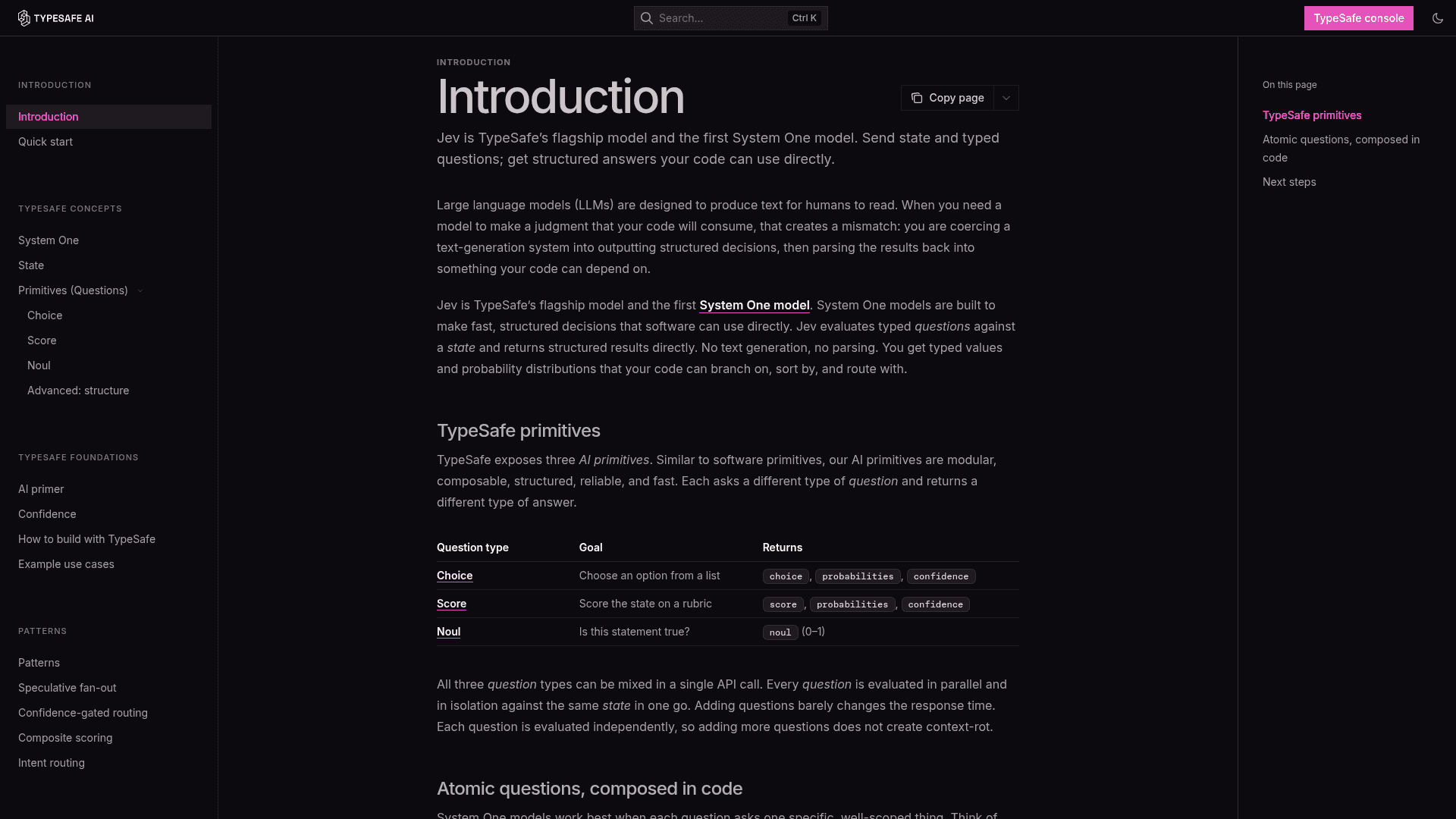
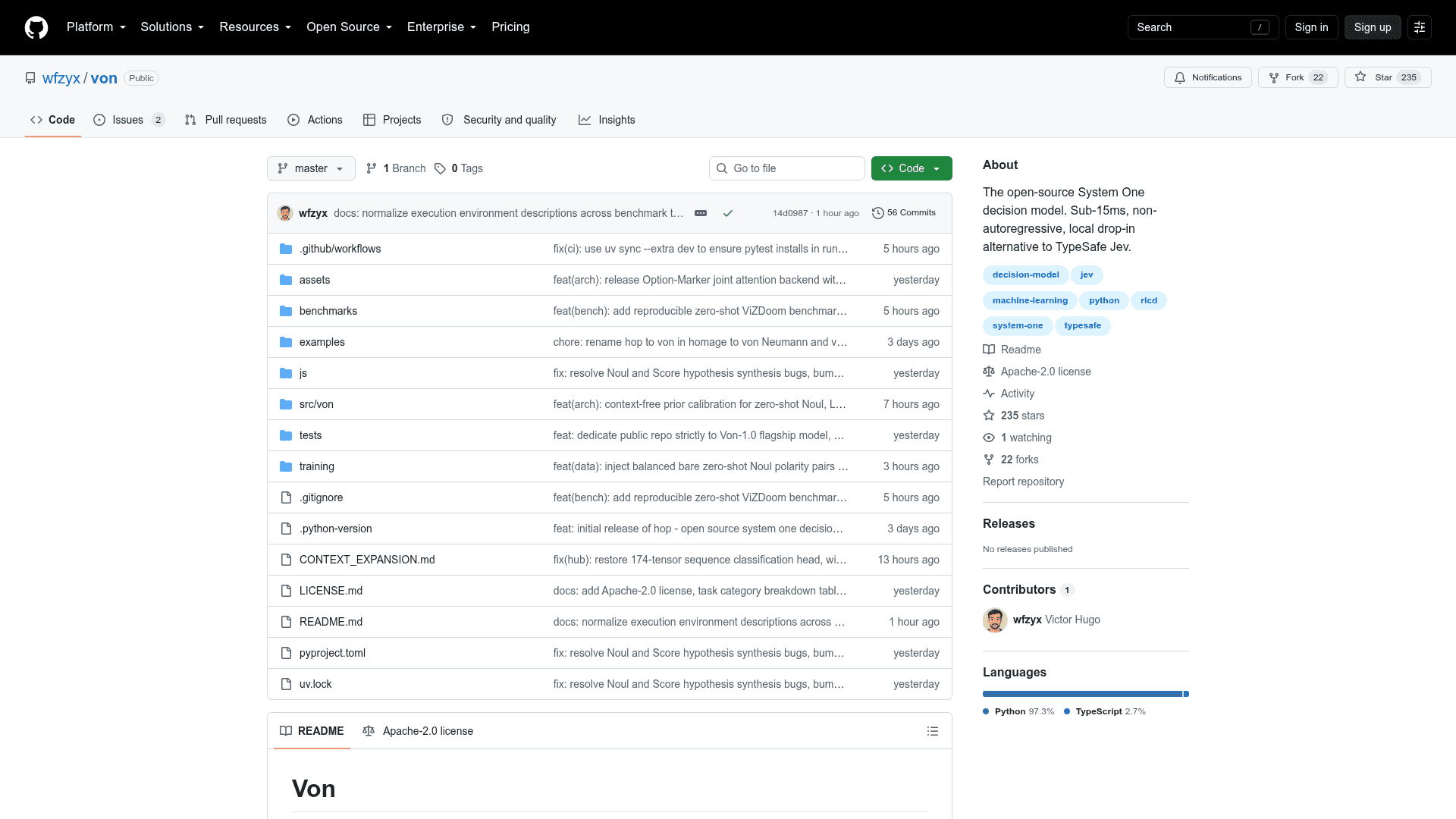
    Both Jev and Von are non-autoregressive decision models that return structured probabilistic outputs rather than generated text, but they split on deployment model and latency target. Jev runs as a hosted API with TypeScript-typed responses in the 70-500ms range, while Von runs entirely on local hardware and returns results in under 25ms with no network round-trip.

    How to choose

    Decision axis: Hosted typed decisions vs. local sub-25ms inference

    Pick Jev if your team builds on a managed API, wants TypeScript-native typed return values out of the box, and can tolerate network latency in exchange for not operating your own inference infrastructure.

    Pick Von if you need inference to stay on-device, your latency budget is under 25ms, or your deployment environment has no reliable outbound connectivity.

    Attribute
    Jev
    Jev screenshot
    Von
    Von screenshot
    SummaryStructured Decision AI ModelModernBERT Intent Routing Model
    Community Score6/1001/100
    Pricing✓ Early Access✓ Open Source
    Pay-As-You-Go$0 usage-based—
    Contact SalesContact Sales—
    View pricing →View pricing →
    PlatformMACOS, Web, API, SDK, CLILINUX, API, SDK, CLI
    API / SDKAPI + SDKAPI + SDK
    Docs / Source
    DocsSource
    DocsSource
    DeveloperTypeSafe AIwfzyx
    Features
    • Three AI primitives: Choice, Score, and Noul
    • Parallel question evaluation in a single API call
    • Typed, structured outputs with no text generation
    • Calibrated probability distributions with every answer
    • Confidence scores for confidence-gated routing
    • 70–500ms end-to-end latency
    • Non-autoregressive single forward pass inference
    • Sub-25ms GPU latency
    • Choice: categorical classification with calibrated probability distribution
    • Noul: binary probability verification with dual positive/negative framing
    • Score: ordinal continuous rating via expected value
    • system_one fan-out: evaluate multiple heterogeneous questions in one pass
    Integrations
    • LangChain (langchain-typesafe)
    • Vercel AI Gateway
    • Python SDK (typesafe-sdk)
    • JavaScript/TypeScript SDK (@typesafe-ai/sdk)
    • Claude agent skill marketplace
    • Browser Use
    • Hugging Face
    • Python
    • TypeScript
    • Node.js
    • Bun
    • NVIDIA CUDA
    Use Case Fit
    • Structured classification (Choice)
    • Continuous scoring (Score)
    • Binary probability estimation (Noul)
    • Parallel multi-question evaluation
    • Non-autoregressive classification
    • Intent routing
    • Guardrail validation
    • Calibrated probabilistic inference
    System Requirements
    • Any OS with a modern web browser or Python 3.10+ / Node 20+ runtime
    • Windows
    • macOS
    • Linux
    Data refreshedSep 21, 2026Sep 21, 2026