
ContextCraft
Open-source Python tool that compresses a Git repository into a token-budgeted Markdown, XML, or JSON context artifact for LLMs using AST analysis and dependency-graph ranking.
At a Glance
ContextCraft CLI and Python SDK released under the MIT License; free to use, copy, modify and distribute.
Engagement
Available On
Alternatives
Listed Oct 2026
About ContextCraft
ContextCraft is an open-source Python tool, published under the MIT License, that compiles a Git repository into a Markdown, Claude XML, or JSON context artifact sized to a chosen token budget such as 4k, 16k, 32k, or 128k. It is available as a command-line tool, a Python SDK, and a local web playground. The latest release listed on GitHub is v0.3.1.
What It Is
ContextCraft is a codebase compressor for LLM prompts. Rather than concatenating every file verbatim, it parses source with Tree-sitter, ranks files by architectural importance, and decides how much detail each file gets so the output fits a target token budget. The README positions it against repository packers such as repomix, gitingest, and code2prompt.
How the Compression Pipeline Works
The README describes a five-stage pipeline:
- A repository scanner honors hierarchical .gitignore and .contextignore files, filters binary and oversized files, and a sanitizer scrubs API keys, PEM blocks, and high-entropy secrets before parsing.
- A registry of 35 languages and formats produces ASTs with symbols, docstrings, and a lexical scope graph, and unused imports are trimmed in signature mode.
- A dependency-graph scorer combines Personalized PageRank with BM25F, biased by an optional focus query, to rank files.
- Each file is rendered at one of four fidelity tiers: FULL, SKEL (signatures, types, and docstrings), SIGS (public declarations), or TREE (a directory-tree entry).
- A multiple-choice knapsack optimizer allocates tiers by marginal utility density, which keeps very large files from consuming the full-detail budget.
Usage Paths
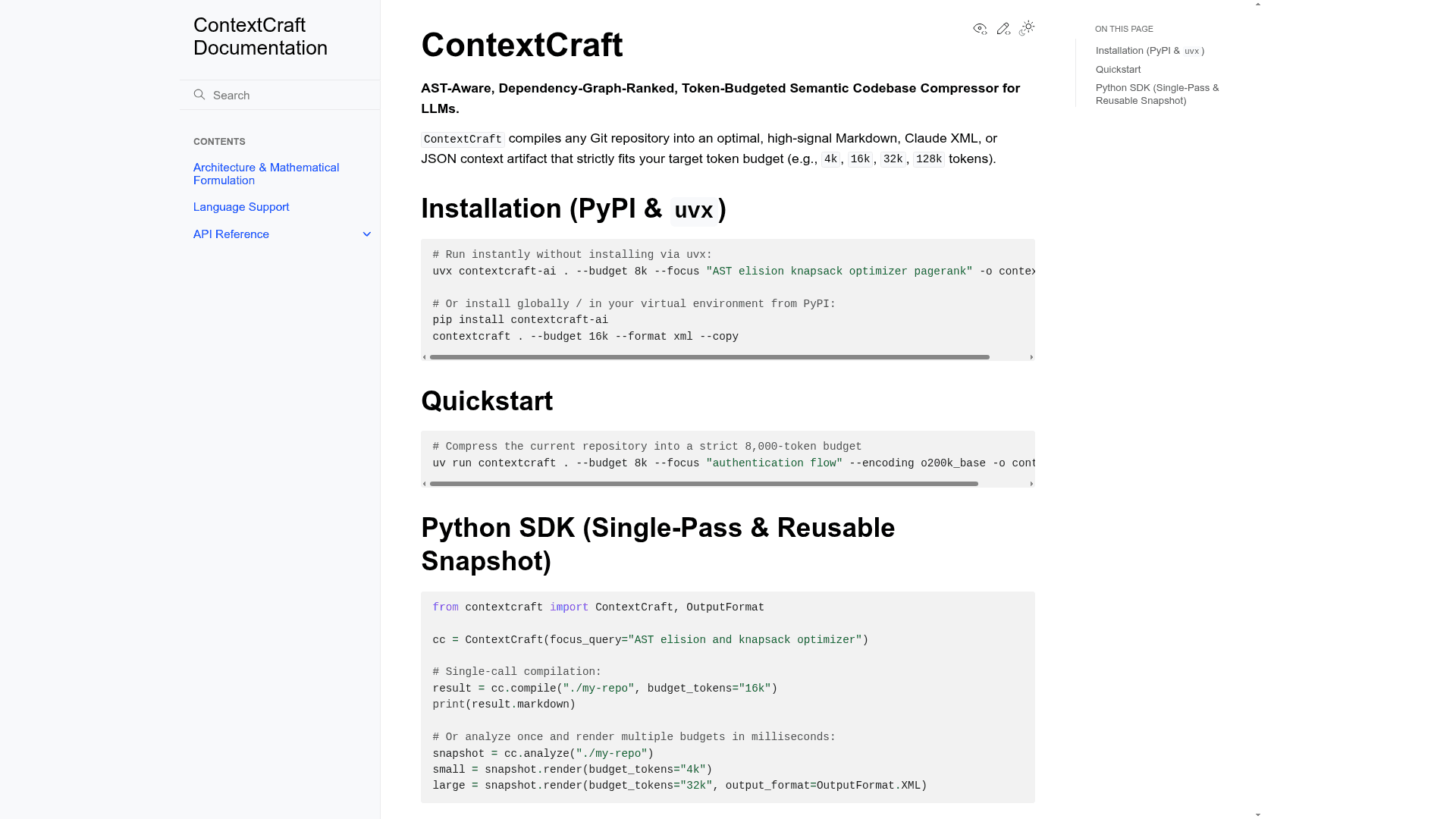
The CLI runs via uvx or after pip install contextcraft-ai, with options for budget, focus query, output format, clipboard copy, tokenizer encoding, and include/exclude patterns. The Python SDK can analyze a repository once and then render several budgets or formats from the same snapshot without reparsing. A FastAPI-based web playground lets users tune budgets, inspect PageRank scores, and compress public GitHub repositories by URL.
Benchmark Claims
The README reports a reproducible benchmark on its own repository (258 files, 119,813 raw tokens), with an 8k budget emitting 7,991 tokens at a stated 14.99x compression ratio. The README also recommends pairing the output with local models for offline workflows.
Community Discussions
Be the first to start a conversation about ContextCraft
Share your experience with ContextCraft, ask questions, or help others learn from your insights.
Pricing
Open Source (MIT)
ContextCraft CLI and Python SDK released under the MIT License; free to use, copy, modify and distribute.
- MIT License (OSI-approved)
- CLI installable via pip or uvx from PyPI (contextcraft-ai)
- Python SDK
- Optional local web playground (self-hosted)
- Parses 35 languages and formats with Tree-sitter
Capabilities
Key Features
- AST-aware parsing of 35 languages and formats with Tree-sitter
- Personalized PageRank and BM25F file ranking with focus query
- Token-budgeted output via multiple-choice knapsack optimizer
- Four fidelity tiers: FULL, SKEL, SIGS, TREE
- Markdown, Claude XML, and JSON output formats
- Secret sanitization of API keys, PEM blocks, and high-entropy strings
- Hierarchical .gitignore and .contextignore support
- Include/exclude patterns and focus-file scoping
- Selectable tokenizer encoding (cl100k_base, o200k_base)
- Python SDK with reusable analyzed snapshots
- Interactive web playground with GitHub URL swap
- Clipboard copy of output